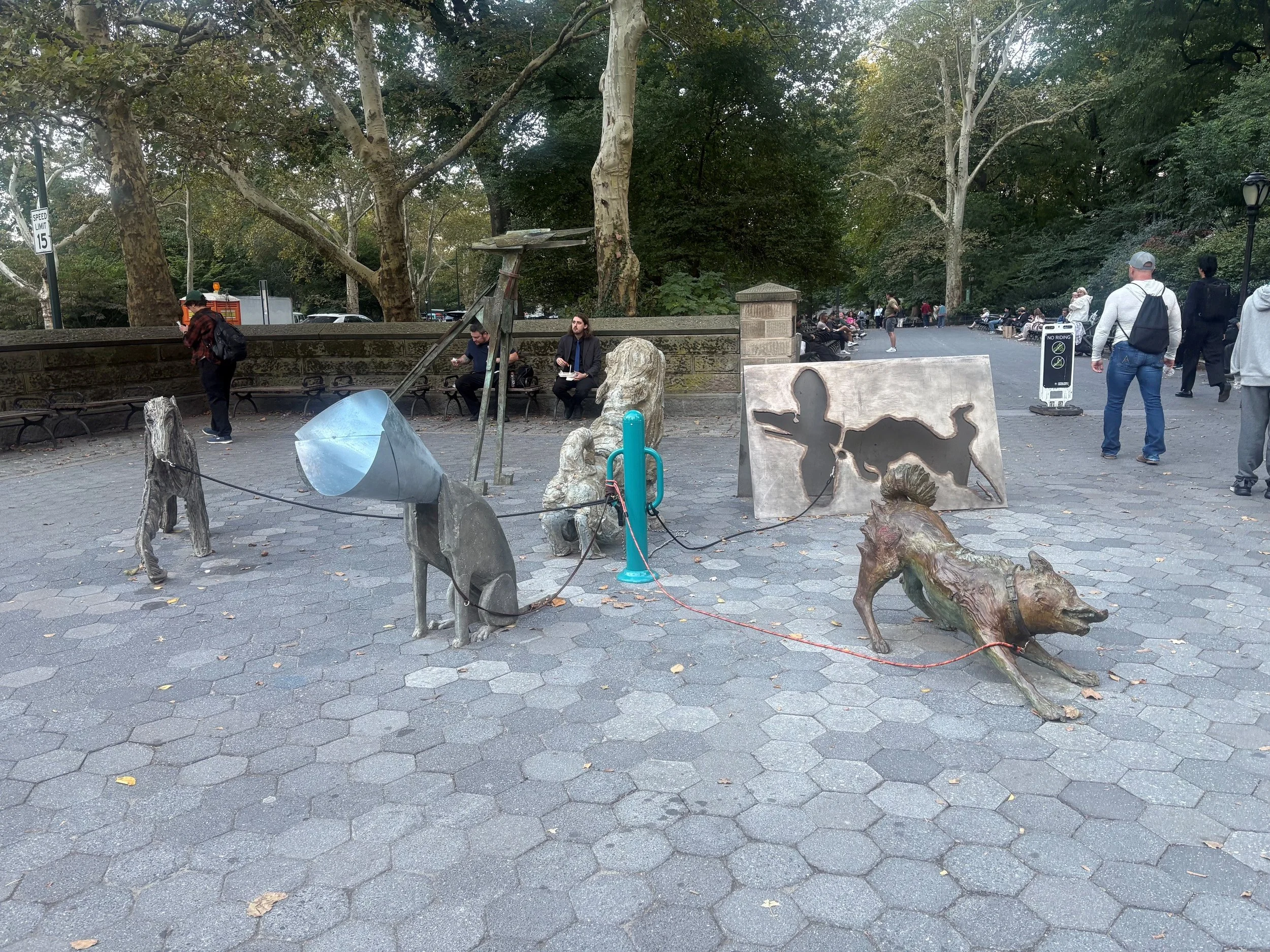
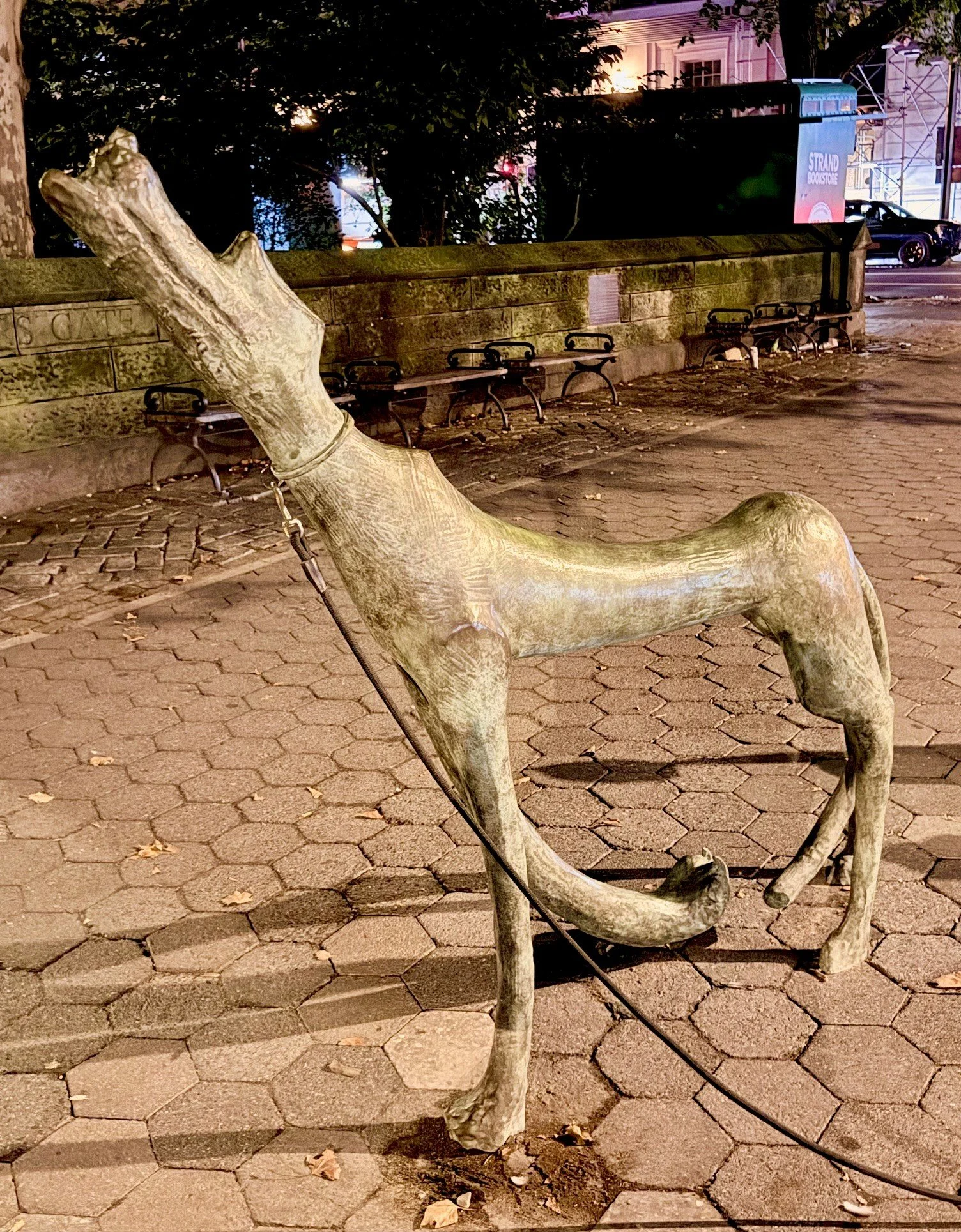
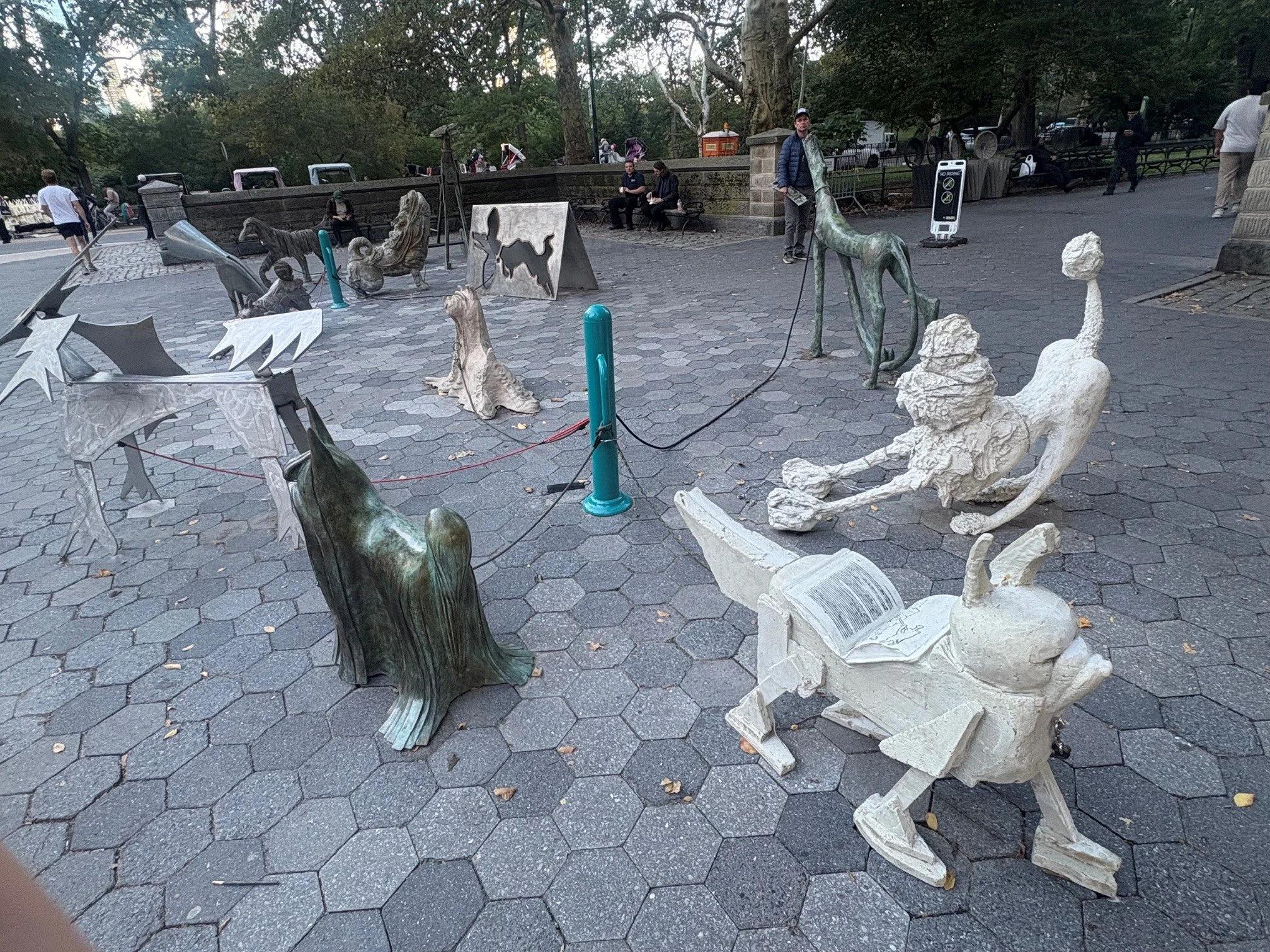
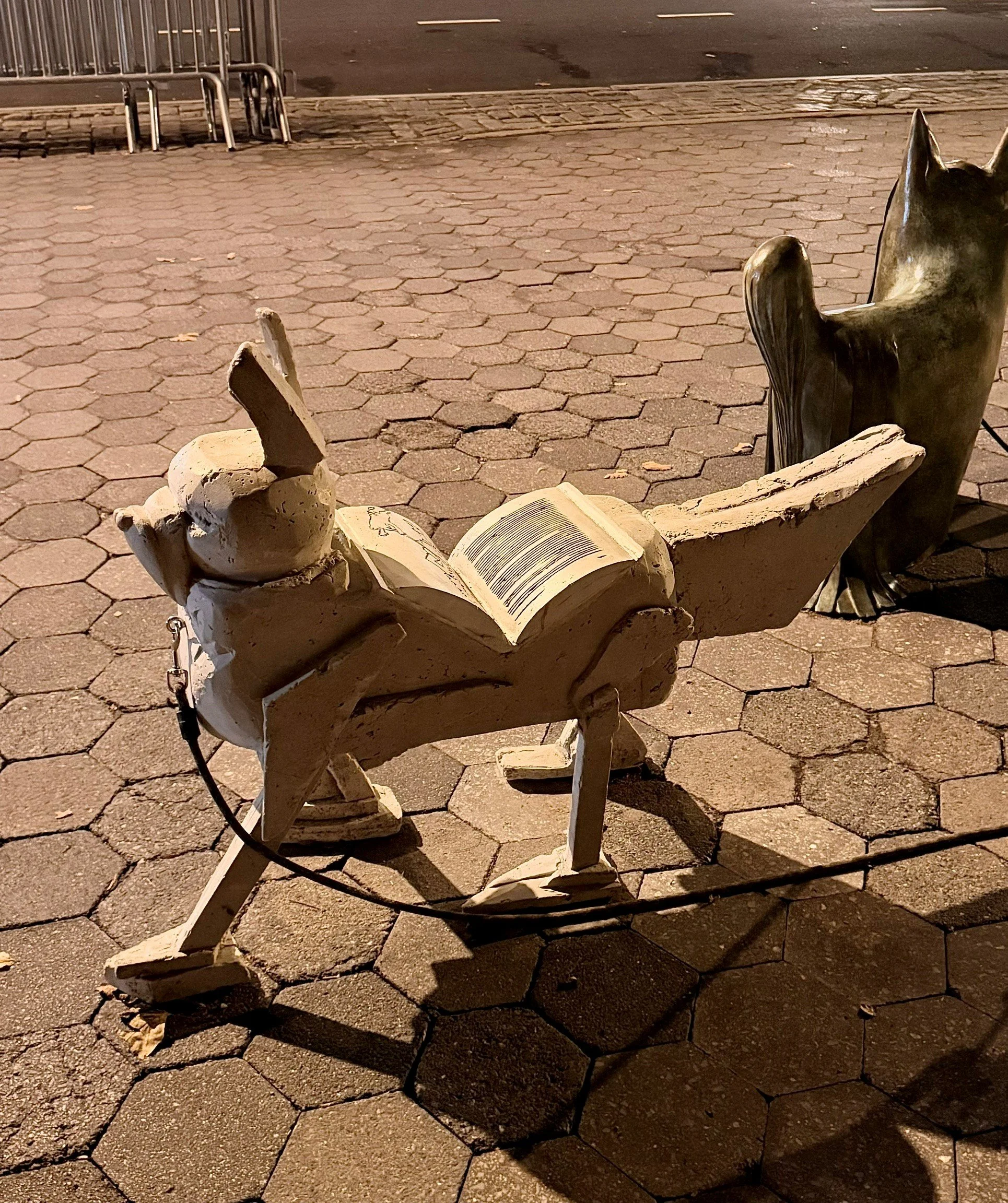
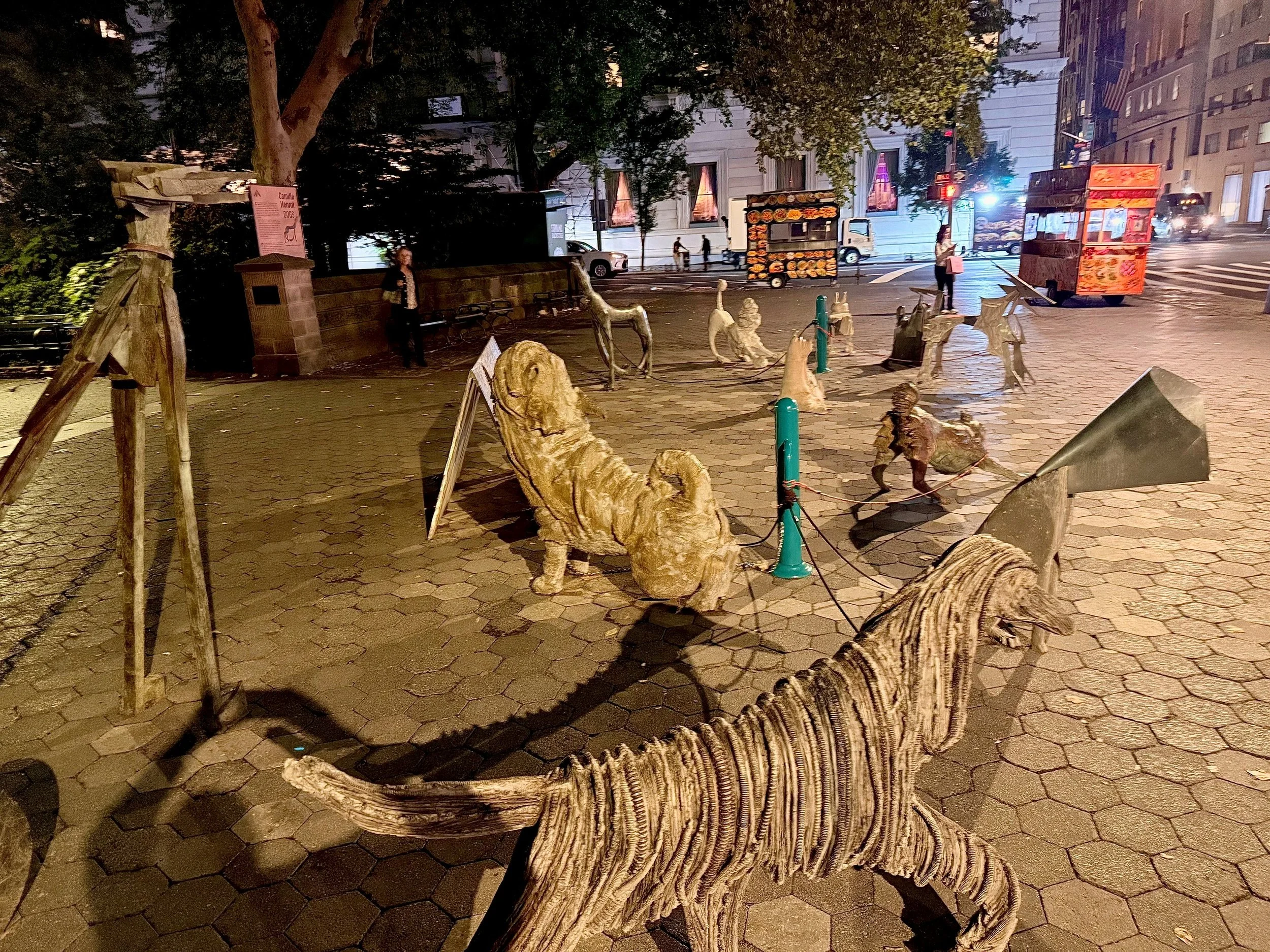
Among the regular menagerie of pets trotting through Central Park on any given afternoon, you may now catch sight of a few curious newcomers flanking the southeast entrance. Leashed around a central post, a dozen sculptures of dogs prowl, stretch, and patiently pose, gazing at onlookers. The work is the first public exhibition in New York by prize-winning artist Camille Henrot, located off Fifth Avenue at Doris C. Freedman Plaza. In wood, steel, and stone, Henrot’s pack of carefully fashioned dogs emulate a jumble of iconic art and cultural references. An open book rests on top of a stout stone bulldog. A long-haired Yorkie, bronze-cast, glances around mournfully for her absent owner. A wolfy mid-sized dog stretches his paws, mid-yawn. They fit right into New York’s eclectic assortment of beloved pets, from chihuahuas in tiny boots, to a cat surveying the sidewalk from a stroller, to the many labs and retrievers tied patiently to bicycle racks. Simply titled “Dogs,” the piece celebrates the great variety of creature companions in parks and apartments around the city, as well as humanity’s long affair with these domesticated pets. Henrot’s choice to depict dogs without their implied walkers or owners allows viewers simply to consider the dogs on their own, with their myriad of personality quirks, silhouettes, dispositions, and whims. For dog lovers and park roamers alike, the sculptures are a delightful addition to a city stroll.
“Camille Henrot: Dogs”
Tech Industry, H-1B Workers, and the PERM Program: What Vance’s Announcement Means
PERM is the process US employers use when they want to sponsor a foreign worker for a green card through employment. In practical terms, it is one of the main pathways that allows some H-1B workers, to move from temporary status to permanent residence in the United States. On October 8, 2026 Vice President JD Vance announced that Microsoft, along with Adobe, Cognizant, Infosys, Wipro, Capgemini, HCL Technologies, and Tata Consultancy Services would be suspended from using the PERM process, a step that could prevent the tech leaders from sponsoring certain H-1B workers for permanent residency in the US.
Officials said the suspension would “last as long as it needs to.”
“Lady in Blue” by Tschabalala Self
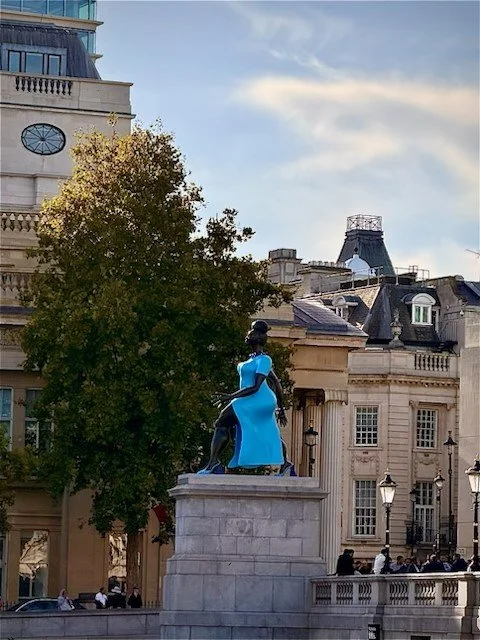
We are still across the pond in London’s Trafalgar Square to meet “Lady in Blue”, a striking bronze sculpture by Harlem born artist Tschabalala Self, unveiled on the Fourth Plinth this September. Rather than honoring a historical figure or larger-than-life hero, “Lady in Blue” celebrates someone much more familiar: the everyday, modern woman making her way through the city. With her confident stride and unmistakable sense of purpose, she represents, as the artist describes her, “an everyday person much like the many who occupy the square daily,” who can now glimpse the statue on their daily commutes. Her vibrant blue dress immediately catches the passing eye, a reflection of the frenetic and vibrant energy of the city, while her accessories reference lapis lazuli, the rare and prized stone that has been used as a pigment in art for centuries.
There’s something particularly fitting about placing this woman in Trafalgar Square. She isn't there to be worshipped or remembered as a figure from the past. She is looking straight ahead; ambitious, self-assured, and ready for whatever comes next! In other words, “Lady in Blue” isn't just another statue frozen in history. She's all of us, and she has somewhere to be.
Putting Empathy First
"Schiaparelli: Fashion Becomes Art"
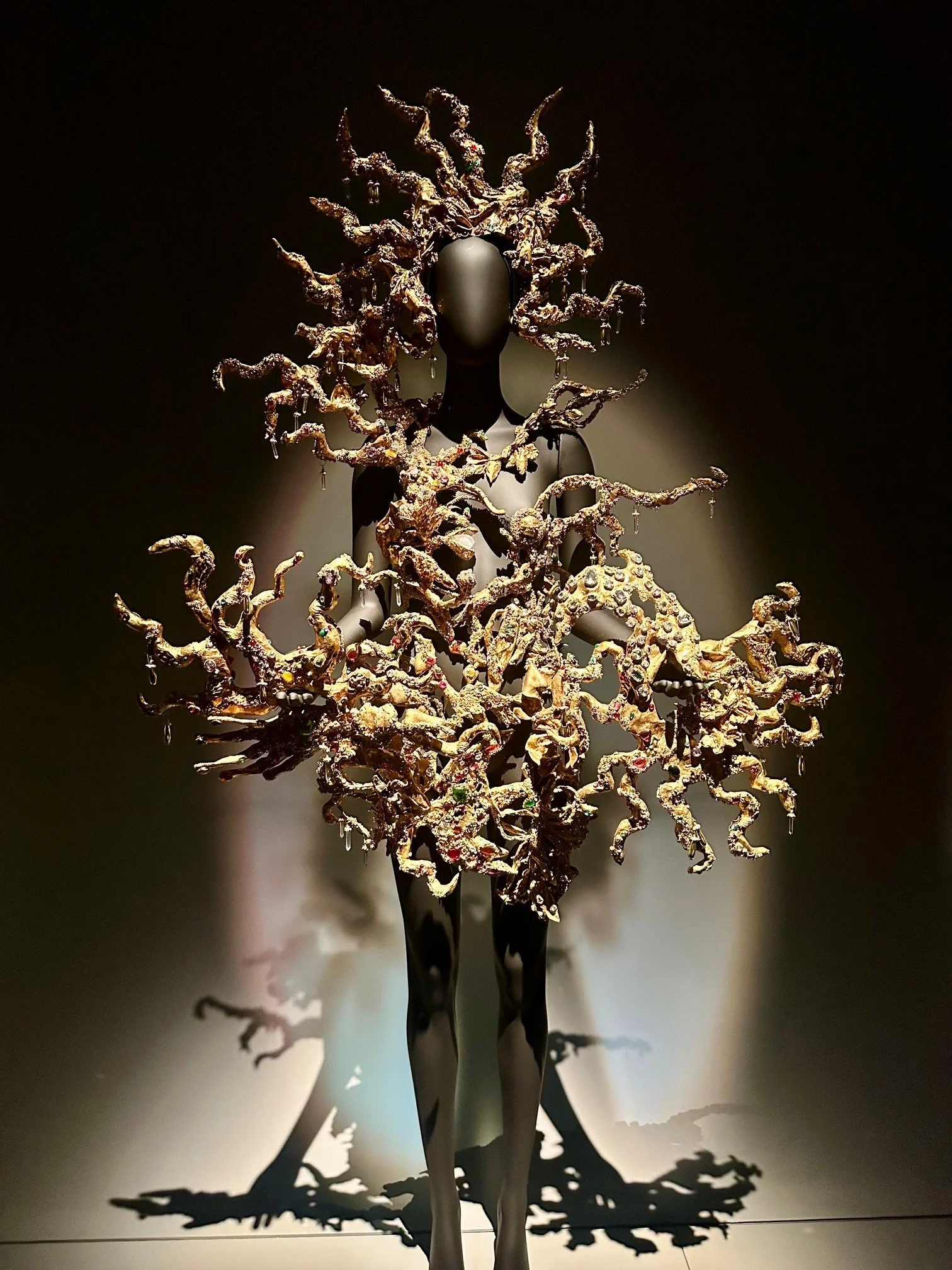
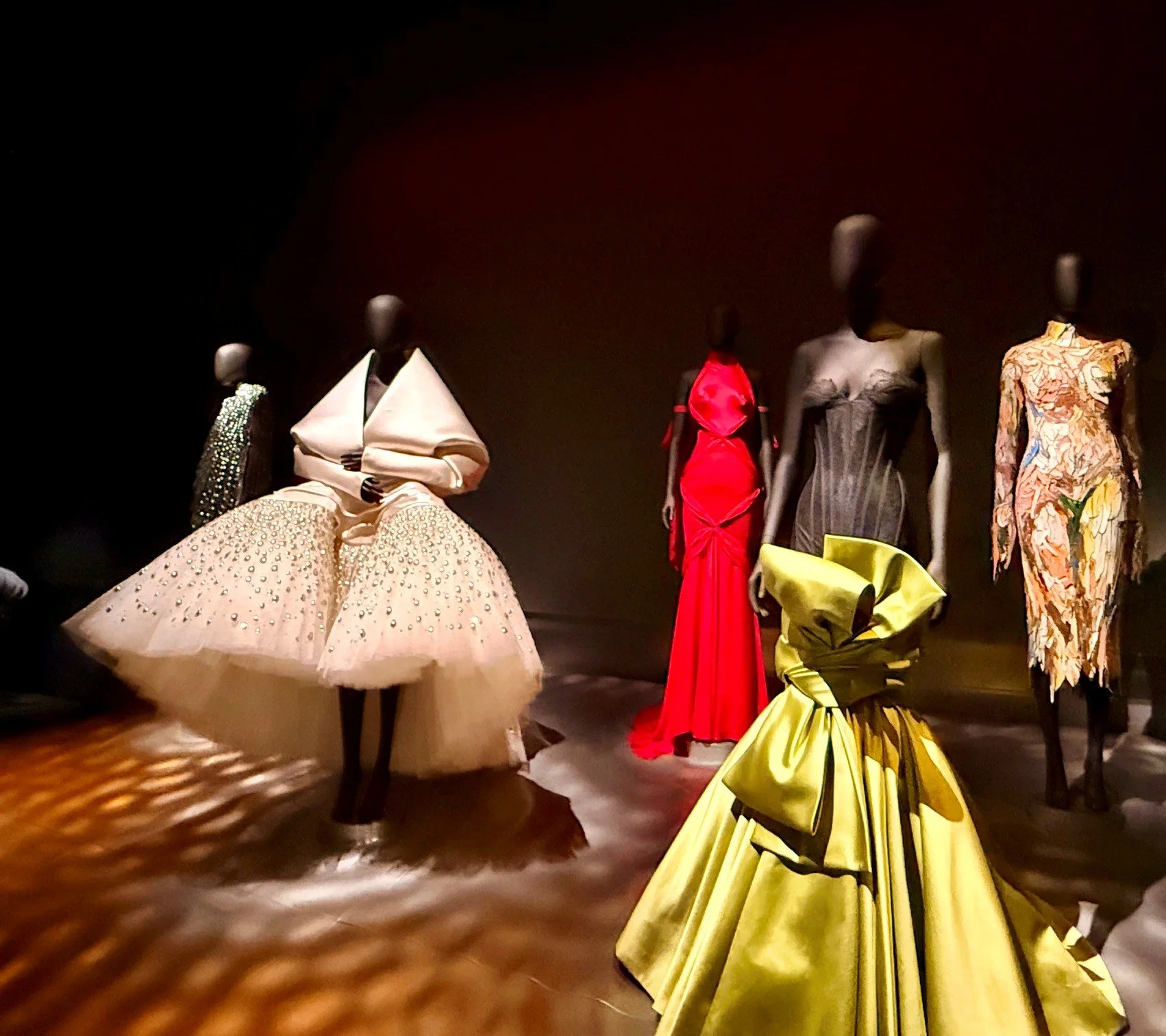
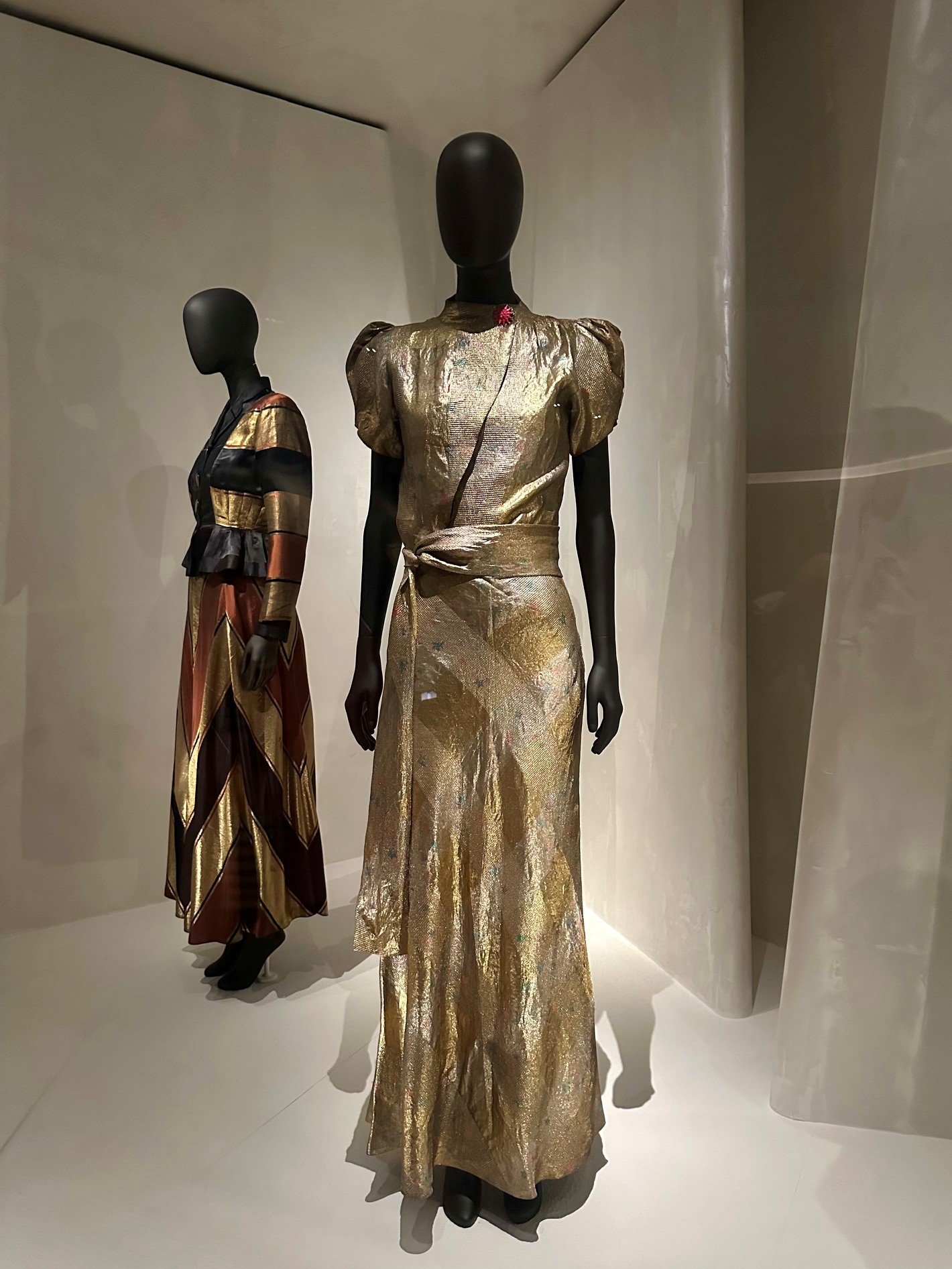
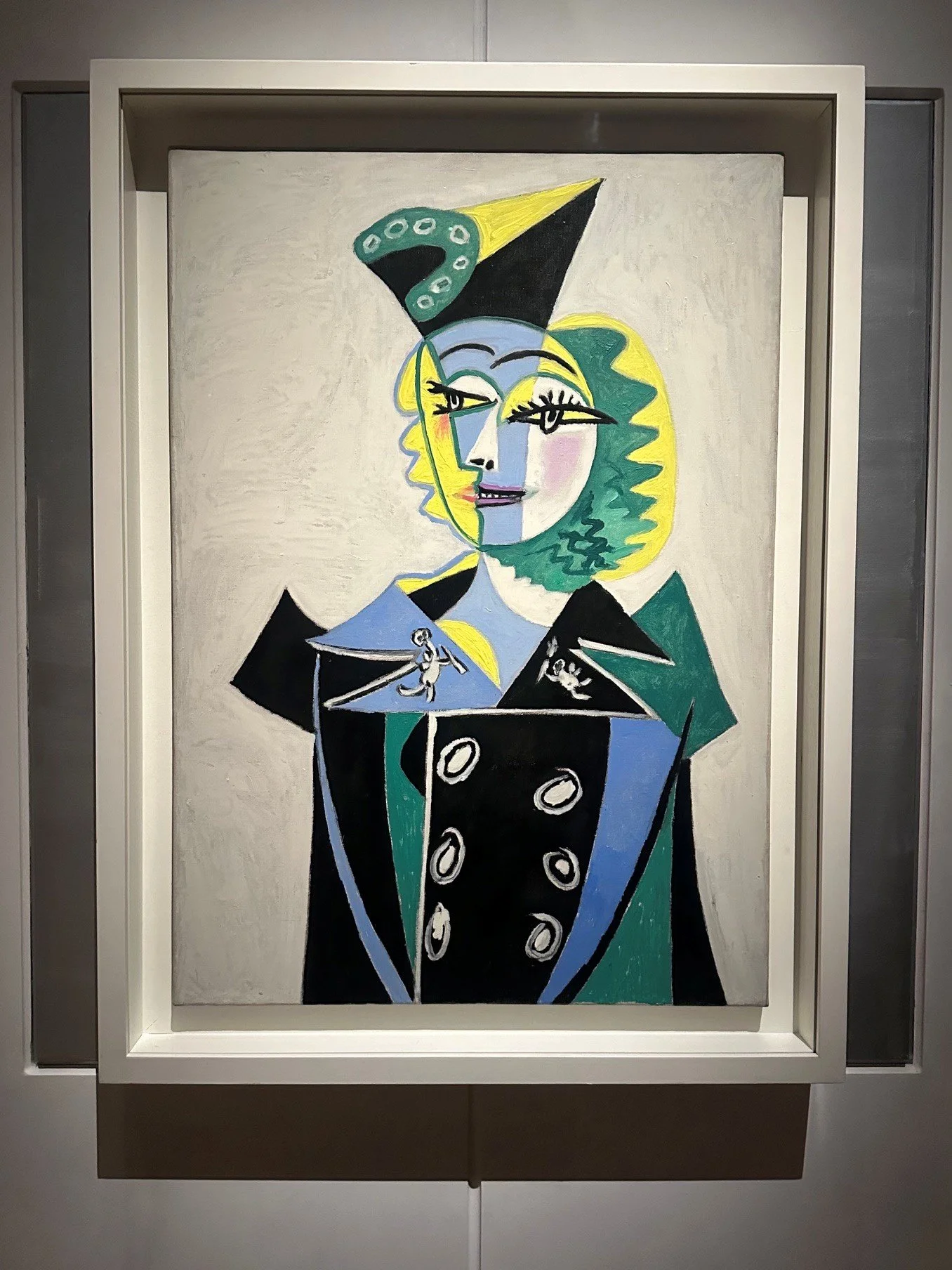
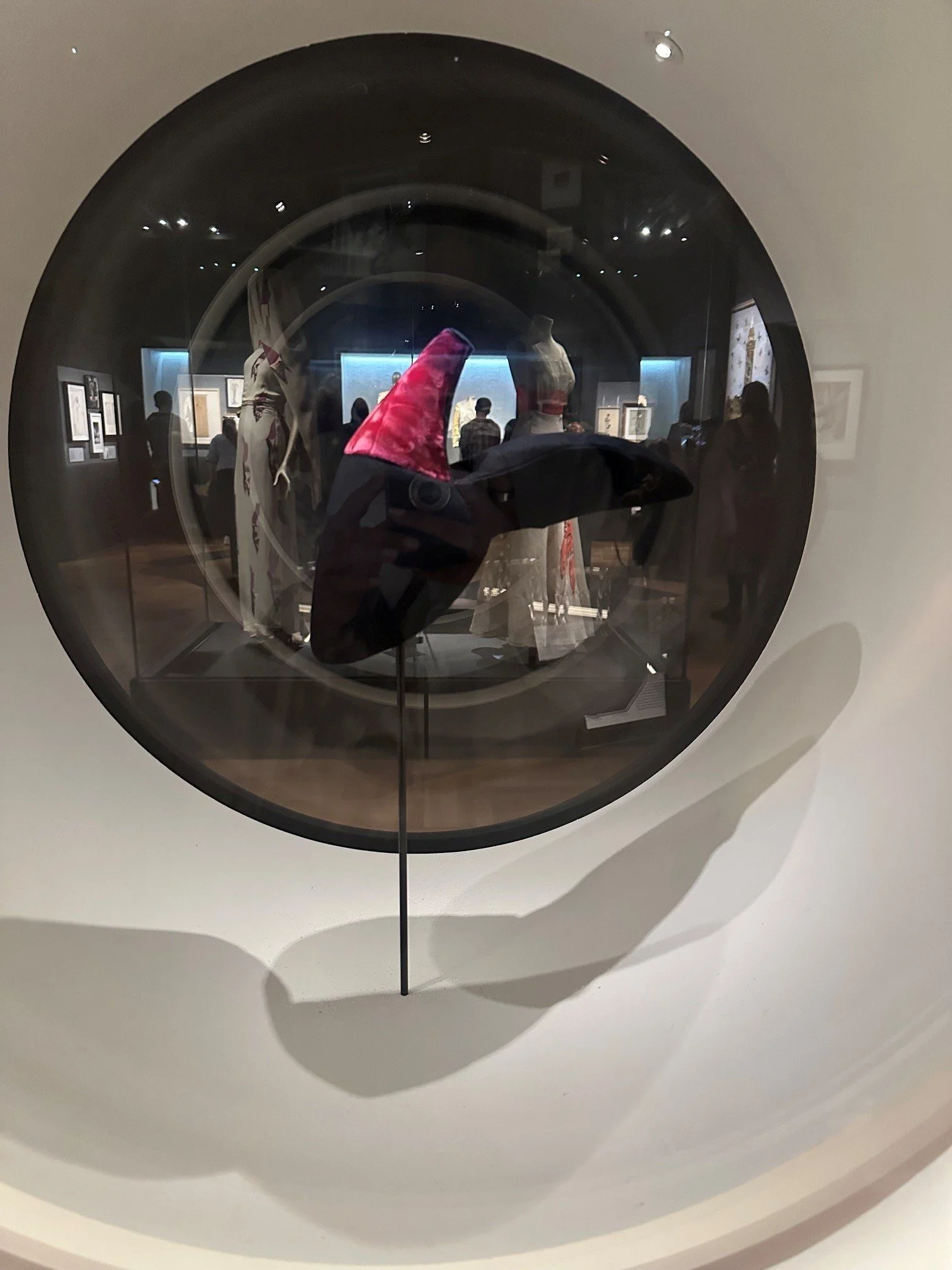
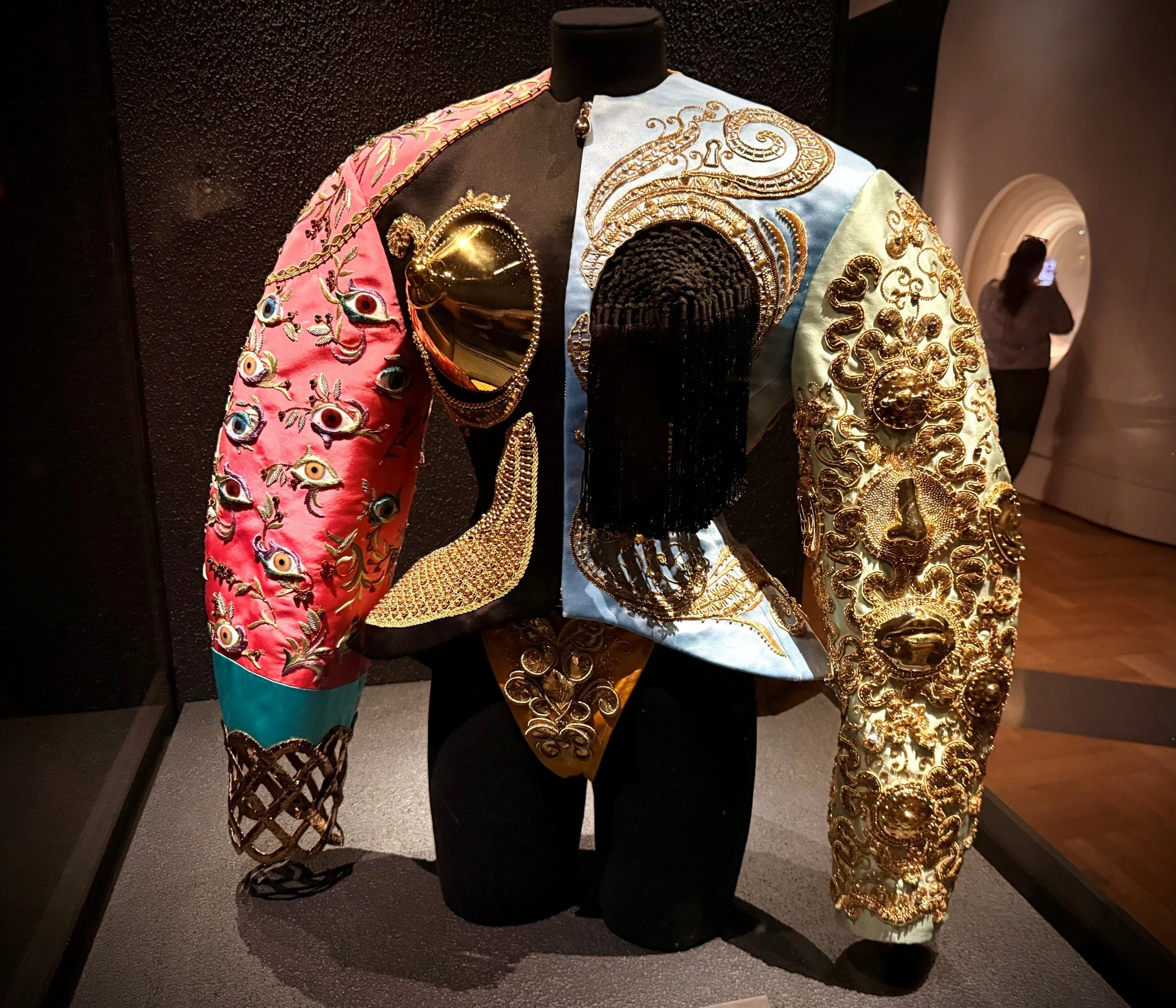
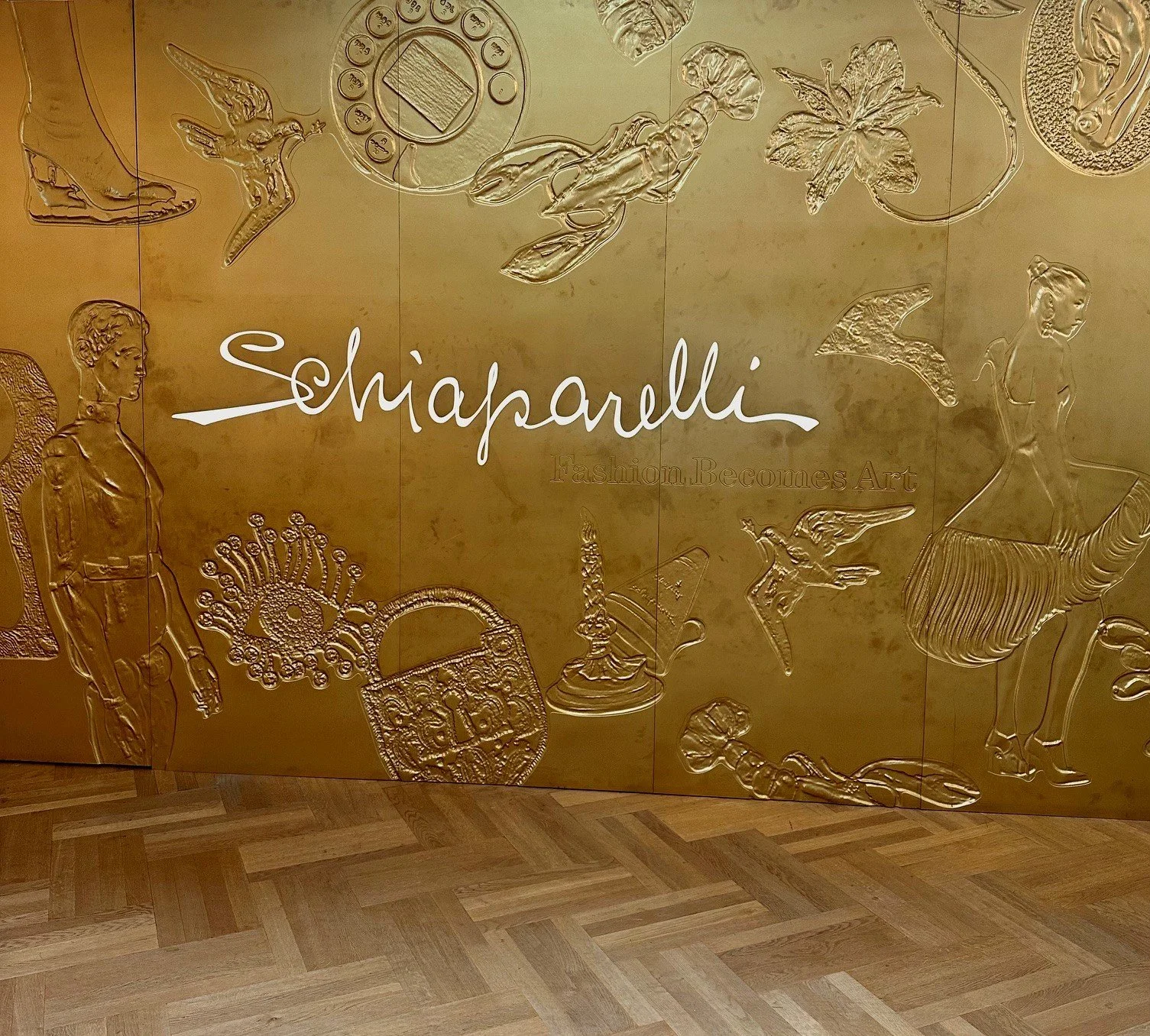
In a showing at V&A South Kensington, fashion legend Elsa Schiaparelli’s lavish and stately designs have been collected for exhibit in the UK for the very first time. We strolled through galleries replete with the imaginative work of the Italian designer and her eponymous fashion house, which pioneered such transformative changes in the early twentieth century as visible zippers and the wrap dress.
Elegant and expressive couture pieces adorn clusters of mannequins marking iconic moments in Schiaparelli’s career, inviting viewers to a high fashion runway where the models linger for hours under the sparkly spotlights. The silhouettes dazzle and leap from the display in curling tendrils and undulating patterns as they branch into more modern, experimental works. The newest pieces have been fabricated under current Schiaparelli creative director Daniel Roseberry, including a gown worn by Ariana Grande at the 2025 Academy Awards. Some nooks hold famed collaborations with boundary-pushing artists of the interwar period, such as the legendary, surrealist “shoe hat” crafted with Salvador Dalí. Other faceless figures flaunt Elsa Schiaparelli’s innovative fabric selections and affair with embellished and unusual fastening mechanisms, from her innovation with tie-up wraps to her insistent curation of distinct zipper pulls and funky buttons.
An abstract portrait in angled shapes of aquamarine and daisy yellow hangs among the couture clothing, a 1937 Picasso painting with the subject in Schiaparelli jewelry, hat, and lapel pins. Its inclusion underscores the exhibit’s thesis — that works of fashion brilliance belong among the finest of art. Catch the array of fashion landmarks and dreamlike designs in London before the exhibit closes on November 15.
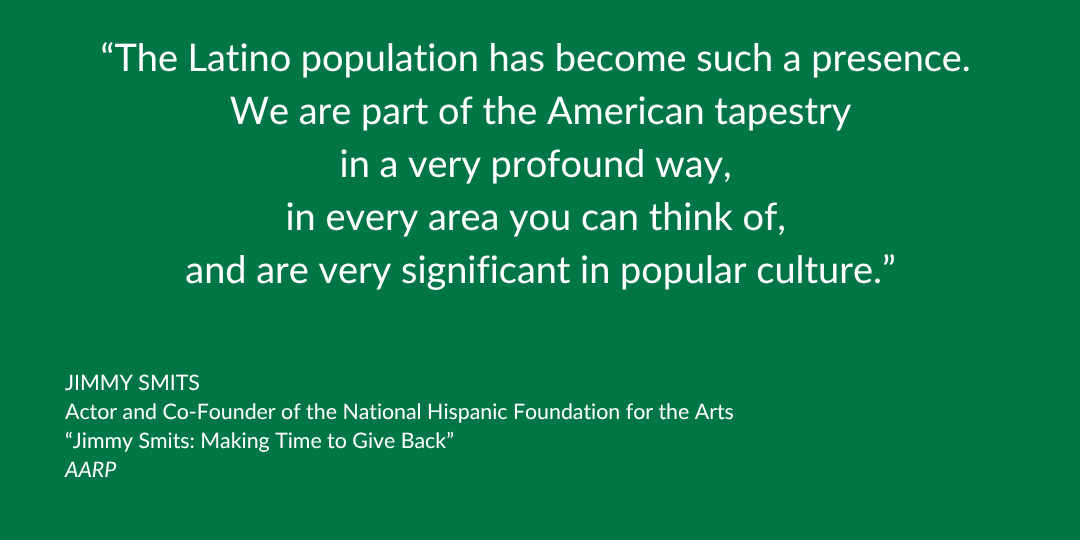
Celebrating National Hispanic Heritage Month
Annual Boat Dance 2026
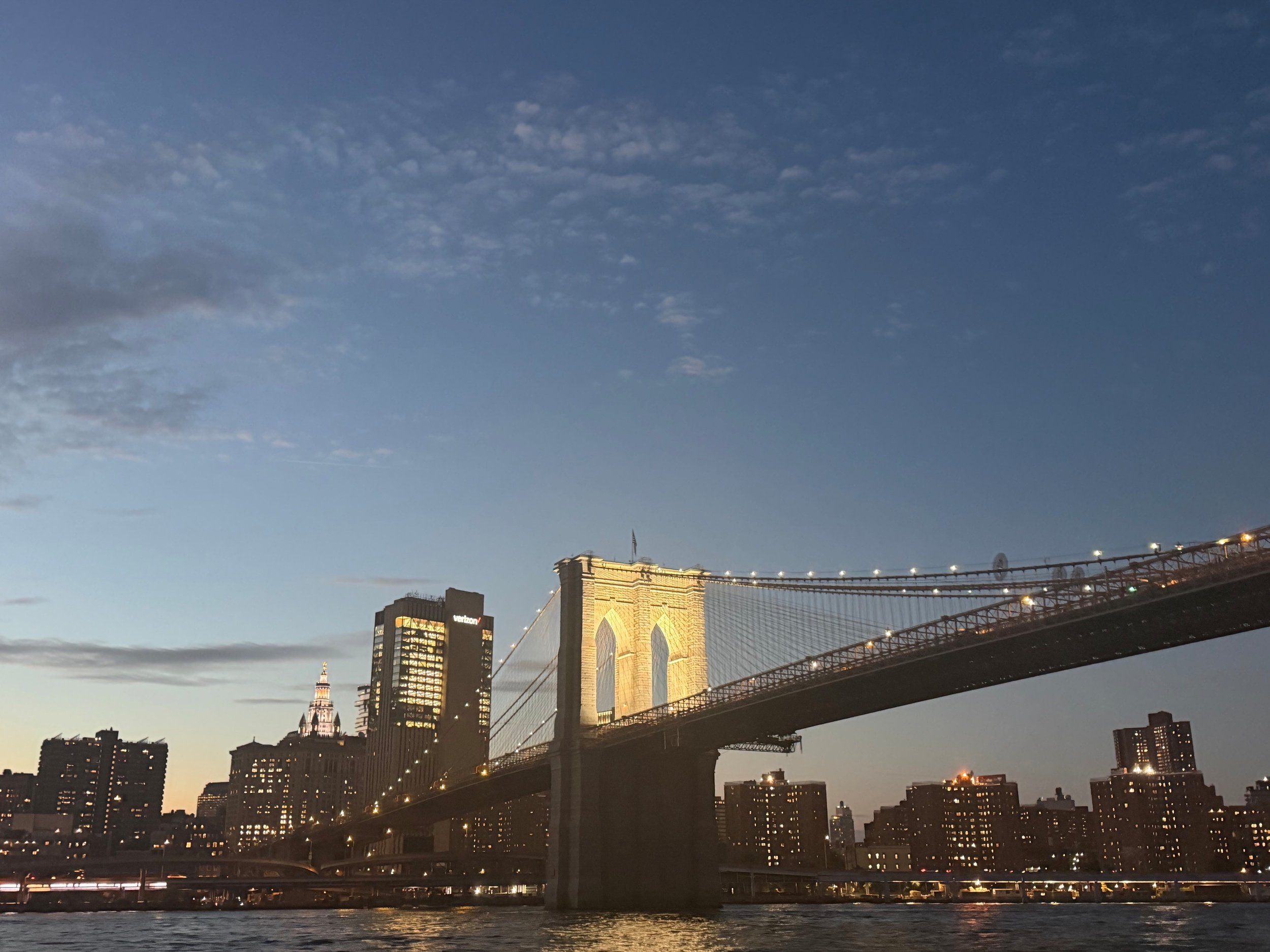
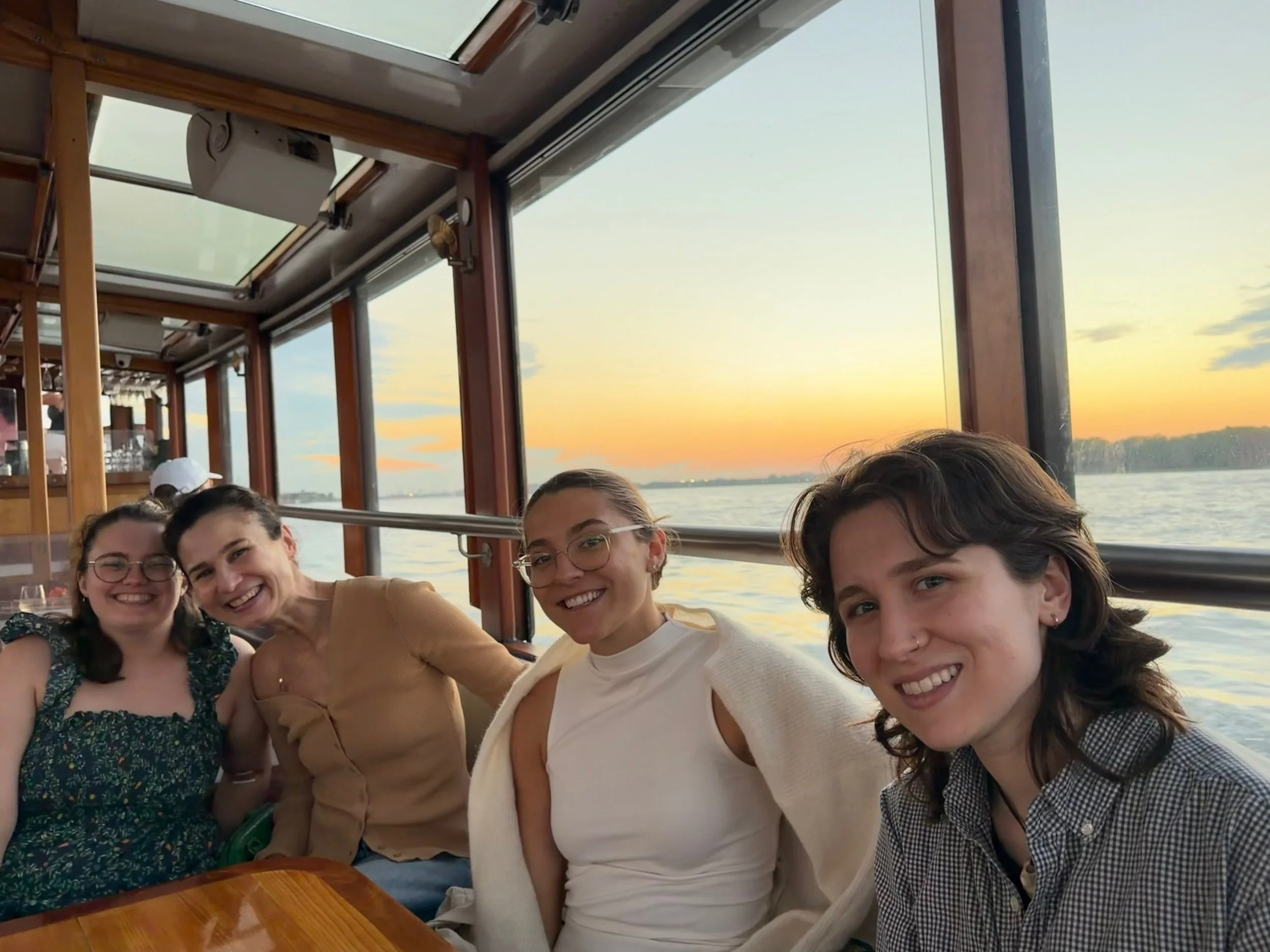
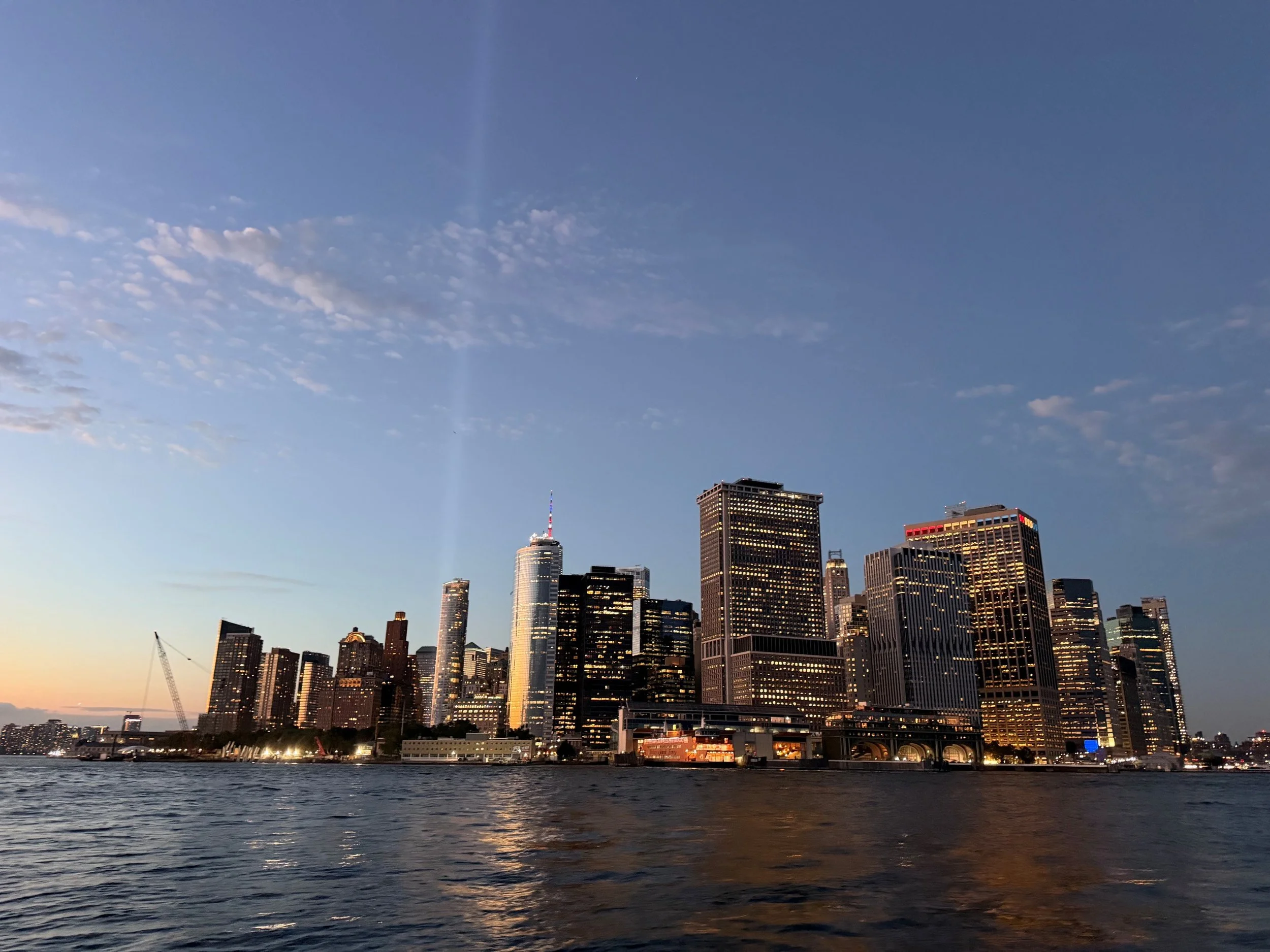
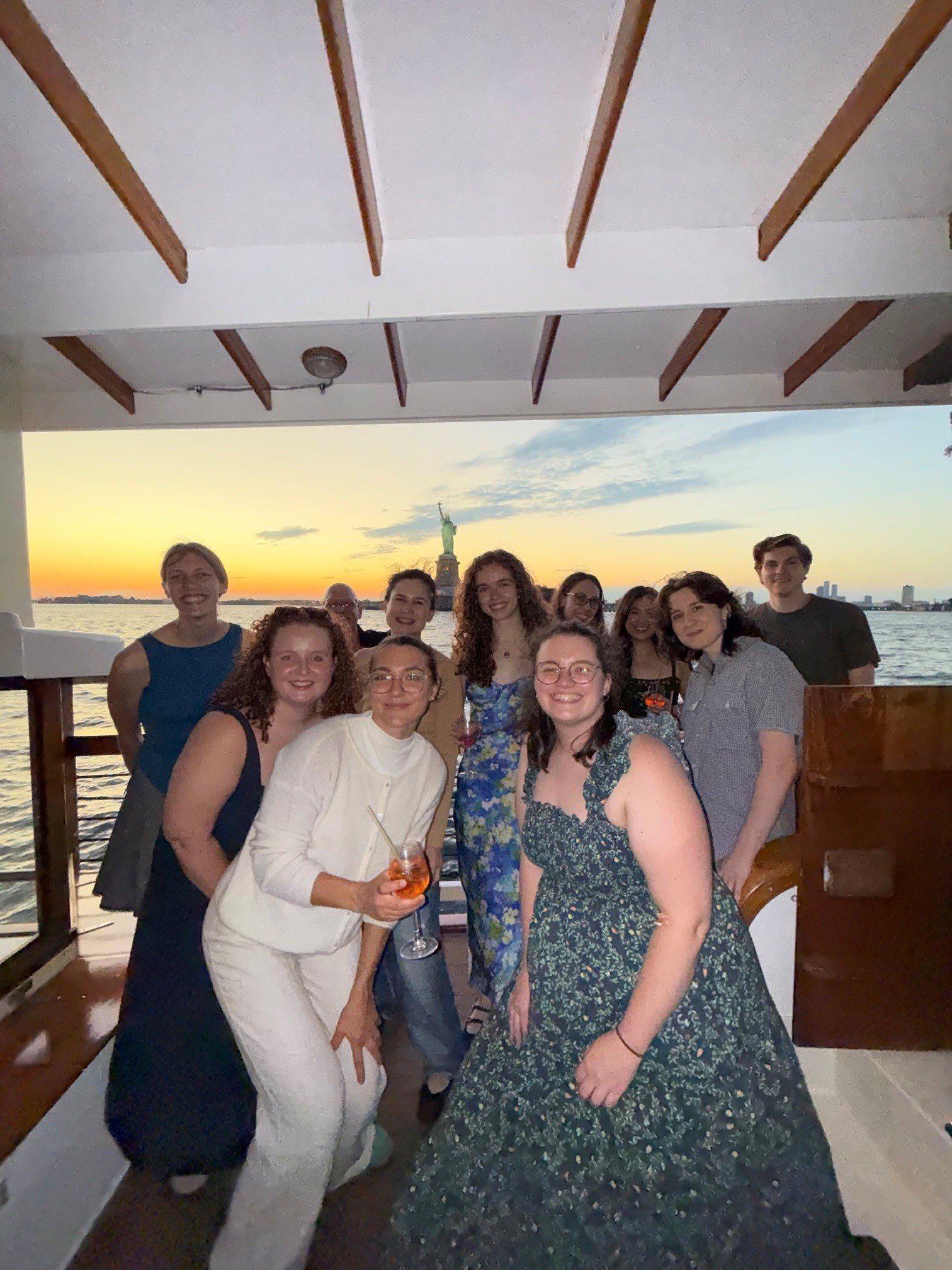
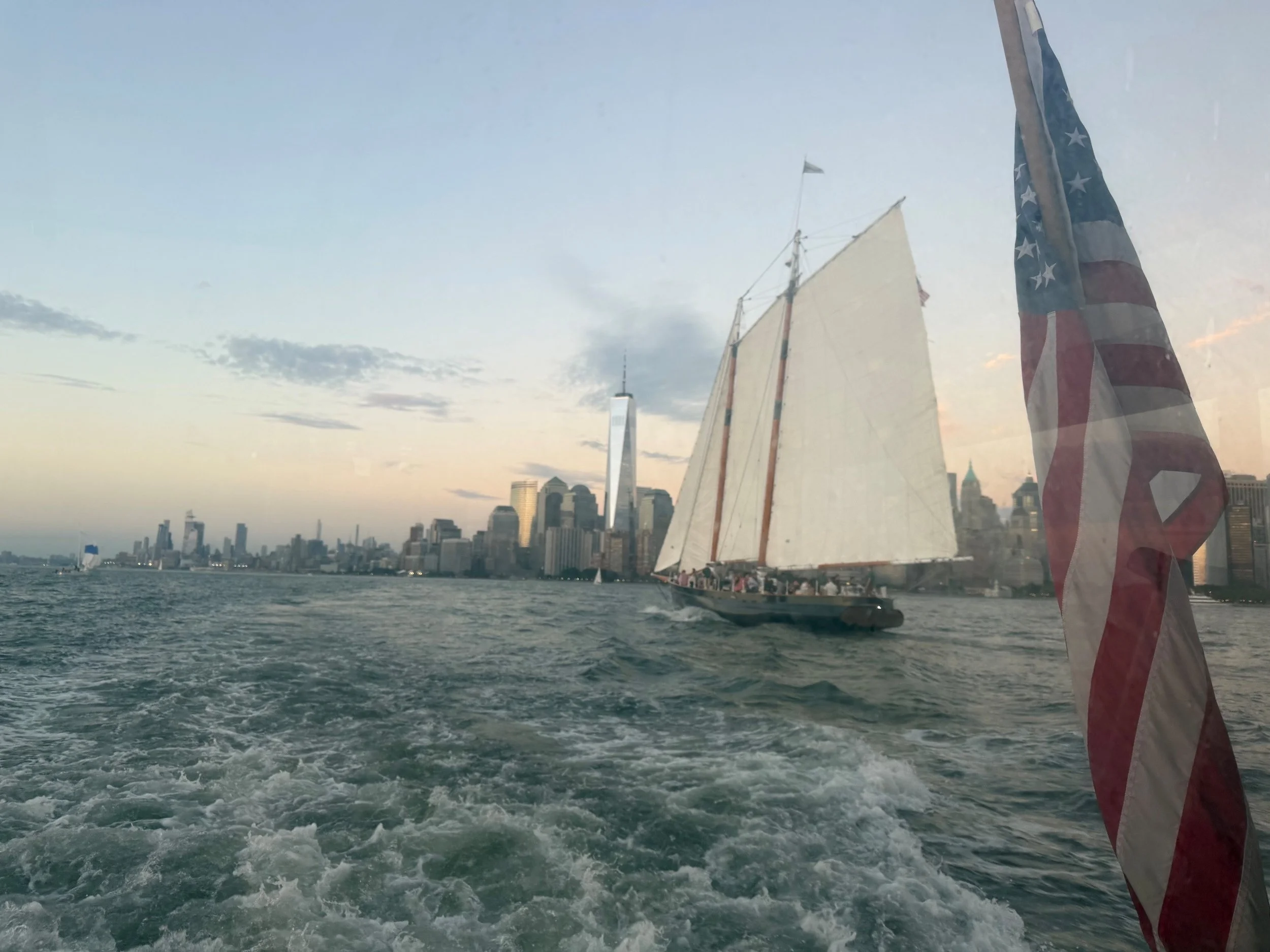
On a beautiful end-of-summer evening, we gathered for our annual sunset cruise along the Hudson River, temporarily trading our desks and deadlines for a charming boat ride beside the New York skyline. Over delicious bites and drinks, we reminisced with current and former colleagues on the tribulations of immigration law and the joys of helping our clients.
As we sailed down the river, we were rewarded with spectacular views of some of the city's most iconic landmarks. The picturesque sight of the Statue of Liberty reminded us why we love what we do. Drifting past downtown Manhattan, illuminated at dusk and dotted with still-lit windows, we felt a renewed love for the city that never sleeps. And as we crossed under the Brooklyn Bridge, we waved to many fellow travelers, on boats, trains, and cars alike, each on their own path.
Now, as we head into fall, we're ready to get back to work. Until next summer's voyage, we’ll persist at what we do best: keeping people moving, keeping cases moving, and steering the ship onward.
Federal Court Blocks DHS Rule Ending “Duration of Status” for Foreign Nationals on F, J, and I Visas
On September 14, 2026, a Massachusetts federal district court temporarily blocked a Department of Homeland Security (“DHS”) regulation scheduled to take effect on September 15, 2026. The regulation would have ended the longstanding “Duration of Status” (“D/S”) system for international students, exchange visitors foreign media representatives, and their qualifying dependents. In Presidents’ Alliance on Higher Education and Immigration, et al. v. U.S. Department of Homeland Security, et al. , the Court postponed the effective date of the rule and prohibited DHS and United States Immigration and Customs Enforcement (“ICE”) from implementing it while the litigation continues. As a result, the existing D/S framework remains in place. The Court has not, however, vacated the rule or issued a final decision on the merits of the case.
Read moreWhite House Extends H-1B $100,000 Payment Requirement
On September 18, 2026, President Trump issued a new proclamation extending the H-1B entry restrictions first imposed in September 2025 for another year. The extension continues the requirement that certain H-1B petitions involving workers seeking entry to the United States be accompanied by a $100,000 payment. The new proclamation extends the restriction through September 21, 2027.
Read more
Donec id justo non metus auctor commodo ut quis enim. Mauris fringilla dolor vel condimentum imperdiet.