In this day and age social media is a part of most people’s daily lives. Updating your status on Facebook, posting pictures on Instagram, making witty commentary on Twitter, and checking up on colleagues on LinkedIn have all become part of our day-to-day activities. But it’s not just family and friends who may be viewing your updates. The Department of Homeland Security (DHS) recently announced that it intends to monitor the social media of immigrants—even permanent residents and naturalized US citizens. Additionally, in May this year, the Trump administration approved a new questionnaire that asks for social media handles going back five years for visa applicants worldwide. Historically, consular officers and USCIS adjudicators have, on occasion, also used Google searches and checked social media to research visa applicants and verify information on the submitted paperwork. For all these reasons, it couldn’t be a better time to discuss how various government agencies might be using the information on foreign national’s social media sites, specifically in regards to adjudicating visa applications and determining admissibility to the United States.
Read moreNew York Times: “Diversity Visa Lottery: Inside the Program That Admitted a Terror Suspect”
Following the terror attack in New York City last week when a man drove a rented truck down a bike path killing eight, President Trump is calling for the elimination of the Diversity Visa (DV) Program, which allowed the suspected terrorist, Sayfullo Saipov, to gain legal permanent resident status. Claiming he wants “merit based” immigration, President Trump says he is asking Congress to “immediately initiate work to get rid of this program.” Throughout the years, lawmakers have made multiple attempts to end the diversity visa program, citing reasons of fraud, increased numbers of low-skilled (and thus supposedly less desirable) immigrant workers, and claims that diversity recipients are not properly vetted and threats to national security.
Read moreSomeplace Else

Soulful Creatures

An ibis coffin at Brooklyn Museum.
In honor of Halloween this week, I checked out Brooklyn Museum's new exhibit Soulful Creatures: Animal Mummies in Ancient Egypt. This exhibit, the first major one to focus on the mummification of animals in ancient Egyptian culture, draws on the museum’s renowned collection and displays thirty mummies alongside related Egyptian art. The reasons for mummification are not entirely known but there are theories: owners mummified beloved pets to perhaps join them in the afterlife; others mummified animals to provide a food source for the deceased in the next life; and still others paid for the mummification to receive the favor of the god associated with that animal. The exhibit also shares the scientific tests used to discover how the Egyptians performed animal mummification. The animal mummies on display were fascinating, and I especially admired the craftsmanship in the elaborate ancient gilded ibis coffin (pictured above) that contains a simple ibis mummy. Check the exhibit out, but be careful: at night all the mummies come to life and wander the museum. Don't get locked in!
Woodside vs. Sunnyside: Battle of the Irish Pubs

Woodside and Sunnyside are two historically Irish neighborhoods in Queens, the most ethnically diverse borough in New York City. After our taco battle that pitted Brooklyn against Queens (Manhattan won, strangely enough), Carolyn and I decided on a new challenge: between the two great Irish neighborhoods of Woodside and Sunnyside, which has the best and most “authentic” Irish pub? We knew the task was going to be difficult. It was going to require drinking lots of beer and whiskey and eating pub food, but we bravely volunteered. We each picked three pubs (I picked three in Woodside and Carolyn picked three in Sunnyside), and out of those three we selected a winner for the other to try. In the end, could we agree on the best pub? The suspense is killing you, isn’t it? - JOSEPH MCKEOWN
Read moreNPR: “Passengers Flying to U.S. Face Heightened Screenings, New Questions”
The Trump administration is imposing heightened security measures for both US citizens and foreign passengers traveling to the US as of October 26, 2017. These measures will affect approximately 325,000 passengers on more than 2,000 flights every day, according to NPR. The new regulations come after government officials lifted the ban on certain electronic devices this past July, and gave airlines a three-month timeframe to improve security. "The security measures affect all individuals, international passengers and US citizens, traveling to the United States from a last point of departure international location," Lisa Farbstein, a spokeswoman for the US Transportation Security Administration (TSA) says.
Read moreWilled a Life

Liz's Excellent Adventure!
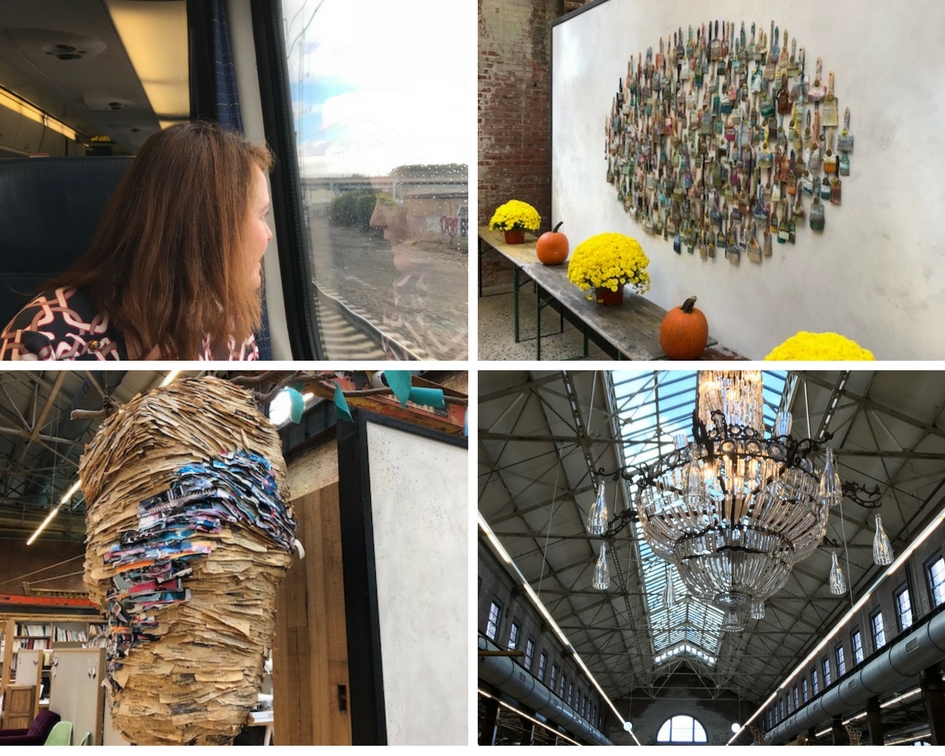
Once in a while Liz gets out of the office to visit clients. This week she and Protima ventured out of New York on Amtrak (see how excited Liz was) for client meetings. They covered a wide range of topics at the meetings—everything from how Trump's travel ban effects our client to overviews about the J-1 program—and in return got a tour of their very cool offices. Liz enjoyed the paint brushes installation and lovely chandelier but a favorite was the beehive made out of newspaper and textiles. All in all, it was a good day. Now back to work, Liz! You can go out next year!
OPINION: USCIS Updates Policy for Adjudicating Nonimmigrant Worker Extension Petitions
For over a decade, filing an extension of nonimmigrant status has been fairly routine in most cases. On Monday, October 23, 2017, US Citizenship & Immigration Services (USCIS) issued a new policy memorandum that instructs its officers to apply the “same level of scrutiny to both initial petitions and extension requests for certain nonimmigrant visa categories.”
Read morePolitico: “Trump targets 11 nations in refugee order”
President Trump signed an executive order on Tuesday to restart the refugee resettlement program, after it was suspended for 120 days as part of the president’s travel ban issued earlier this year. The order will resume refugee admissions but will initiate a new 90-day review period for officials to conduct an “in-depth threat assessment” of eleven countries. While neither the executive order nor the White House named these eleven countries, Politico says that based on statements from senior administration officials these countries appear to include: Egypt, Iran, Iraq, Libya, Mali, North Korea, Somalia, South Sudan, Sudan, Syria and Yemen—all majority-Muslim countries except for North Korea and South Sudan.
Read more
Donec id justo non metus auctor commodo ut quis enim. Mauris fringilla dolor vel condimentum imperdiet.