“How do I get a Green Card” is one of the most common questions attorneys at our law firm receive. And while it may be a surprise to many that a Green Card (that is, permanent residency in the US) is not right for everyone nevertheless people are always keen on obtaining one, especially if they have spent a few years in the US. There are generally two paths to permanent residency—via employment or family. But those aren’t exactly the only ways, and we thought it would be interesting to explore several of the lesser-known paths to that coveted Green Card.
Read moreSan Francisco Chronicle: “H-1B visa worries won’t slow applications, experts say”
Beginning next week on April 3 (since April 1 is a Saturday), immigration practitioners and petitioners will be able to file new H-1B petitions for those who have never had H-1Bs, commonly referred to as “cap cases.” Amid the uncertainty over whether President Trump plans to makes dramatic changes to the H-1B program, immigration experts anticipate another record-breaking year of petitions. While some immigration practitioners attribute the expected high amount of petitions to the strong economy and high demand for specialized knowledge positions in hubs such as Silicon Valley, others believe this may be their last shot for an H-1B before it is overhauled. “There are a lot of companies that are saying, ‘Hey, this is my only opportunity to get in under the current H-1B situation,’ because everyone is expecting a change,” Marcine Seid, an immigration attorney in Palo Alto, tells the San Francisco Chronicle. “And they don’t expect it to be for the better.”
Read moreWe Are With You

New York Times: “Trump Administration Orders Tougher Screening of Visa Applicants”
The Trump administration is making it more difficult for millions of visitors to enter the United States by demanding additional security checks before issuing visas to tourists, business travelers, and relatives of American residents, all seemingly in fulfillment of a campaign promise to enact “extreme vetting.” Secretary of State Rex W. Tillerson has sent diplomatic cables to US Embassies and Consulates worldwide with these instructions for stricter vetting, basing them off a March 6 presidential memorandum ordering the secretary of state, the attorney general, and the secretary of homeland security to “implement protocols and procedures” to enhance visa screening. The new security checks generally do not apply to citizens of countries in the Visa Waiver Program, which includes thirty-eight member countries. The additional scrutiny, for example, will ask applicants about their background and social media history if a person has ever been in a territory controlled by the Islamic State. “Consular officers should not hesitate to refuse any case presenting security concerns,” Secretary Tillerson writes in the cables. “All visa decisions are national security decisions.”
In 2016, the United States issued more than ten million visas, and this additional scrutiny is likely to lengthen the already bureaucratic process. “This will certainly slow down the screening process and impose a substantial burden on these applicants,” Greg Chen, the director of advocacy for the American Immigration Lawyers Association, tells the New York Times. “It will make it much harder and create substantial delays.” Chen questions how a single interviewer who conducts 120 interviews per day—at about five minutes per interview—can improve security. “It’s highly unlikely they could obtain information that demonstrates whether someone is a national security threat in such a brief interview process,” he says.
Future is Goddess

Victim (2015) by Michela Martello.
Future is Goddess, a new exhibit at local gallery Pen + Brush, features the work of Italian-born artist Michela Martello. Her work is a blend of "strength and softness, of domesticity and demolition" and "takes a stand against the anxieties of 2017 and affirms women's power and potential in response to our current political and social uncertainty." The artist, who resides in Brooklyn, has a background in illustration and produces murals and artwork on textiles. This exhibit, an eight-year survey of her work, is an intentional play on the empowering phrase, the “Future is Female,” with the role of Goddess "signifying a transformative rise in feminine power[.]" Among other pieces, the exhibit features a site-specific graffiti mural on the gallery wall with three goddesses representing a mixing of cultural backgrounds, to which viewers are invited to interact by tagging. The exhibit is on view through April 22, 2017.
The Trump Effect
It’s only been a little over two months since President Trump was sworn in and already his immigration policies, executive orders, and implementation guidelines—not to mention his own anti-immigrant rhetoric—have had a wide-ranging impact on US businesses, educational institutions, international partnerships, industries, and, of course, immigrant communities. Through his interactions with foreign leaders, he is also altering the world’s perception of the United States. What exactly has he done? Here we highlight some areas in which the “Trump Effect” is being felt.
Read moreNew York Times: “US Limits Devices for Passengers on Foreign Airlines From Eight Countries”
The US government has barred passengers on foreign airlines headed to the United States from ten airports in eight majority-Muslim countries from carrying “personal electronic devices (PEDs) larger than a cell phone or smart phone” under a new flight restriction enacted by the Trump administration. Claiming that “intelligence indicates that terrorist groups continue to target commercial aviation, to include smuggling explosive devices in various consumer items,” the new policy states that items including laptop computers, tablets, cameras, travel printers, and games bigger than a phone must be placed in checked baggage and are not permitted in the cabin. As to the definition of “larger than a cell phone,” DHS explains: “The size and shape of smart phones varies by brand. Smartphones are commonly available around the world and their size is well understood by most passengers who fly internationally. Please check with your airline if you are not sure whether your smartphone is impacted.”
Read moreThe Stranger Who Was Your Self

Happy St. Patrick's Day!
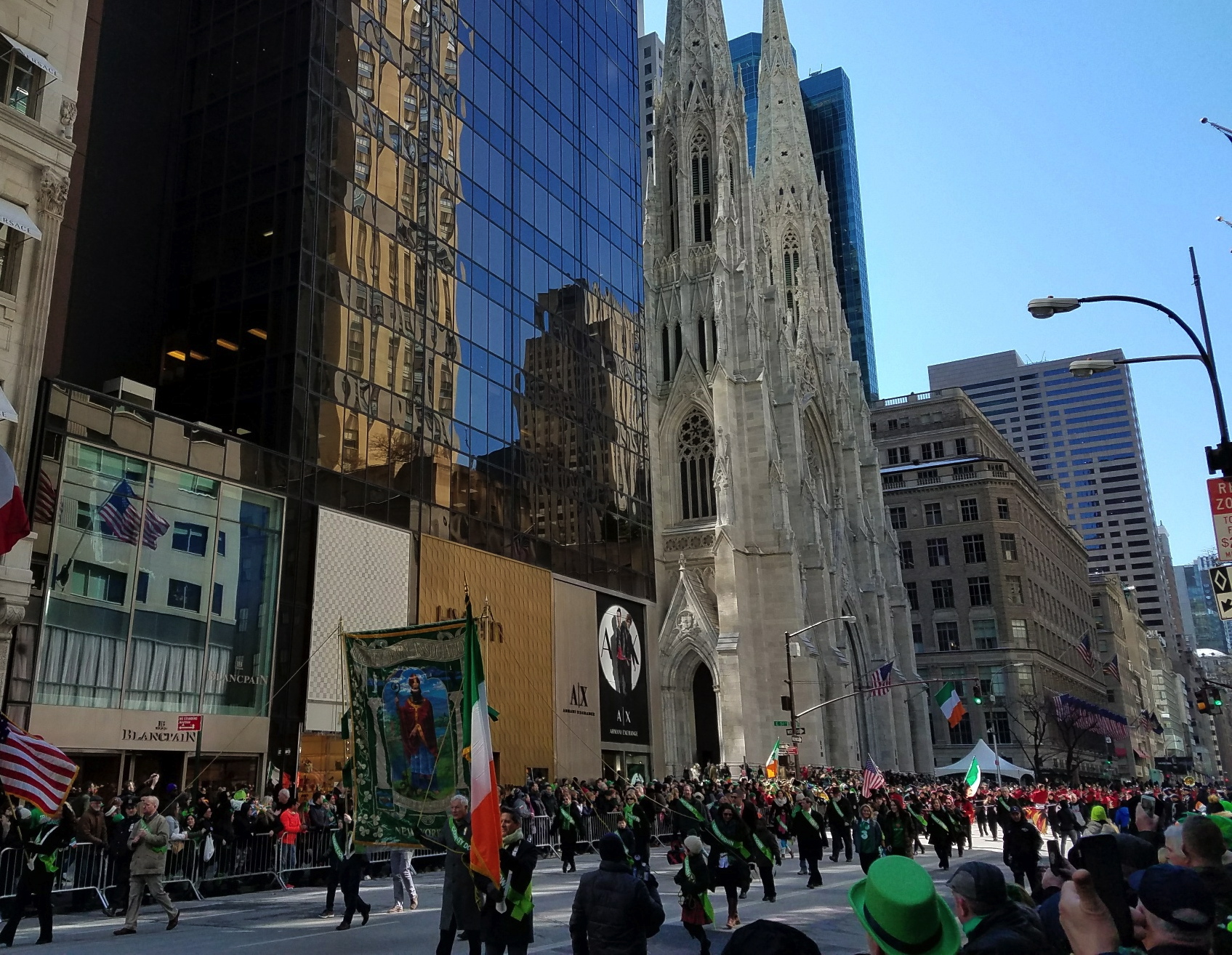
The St. Patrick's Day Parade on 5th Avenue in New York City.
For St. Patrick's Day today we set out to capture the most Irish photo possible. We believe we have succeeded: this photo of a banner of St. Patrick in front of St. Patrick's Cathedral in the St. Patrick's Day Parade with an Irish flag should certainly qualify. St. Patrick’s Day Parade is one of New York City’s oldest traditions. The first parade, held on March 17, 1762, consisted of homesick, Irish ex-patriots and Irish military members serving with the British Army stationed in the colonies in New York. The marchers wore green since this was a sign of Irish pride that was banned in their home country. The parade's tradition of marching past St. Patrick's Cathedral has not changed, except that originally the marchers passed Old St. Patrick's Cathedral on the corner of Mott and Prince Streets in SoHo. Now time for a Guinness (the only thing missing from the photo)!
An Introduction to the Wonderful World of PERM
Whenever employers wish to hire foreign nationals for a permanent position in their company, they have to go through the process of sponsoring the foreign national for a Green Card. In any conversation about this process, the word “PERM” may come up, in the context of the employer-sponsored labor certification. (There are other routes to the Green Card but this post will focus only on the PERM.) PERM stands for Program Electronic Review Management (sorry to all of you who had images of the iconic 1980s hairstyle in your head) and refers to the review of the labor market testing the employer must conduct in order to obtain a certification from the US Department of Labor (DOL) that no US workers exist to fill the job offered to the foreign national.
Read more