
President Trump’s revised travel ban, which temporarily bars travel to the US for certain citizens of six-predominately Muslim countries and temporarily suspends the US refugee program, goes into effect this week on March 16. The travel bans, in addition to disrupting the lives of many innocent immigrants and refugees, have negatively impacted air travel to the US and threaten US tourism, many leading travel industry authorities and leaders say.
Read moreMexican-American Dream

Fearless Girl
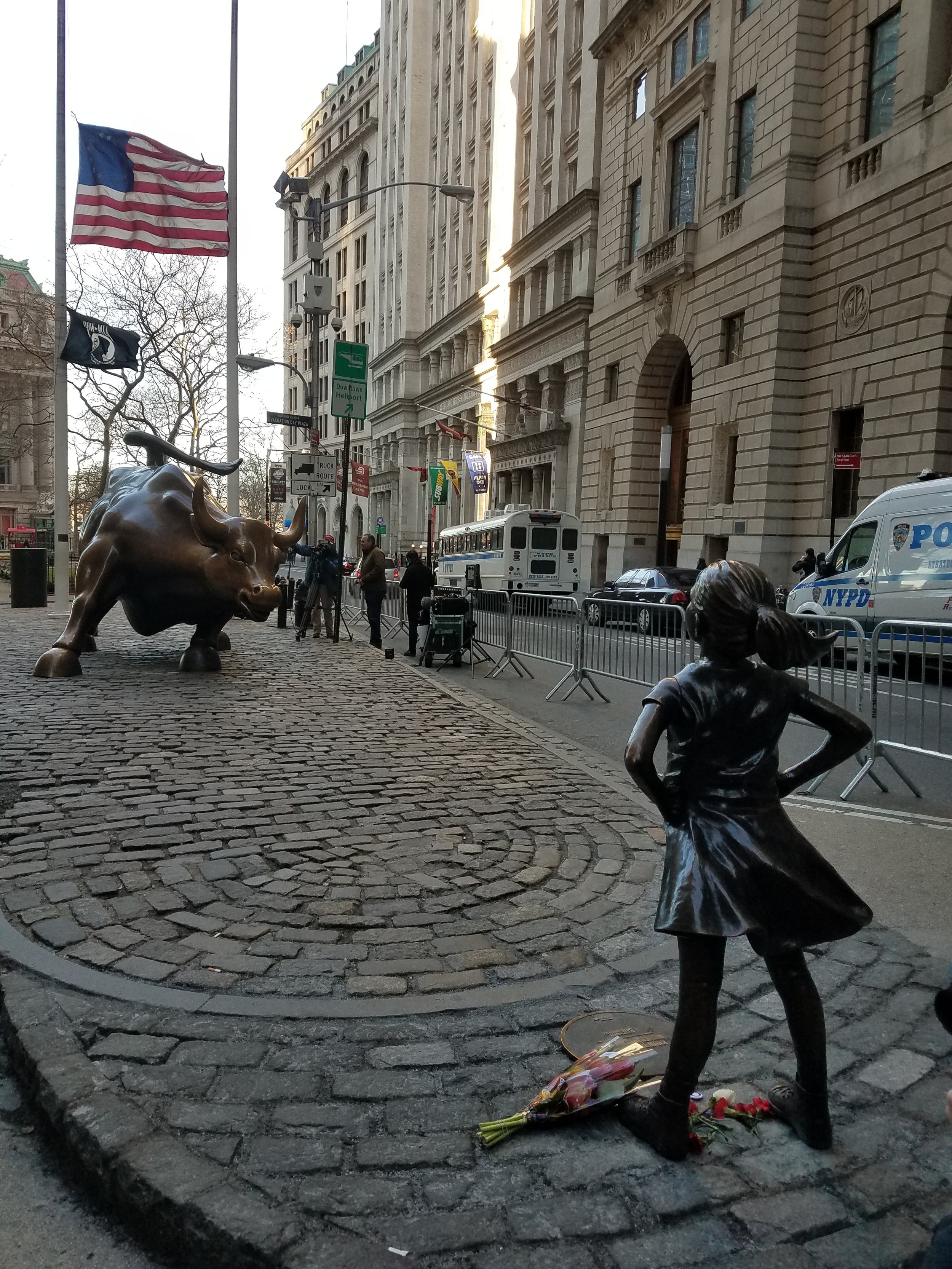
Fearless Girl by Kristen Visbal.
In time for International Women's Day, artist Kristen Visbal created the bronze statue standing defiantly in front of the iconic Wall Street bull. The already popular statue, which is only scheduled to be on display for a week, was commissioned by State Street Global Advisors, a nearly $2.5 trillion investor and asset manager, for a campaign aimed at getting company boards to increase the number of members who are women. The money manager says it may vote against boards if a company fails to add female board members, and will send a letter to 3,500 companies asking the companies to act. "One of the most iconic images on Wall Street is the charging bull," Lori Heinel, State Street's deputy global chief investment officer, tells Business Insider. "So the idea of having a female sort of stand against the bull or stand up to the bull just struck us as a very clever but also creative and engaging way to make that statement. Even though it's a little girl, her stance is one of determination, forwardness, and being willing to challenge and take on the status quo."
O-1 Visas for Chefs: A Recipe

Many foreign nationals work in the US culinary industry. Of course, this is not surprising since American cuisine has long been influenced by culinary traditions from around the world. While there are a number of visa options that may be suitable for restaurant workers, in this post we are focusing on one of the most common visas available for highly talented chefs, bakers, and front of house staff. That’s the O-1B, for artists of extraordinary ability. (Yes, chefs are artists too!) We’ve previously discussed the O-1 generally and specifically for the TV and film industry, but for those culinary talents considering visa options for the US, we have an O-1 recipe for you! (Okay, this is a little silly, but we’re always looking for new ways to explain complex visas processes.)
Read morePresident Trump Signs Revised Executive Order Banning Travel from Six Muslim-Majority Countries and Suspending the US Refugee Program
On Monday, March 6, 2017, President Trump signed a revised executive order temporarily banning travel to the US for certain citizens of six-predominately Muslim countries as well as temporarily suspending the US refugee program. The executive order, “Protecting The Nation From Foreign Terrorist Entry Into The United States,” supersedes the original order issued January 27, and was revised to better withstand legal scrutiny in the courts (which his initial executive order had failed to do). According to Secretary of Homeland Security John Kelly, the order will “make America safer, and address long-overdue concerns about the security of our immigration system.” The travel ban and refugee resettlement suspension is set to go into effect on March 16, 2017.
Read moreUSCIS Will Temporarily Suspend Premium Processing for All H-1B Petitions
US Citizenship & Immigration Services (USCIS) will temporarily suspend premium processing for all H-1B petitions effective April 3, 2017, the beginning of the filing period for H-1B “cap” cases. During the premium processing suspension, which may last up to six months, petitioners will not be able to file Form I-907, Request for Premium Processing Service for a Form I-129, Petition for a Nonimmigrant Worker, which requests the H-1B nonimmigrant classification, for either H-1B “cap” or “cap exempt” petitions. USCIS will notify the public before resuming premium processing for H-1B petitions. All Form I-129 H-1B petitions properly filed before April 3, 2017, will continue to be premium processed within the required fifteen-day calendar frame. Note that the temporary suspension of premium processing for H-1B cases does not apply to other eligible nonimmigrant classifications.
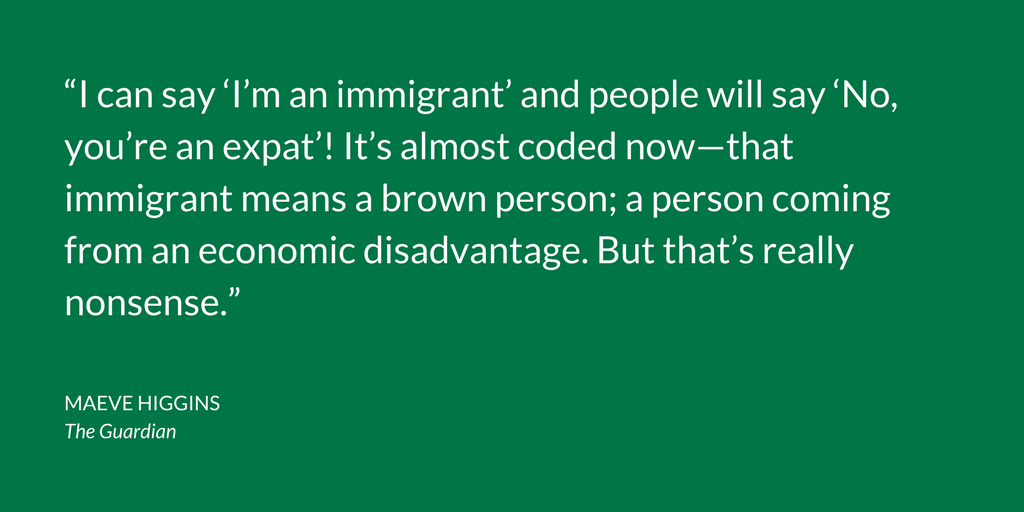
Read moreExpat vs. Immigrant
The House That Wouldn't Grow Up

The house where famous author J.M. Barrie lived is on the left.
Back in London, I came upon the house of Scottish dramatist and novelist J.M. Barrie, who is best known for his creation of Peter Pan, the boy who wouldn't grow up. The beautiful Victorian semi is next to Kensington Gardens, which inspired the playwright when he created Peter Pan, and where the famous statue of Peter Pan was erected in 1912. The charming house was built in 1820 and first inhabited by a gardener before Barrie and his wife, Mary Ansell, moved there in 1900. The house was later sold to sculptress Kathleen Bruce, the widow of Barrie’s friend and Antarctic explorer Captain Robert Scott. All in all, I'd say the house is looking pretty picturesque and you can just see some spring blossoms coming in.
Ashley Tighe: The DLG-Proust-Actors Studio Questionnaire
Ashley, our receptionist and legal assistant, is a dancer. Although her dreams of a professional dance career were “shattered” after a terrible knee injury, she nevertheless still goes to classes in Manhattan. This is quite remarkable since in addition to working fulltime at the firm, she is also a part-time law student at New York Law, where she is expected to graduate in 2019 (hang in there, Ashley, you can do it!).
Read moreRolling Stone: “Why Trump's Immigration Policy Is a Legal Mess”
Last week Secretary of the Department of Homeland Security (DHS) John Kelly released two memos aimed at detailing how his department would implement President Trump’s executive orders on immigration. While the memos confirm and clarify fears about the intention of the executive orders, as Matthew Bray noted, they fail to answer some fundamental questions about how the administration will prioritize its use of resources if nearly everyone is a priority. Additionally, legal experts already believe there are ways that these orders, just like the travel ban, could be successfully challenged in court. Omar Jadwat, director of the ACLU's Immigrants' Rights Project, and Camille Mackler, director of legal initiatives for the New York Immigration Coalition, detail in an interview with Rolling Stone what could be several potential legal problems with Trump's immigration policy.
It Would Impede Access to a Lawyer
What the memo says: Immigrants arriving from a contiguous country—that is, Mexico or Canada—can be returned to that country, no matter where they're originally from, "pending the outcome of removal proceedings."
What an expert says: This involves due process—and due process is a right guaranteed under the Fifth Amendment. "The Supreme Court has held that you're entitled to a lawyer in your immigration court proceedings…How are you going to ensure that the due process protections of immigration proceedings are upheld if you're forcing somebody to be in a foreign country, appearing via video?" Mackler says. "Just as a practical matter, how is a lawyer supposed to represent somebody when they are that far away?"
It Would Lead to Quicker Deportations Without a Hearing
What the memo says: With exceptions only for unaccompanied minors and political asylees, DHS plans to make undocumented or improperly documented immigrants eligible for "expedited removal"–deportation without any kind of hearing–if they have been in the US for less than two years. This changes a policy that held that only immigrants apprehended within 100 miles of the border and fourteen days of their arrival were eligible for expedited removal.
What an expert says: This could lead to another potential Fifth Amendment violation. "Expedited removal is a big due process problem," Jadwat says. "The notion that you could basically deport somebody and then give them a hearing later about whether you should have deported them seems totally contrary to any basic notion of even logic."
It Would Bring Back Secure Communities, a Problematic and Abandoned Bush-era Deportation Program
What the memo says: DHS calls for the reinstatement of Secure Communities, a deportation program created by former President George W. Bush that used local and state law enforcement to detain non-citizens. Former President Obama replaced this program with the Priorities Enforcement Program, which prioritized more serious criminals for deportation.
What an expert says: Secure Communities was abandoned because "the government was consistently losing in court, and courts were repeatedly disapproving of the way the federal government was using detainers," Jadwat says. "There's a big footnote in [the DHS memo ending Secure Communities] that basically explains: Here are a bunch of the cases that have gone against us, which is a big part of the reason we're changing from S Com to PEP."
It Could Violate Privacy Rights of Immigrants
What the memo says: DHS intends to create an office that would provide the victims of crimes perpetrated by undocumented immigrants with information about the offender's "immigration status and custody status, and [an assurance] that their questions and concerns regarding immigration enforcement efforts are addressed." President Trump has also stated in an executive order that it would distribute a weekly list of criminal actions committed by undocumented immigrants, a move that is likely to further provoke anti-immigrant sentiment.
What an expert says: These proposals could be challenged on privacy concerns. "Suspending the Privacy Act rules for anyone except US citizens and green card holders—that had actually been found...to not be practicable because it's very, very hard from an agency standpoint to track when somebody becomes a green card holder or US citizen for the purposes of figuring out whether the Privacy Act applied to them or not," Mackler says. "The privacy violations, and potential of [the government] exposing themselves to libel and slander or anything like that by the publication of these weekly and monthly reports [are significant].”
While President Trump’s immigration policy is ostensibly designed to prevent terrorists from entering the US and keep Americans safe, since President Trump’s election, there has been a dramatic increase in reports of hate crimes across the US. The recent shooting of Srinivas Kuchibhotla and Alok Madasani, two immigrants from India, by Adam Purinton, has led many to suggest that President Trump’s anti-immigrant policy and rhetoric has produced a climate of hostility toward foreigners in the US. Purinton, who was thrown out of the bar where Kuchibhotla and Madasani were drinking after he called them ethnic slurs and suggested that they did not belong in the United States, returned a short time later and fired on the two men, as well as another man who tried to apprehend the gunman. The attack, which killed Kuchibhotla, is being investigated as a possible hate crime. The gunman reportedly said later that he believed he had killed two citizens of Iran, one of the seven-predominately Muslim countries included in Trump’s travel ban.
The White House strongly rejected the idea of a link between the shooting and the administration’s anti-immigrant language and policy. Madasani, who was injured but survived the attack, calls the shooting “an isolated incident that doesn’t reflect the true spirit of Kansas, the Midwest and the United States.”