

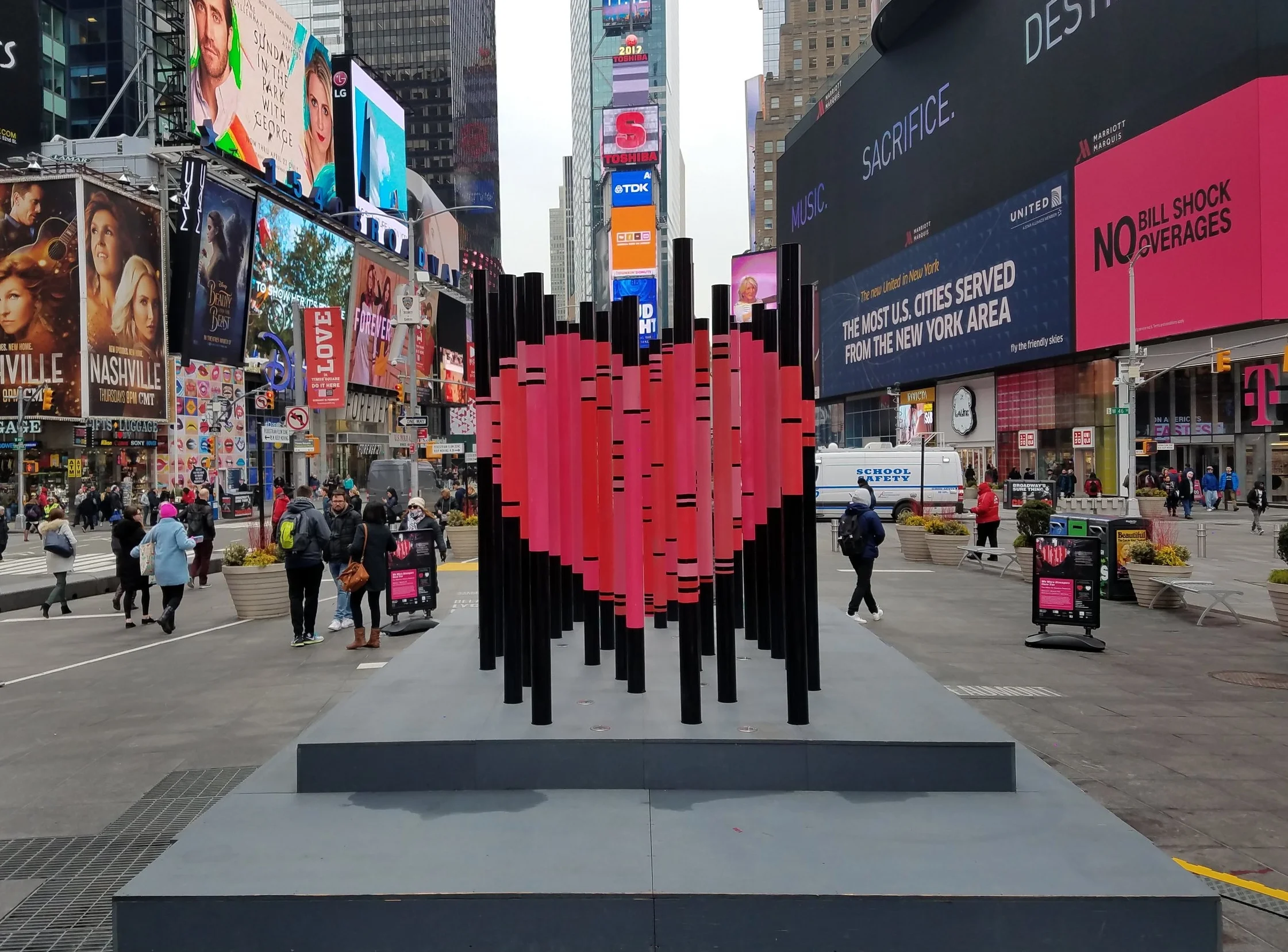
We Were Strangers Once Too, the winning design for the 2017 Times Square Valentine Heart Design Competition, celebrates New York City’s rich immigrant culture. The sculpture, on display in Father Duffy Square in Times Square, consists of thirty-three metal poles inscribed with the origins of foreign-born NYC residents. As viewers walk around the sculpture, the red and pink poles come together to create an iconic Valentine’s Day heart. “Now more than ever New Yorkers need to stand up and say we are proud to live in a city of immigrants,” says a spokesperson for The Office for Creative Research, which designed the sculpture. “We Were Strangers Once Too is our way to acknowledge and say thank you to the diverse communities of NYC for their many contributions historically, currently and into the future.”
We Were Strangers Once Too
Trump’s Executive Order "Enhancing Public Safety in the Interior of the United States" – A Sign of Things to Come, or Business as Usual?
In the same week that President Trump issued his now infamous executive order suspending refugee admissions into the US and temporarily barring entry to passport holders from seven predominantly Muslim countries, he also issued two other executive orders that affect immigration. These other two orders—“Border Security and Immigration Enforcement Improvements,” which, among other things, directs the immediate construction of a border wall, and "Enhancing Public Safety in the Interior of the United States"—did not receive quite the same level of media attention as the “travel ban,” which has been the subject of already extensive federal litigation. Still, both may have a very broad impact on immigration and immigrant communities in the US. Trump's other executive actions signed early February—including "Enforcing Federal Law with Respect to Transnational Criminal Organizations and Preventing International Trafficking," which among other actions aims to increase prosecutions for immigration and visa fraud, and "Task Force on Crime Reduction and Public Safety," which will set up a task force to develop "strategies to reduce crime, including, in particular, illegal immigration"— may also signify that the scope of individuals likely to be targeted and deported is widening.
Read moreNew York Times: “Japan Limited Immigration; Now It’s Short of Workers”
Japan’s strict stance on immigration—it has very little illegal immigration and is officially closed for those seeking low-skill labor—has led to worker shortages in many industries. Similar to the United States and other developed countries, Japan has had a difficult time finding workers for low-skill and low-wage jobs in the food, manufacturing, healthcare, and restaurant industries, and these labor shortages have helped put a brake on economic growth:
That is prompting Japan to question some fundamental assumptions about its labor needs. The debate is politically delicate, but changing realities on the ground—in Japan’s factories and fields—are forcing politicians to catch up. Japan’s total foreign-born labor force topped one million for the first time last year, according to the government, lifted in part by people entering the country on visas reserved for technical trainees.
While the government has incredibly strict immigration policies, lawmakers created immigration loopholes, most notably a “trainee” program, to allow hundreds of thousands of low-wage workers from such countries as China, Vietnam, the Philippines, and Cambodia, fill empty jobs. As the Japanese population shrinks, in the last five years the trainee program has doubled in size, to over 200,000, according to official data, and there are plans to expand it. The “trainee” designation is not entirely accurate, since apart from a short period of language study, most trainees “receive little or no instruction that would distinguish them from regular manual laborers,” specialists and participants say. “The system is like calling a crow white,” Yoshio Kimura, a member of Parliament from the governing Liberal Democratic Party who heads the party’s labor committee, tells the New York Times. “What we’re really doing is importing labor.”
Because of decades of low birthrates, the number of working-age Japanese has been falling since the mid-1990s. Official census figures confirmed recently that Japan’s population shrank by nearly a million during the last half-decade. Nationwide unemployment is at three percent. The situation is serious in some industries with three to four positions open in nursing care and construction for every person who applies, according to government surveys.
Despite its popularity and critical function it plays because of the declining population, the trainee program is full of abuse. Nobuya Takai, a lawyer who has represented foreign trainees in labor disputes, explains that since companies do not hire the trainees directly, but through a myriad of government and private-sector middlemen, most trainees end up thousands of dollars in debt to pay broker fees before they even arrive. Moreover, since trainees cannot easily switch jobs, they do not have the option to leave a bad or abusive employer. “They can’t change jobs, and they lose money if they go home,” Takai says. Complaints about unpaid labor are common. Liu Hongmei, a Chinese worker, quit her Shanghai clothing factory job because she was promised wages three times her $430-per-month Chinese wage. “It seemed like a big opportunity,” she says. She arrived in Japan in debt after paying brokers $7,000 to arrange her visa, and found difficult working conditions and lower-than-promised pay. Her bosses, she says, “treat us like slaves.” In 2011, an American State Department report on human trafficking indicated the trainee program had inadequate protections against “debt bondage” and other abuses.
Some argue that Japan’s anti-immigrant stance and worker shortage problems may be a warning for other developed countries as they make possible changes to immigration policy. Present Trump campaigned on calls for a crackdown on undocumented immigrants, saying they “compete directly against vulnerable American workers.” He also promised to cut back legal immigration with new controls to “boost wages and ensure open jobs are offered to American workers first,” although a study last year found, with few caveats, that immigrants do not take Americans’ jobs and in many cases create jobs.
Japanese parliament has approved the creation of a new agency to oversee the trainee program last year, in response to criticism over worker abuse. Additionally lawmakers plan to bring in more workers, and allow more kinds of businesses to hire them, including nursing homes and cleaning companies for offices and hotels. Kimura and some other lawmakers want to establish a formal guest worker system, though it would still not open a path to permanent stays. “If we want economic growth in the future, we need foreigners,” Kimura says.
Hard Not to Fall in Love with America

New York Winterland
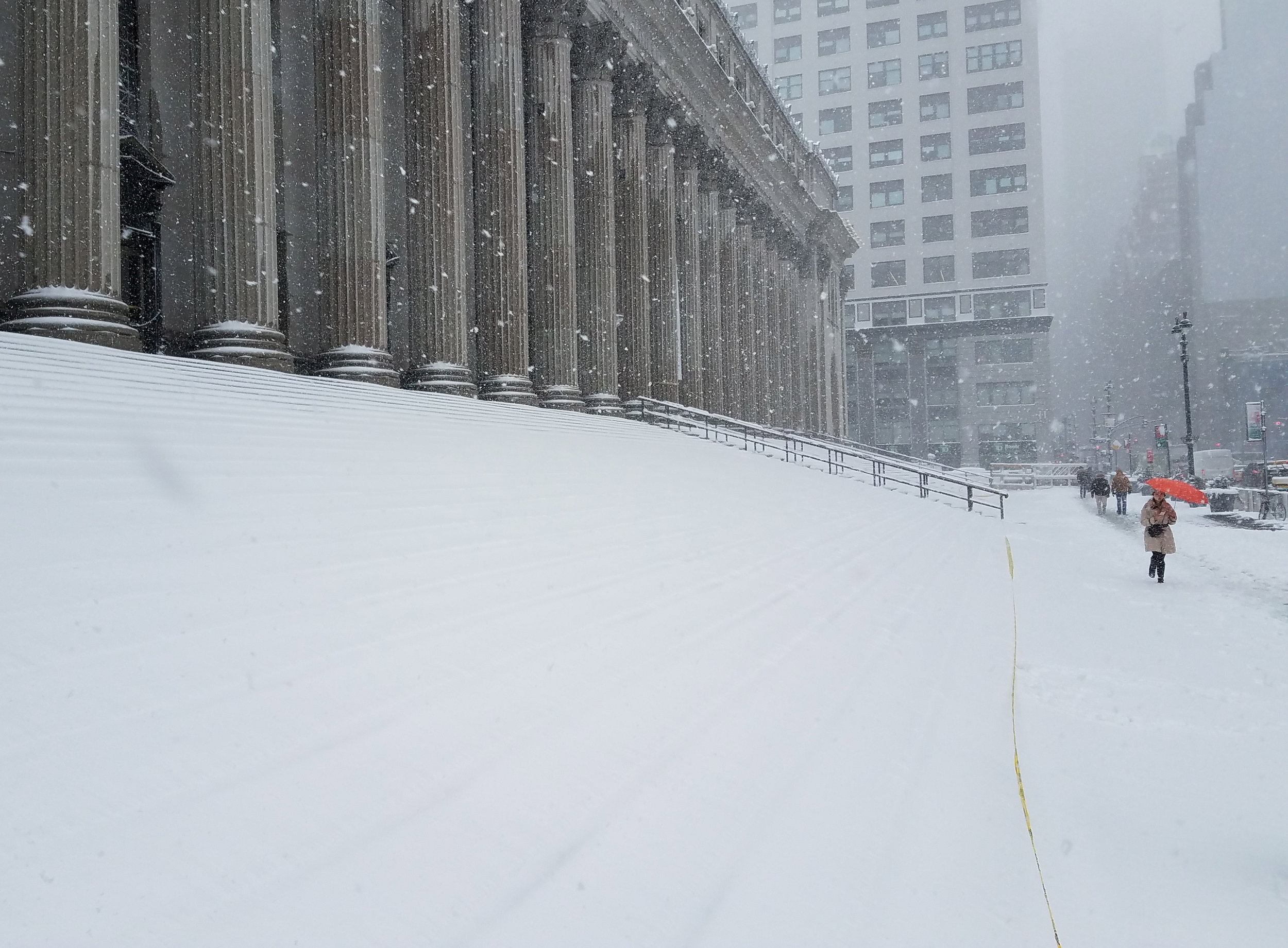
After deceptively warm and spring-like weather on Wednesday, New Yorkers were greeted by a powerful winter storm when they woke up yesterday. With about one foot of snow and wind gusts up to thirty-five miles per hour as well as a temperature drop to the twenties, it was a good day to stay inside and watch movies. Oh wait, it was a work day. It was a good day to bundle up and take the subway, which was thankfully still running, and go to work and get lots done and admire the beautiful snow falling outside.
New York Times: “U.S. Technology Startups Panic Over Immigration Ban”
Silicon Valley technology start-ups and businesses, many with immigrant founders and a diverse workforce, are reacting strongly against President Trump’s executive order banning travel for nationals of certain Muslim-majority countries. President Trump’s executive order, issued late last month, halted the US refugee program for 120-days, barred Syrian refugees indefinitely, and imposed a ninety-day travel suspension on individuals from seven predominantly Muslim countries, including Iran, Iraq, Libya, Somalia, Sudan, Syria, and Yemen. The ban, which was temporarily halted on Friday by a Seattle judge, has led to widespread protests and legal challenges, and many venture capitalists and start-up founders are reporting it’s already impacted key business decisions and employee operations. "I've never seen something impact the day-to-day thought process of CEOs so fast,” Neeraj Agrawal, general partner at Battery Ventures, tells the New York Times.
"Here and now, today, we have businesses that are stopping because their employees can't travel in and out of the United States," David Cowan, a partner at Silicon Valley firm Bessemer Venture Partners, says. "This will be the No.1 cause of missed business plans in 2017." Cowan, who also sits on the board of a cybersecurity company in Israel, says the company has delayed moving its headquarters to the US because its employees are "from all sorts of countries.” Other companies have also reported delaying plans to open up US locations. Amin Shokrollahi, founder and chief executive of Kandou, a semiconductor company, is reconsidering plans to open a US design center that would have employed at least twenty people. The Iranian-German dual citizen is based in Switzerland, and he and his Iranian colleagues canceled plans to attend a trade show in Silicon Valley, where he was supposed to have received an award.
The employee base of many Silicon Valley companies is especially diverse. More than half of all "unicorns"—startups valued at $1 billion or more—have at least one immigrant founder, according to a 2016 study by the National Foundation for American Policy, a non-partisan think tank based in Arlington, Virginia. "There is a panic in the startup community," Bill Stock, president of the American Immigration Lawyers Association (AILA), tells the New York Times. "Startups are very concerned because of the unpredictability of the order."
The opposition to the travel ban is so strong that nearly 130 companies, many of them in the technology field, filed an amicus brief late Sunday in the US Court of Appeals for the Ninth Circuit, which declined to reinstate the travel ban after it had been blocked. The brief was signed by large and small tech companies including Apple, Facebook, Microsoft, Google, Uber, Tesla, and Intel and says that the “instability and uncertainty” created by the executive order “will make it far more difficult and expensive for US companies to hire some of the world’s best talent—and impede them from competing in the global marketplace.” President Trump says the ban is necessary to protect Americans, objecting to the judicial ruling that blocked his ban: "The judge opens our country to potential terrorists and others that do not have our best interests at heart. Bad people are very happy!"
While many technology companies have been outspoken in their protest of the ban, other companies are keeping quiet. Fortune Magazine contacted nearly every company in the Fortune 100 for a response to the Muslim ban, and the “responses were almost uniformly no-comments or punts, with spokespeople explaining executives were still assessing the impacts of the ban.”
The World Divided

Go Roger!

I was thrilled to be in Melbourne last Sunday to watch the great Roger Federer win his 18th major title at the Australian Open. Federer, back after a six-month hiatus due to a knee injury, fought against his old nemesis, Rafael Nadal, who was also returning to play after a bad wrist injury last year. Over their career thirty-four matches, beginning at Miami in 2004, they have demonstrated that they are two of the best players in tennis. (Okay, my preference is clearly Roger but others may disagree.) The victory was especially sweet since they have previously met eight times in final matches and Nadal has emerged as the winner in six. Not this time. Go Roger! See you at Wimbledon!
Don't Panic: Secondary Inspection Isn’t Always Cause for Concern
First off, we’re big fans.
You are one of the most successful film stars in the world (if not the most successful). I mean, to have nicknames like “King of Bollywood” and “King Khan” and to be known simply by the initials “SRK,” it’s obvious you are very special. You’ve appeared in more than eighty Bollywood films, have earned numerous accolades including 15 Filmfare Awards, and have a passionate following in Asia and the Indian diaspora worldwide.
Read more