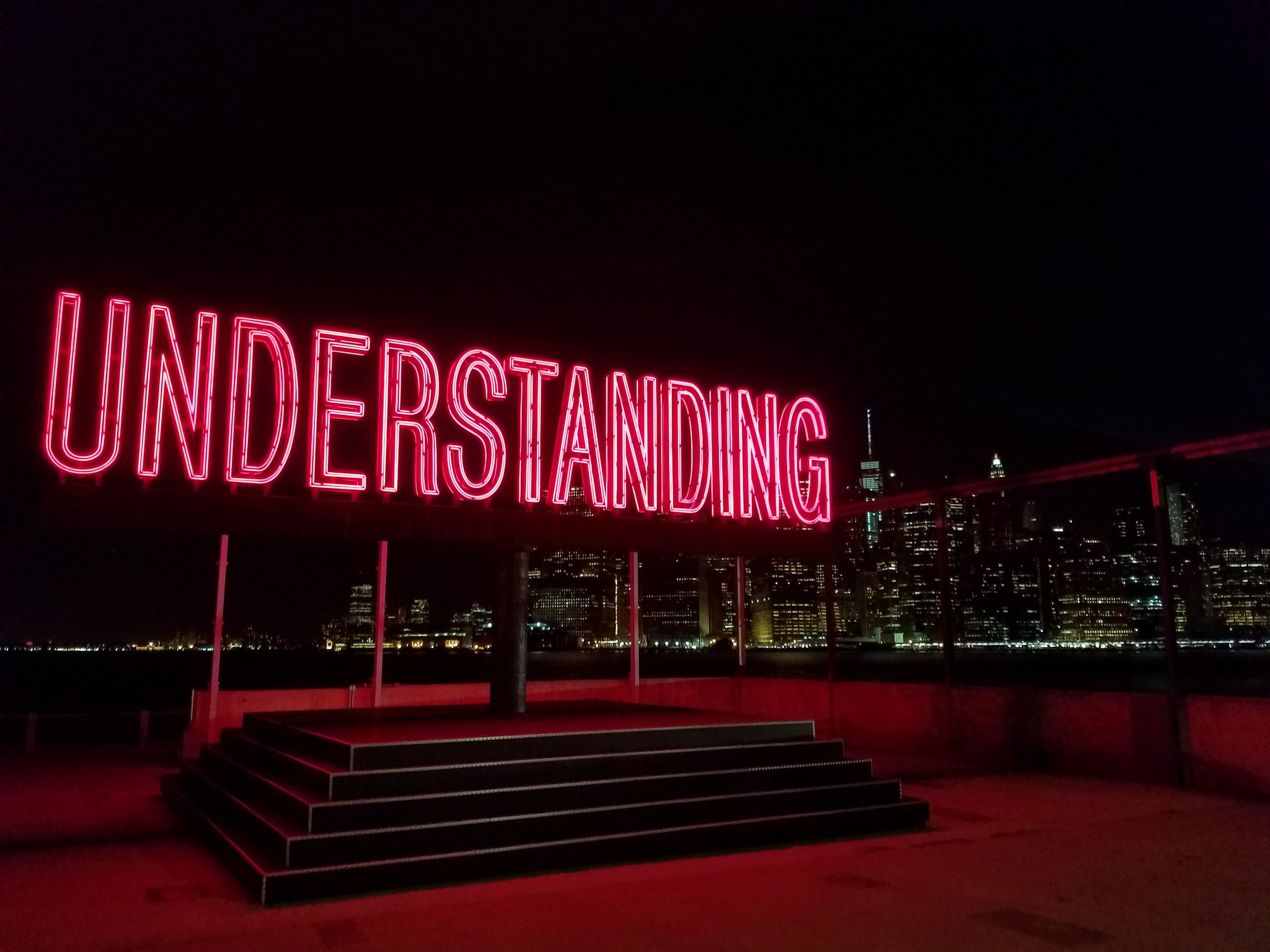
Understanding

Understanding by Martin Creed

Understanding by Martin Creed

British interdisciplinary artist and musician Martin Creed's lastest piece, titled Understanding (as you might guess), is inspired by neon signs, Times Square marquees, and advertising logos. But instead of selling a product, Creed is proclaiming a word that is "fundamental to communication between people." These ten–foot–tall letters are mounted on a fifty–foot–long steel I–beam, and rotate 360 degrees, "constantly shifting perspective on the work." The letters spin at differing speeds according to a computerized program designed by the artist. Understanding is at Pier 6 at Brooklyn Bridge Park through October 23, 2016.

LA Times: "Arizona's once-feared immigration law, SB 1070, loses most of its power in settlement"

Arizona has announced an end to its practice of requiring police officers to demand the identification documents of people suspected of being in the country without legal documentation. The announcement is part of a settlement between the State of Arizona and the National Immigration Law Center and other immigrants’ rights groups that sued six years ago just after passage of the controversial Senate Bill (SB) 1070.  

This decision concedes a key point of arguably one of the nation’s most aggressive immigration bills, Arizona’s SB 1070, formally titled the “Support Our Law Enforcement and Safe Neighborhoods Act,” signed by then-Governor Jan Brewer in April 2010. This bill was an “omnibus of Arizona anti-immigration measures, collecting a decade’s worth of fears of Mexican drug cartels, competition for jobs and the state’s rapidly expanding Latino population into one piece of legislation.”

Specifically, SB 1070 contained elements designed to decrease the number of undocumented immigrants in the state by compelling police to ask for identification and permitting officers to make arrests without a warrant if the officer believed the individual had committed an offense that made them deportable. The law also made it a crime to fail to carry registration papers and for undocumented immigrants to solicit work.     

As part of the settlement, Arizona Attorney General Mark Brnovich issued an informal opinion instructing police officers to “ignore the provision in the law that requires them to investigate a ‘reasonable suspicion’ that a person is in the country" without proper documentation, which immigrants’ rights groups warned would lead to racial profiling. “Officers shall not prolong a stop, detention or arrest solely for the purpose of verifying immigration status,” Brnovich wrote. “Officers shall not contact, stop, detain or arrest an individual based on race, color, or national origin, except when it is part of a suspect description.” Additionally, Brnovich issued a statement assuring Arizonans that elements of SB 1070 would remain valid. “We have succeeded by keeping the key provisions of SB 1070 in place,” Brnovich says. “Our goal while negotiating this settlement was to find a common-sense solution that protects Arizona taxpayers while helping our great state move forward.”

Immigration advocates are claiming the settlement as a win for immigrant rights. “For the very first time since May 2010, there will be clarity to every law enforcement officer in the state that the only way to follow SB 1070 is to make sure no one is detained on their immigration status alone,” Karen Tumlin, legal director of the National Immigration Law Center, tells the Los Angeles Times.

This SB 1070 settlement comes as a group of advocacy organizations is filing a new federal lawsuit claiming that those who qualify for Arizona driver’s licenses have been illegally denied the chance to obtain them. This latest suit comes less than two years after a federal judge forced the state to grant driver’s licenses to recipients of the federal Deferred Action for Childhood Arrivals (DACA). Then-Gov. Jan Brewer had issued a directive banning them from getting licenses, claiming the decision grew out of “liability concerns and the desire to reduce the risk of the licenses being used to improperly access public benefits.” Victor Viramontes, an attorney with the Mexican American Legal Defense and Educational Fund, one of the groups filing the lawsuit, says the state should have allowed all deferred action recipients to get licenses following the federal court ruling. “They should have stopped discriminating the minute this policy was declared unconstitutional, but they keep doing it,” he tells CBS News.

Hello from Vermont!

Lake Champlain

Lake Champlain

Matt and I traveled up to beautiful Vermont for the annual stakeholder’s event at the Vermont Service Center (VSC) of US Citizenship & Immigration Services (USCIS). These annual stakeholder events provide a valuable opportunity to meet officers of the VSC and fellow practitioners and discuss immigration issues and topics. (Okay, and also ask about that case that has been pending for way beyond the processing times.) At these stakeholder events, the VSC typically hosts roundtables and informational sessions related to business, family, and student-based immigration case types as well as customer service issues and concerns. The highlight is a tour of the VSC itself, but for security reasons, the VSC doesn't allow photos of their buildings. That's okay, though. This beautiful sunset on Lake Champlain will do!

The Washington Post: "Appeals court strikes down proof-of-citizenship voting requirement in 3 states"

The US Court of Appeals for the District of Columbia Circuit has reversed a prior ruling that allowed certain state US election agencies to require a proof-of-citizenship for a mail-in federal voter registration form used for November’s election in Kansas, Alabama, and Georgia. To date, Kansas was the only state to actually enforce the rule, and in oral arguments, civil rights groups claimed that if permitted the ID provision could potentially disenfranchise tens of thousands of US citizens applying to vote in Kansas without required papers. 

The requirement entailed a “demand to show documentation such as a birth certificate, passport or naturalization papers instead of accepting signed and sworn affirmation of citizenship to register to vote in federal races.” Two US Appeals Court judges, Judith W. Rogers and Stephen F. Williams, granted a preliminary injunction and the case will go back down to the district court.

For native and naturalized citizens, one of the greatest rights one possesses is the right to vote for public officers; however, voter requirements, including providing a state-issued ID or proof of citizenship, have been considered by some an undue burden and discriminatory. The Obama administration has waged ongoing battles with conservative lawyers and Republican lawmakers over voter requirements and who will be eligible to vote in this year’s presidential election, and the administration has asked federal appeals courts to repeal new voting laws passed in Texas, North Carolina, and other states. Chris Carson, president of the League of Women Voters, who brought the suit in this case, says voting should be made easier, not harder: “We are grateful to the court of appeals for stopping this thinly veiled discrimination in its tracks,” she tells The Washington Post. “All eligible Americans deserve the opportunity to register and vote without obstacles.”

In this case, voter groups sued after what they called an “unauthorized and unilateral decision” earlier this year by Brian D. Newby, executive director of the US Election Assistance Commission, to grant the three states’ requests to change the federal registration form to include new ID requirements to reportedly combat voter fraud. In the 2-1 ruling, US Appeals Court Judge A. Raymond Randolph, disagreed with his fellow judges and agreed with Newby stating that it would “raise serious constitutional doubts” if the federal elections assistance body prevented a state from “enforcing its voter qualifications.” Kansas Secretary of State Kris W. Kobach, who defended the voter ID requirement in court, claimed that “any harm to potential voters was speculative.” The final result of this case remains to be seen as it is now back with the district court, though Kobach stated previously that if the state were to lose it would retroactively allow voters to cast ballots in federal races if their applications were canceled solely because they did not document citizenship.

The New York Times: "What an Undocumented Immigrant Wanted to Tell Donald Trump"

Republican Presidential Nominee Donald Trump’s campaign has weighed in on the immigration debate more times than one can count.  Perhaps most famously, he proposes to build a wall along the US/Mexico border and have Mexico pay for it.  In an effort to realize this proposal, Trump recently headed south for a meeting with Mexico’s President, Enrique Peña Nieto, who opposes Trump’s ideas. While the meeting allegedly showed a more restrained Trump, upon his return, he delivered an immigration speech that reiterated his tough stance on undocumented immigrants.

One person who was looking forward to hearing the speech was José Enrique Camacho, an undocumented immigrant who works as a groundskeeper at an apartment building in Phoenix, where the speech was delivered. Camacho has lived in the United States for 24 years. By his own account, Camacho does not drink or steal. Rather, he goes to church on Sundays and owns a car and a home. He has a daughter who just graduated college and a son who is in high school. He has always instilled in his children that the United States is a country where you can do anything, and unfortunately, Mexico is not.

Camacho wanted to attend Trump’s speech on immigration not because he aligns himself with Trump or his politics, but because he wanted to be able to share one simple thought with him. Camacho said, “Mr. Donald Trump, he doesn’t know that when we come here from Mexico, it’s because we’re hungry, we’re needy…We come here to help ourselves and our families.” Camacho continues, “Mexico can’t help us…If it could, no one would ever leave.” Camacho is one of eleven million undocumented immigrants who fear that if Trump wins in November, he will make good on his promise to deport all undocumented immigrants starting on his first day in office. Passing the legions of “Make America Great Again” red hat supporters, Camacho poses one last question, “Imagine what would happen if all the Mexicans left this country,” he said. “Has Donald Trump ever thought of that?”