

Joseph, our esteemed HR Manager and Blog Editor is taking the Labor Day holiday to the next level. He left this week for a wonderful vacation in Begur, Spain, a small town in Costa Brava that was deemed a "hidden holiday treasure" by The Guardian. Begur is known for its stunning beaches and historical landmarks, including medieval castles constructed in the 16th and 17th centuries. As you can see, Joseph is working hard on his Spanish language skills. He has figured out that "hola" means hello. Good job, Joseph! Keep up the studies! Have a safe and happy Labor Day weekend!
Greetings from Begur!
The Washington Post: "This man launched a website so people can invite refugees to stay in their homes"
Open any newspaper or watch any news program and you will inevitably be bombarded by stories about immigration. You will hear about how the presidential candidates feel. You will hear about detainments and crime rates. You will hear about illegal statuses. But, what you might not hear a lot about is compassion. Amr Arafa, a thirty-four year old immigrant from Egypt recently launched EmergencyBNB, a home rental website aimed at providing a place to stay for refugees and domestic violence victims free of charge. His website is similar to the popular Airbnb website, but no money is exchanged in the process.
Arafa is an immigrant success story. He came to the US in 2005 on a student visa and for the better part of the next decade stayed in the US on other student and temporary work visas. In 2015, he secured a green card and lives in the Washington DC area. Arafa said that his desire to help “started when I got this green card. I got this incredible dosage of stability.” Indeed, he was able to visit his home country for the first time in eight years and came home with a new mission. He started by putting his own apartment on Airbnb at the cheapest rate ($10), stated that the space was available to refugees and domestic violence victims, and then he refunded the fees paid. However, this plan proved to be too difficult as many people contacted Arafa simply for a free place to stay. While he does not have a proper vetting system, Arafa does speak with guests before their stay is confirmed and requests government documentation as proof of refugee status.
Currently, there are over three million refugees in the United States, with over 63,000 entering the US since October 2015 and not all of them have safe, stable places to stay while their refugee petitions are being adjudicated. Moreover, according to the National Coalition Against Domestic Violence, approximately twenty people per minute are victims of domestic violence and oftentimes there is no safe escape. Indeed, Alysha Tagert, a social services program coordinator for the Torture Abolition and Survivors Support Coalition, told The Washington Post that it is difficult to find housing, particularly in the Washington DC area, for the victims her organization encounters. By opening his own home, and new website, Arafa hopes to spread the word that everyday people can make a difference.
USCIS Proposes Rule to Welcome International Entrepreneurs
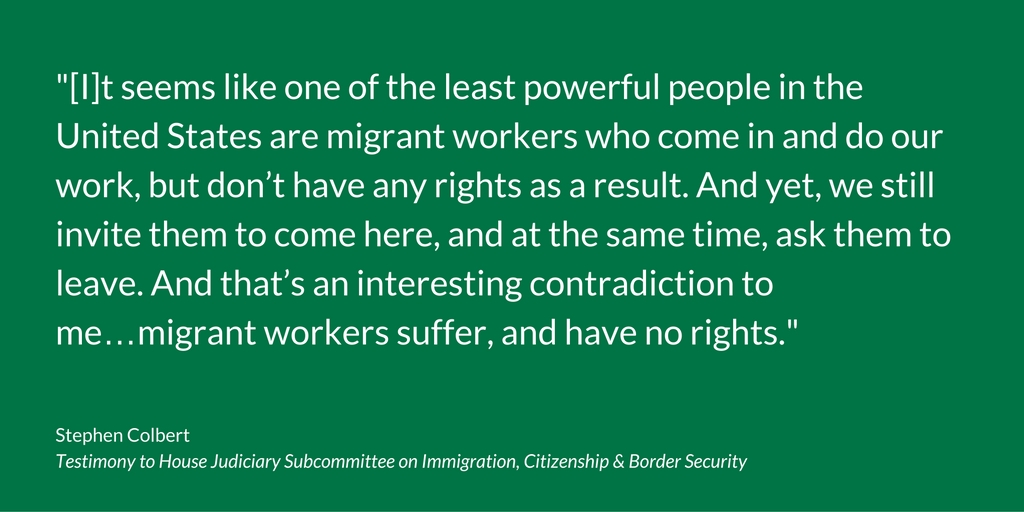
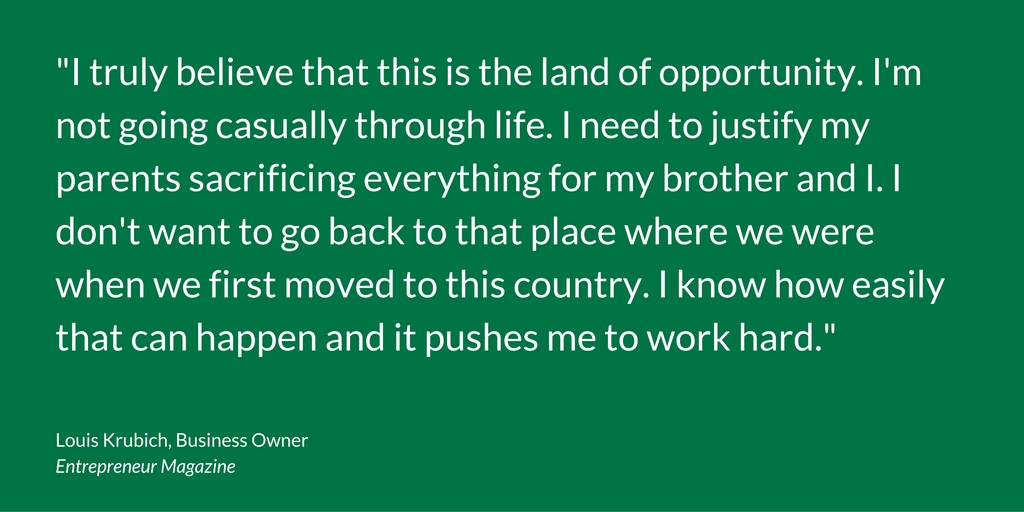
The United States has long been the land of opportunity and that has been particularly true for the world’s brightest business minds. Indeed, studies show that “more than 40 percent of Fortune 500 companies were founded by immigrants or the children of immigrants.” Entrepreneurs may not fit easily in nonimmigrant visa categories, but there may be a better option soon. Last week, US Citizenship & Immigration Services (USCIS) announced a new International Entrepreneur Rule, “which would allow certain international entrepreneurs to be considered for parole (temporary permission to be in the United States)” in order to start or scale a business in the US. The rule has been sent to the Federal Register, and once posted, the public will have forty-five days to submit comments. “America’s economy has long benefited from the contributions of immigrant entrepreneurs, from Main Street to Silicon Valley,” USCIS Director León Rodríguez says in the announcement. “This proposed rule, when finalized, will help our economy grow by expanding immigration options for foreign entrepreneurs who meet certain criteria for creating jobs, attracting investment and generating revenue in the U.S.”
The Department of Homeland Security (DHS), pursuant to Section 212(d)(5) of the Immigration and Nationality Act (INA), 8 U.S.C. 1182(d)(5), has the authority to parole individuals in the United States “on a case-by-case basis, for urgent humanitarian reasons or significant public benefit.” In its new rule, USCIS proposes to “amend its regulations implementing this authority to increase and enhance entrepreneurship, innovation, and job creation in the United States.” The proposed International Entrepreneur Rule would grant parole to entrepreneurs with “startup entities whose stay in the United States would provide a significant public benefit through the substantial and demonstrated potential for rapid business growth and job creation.” The parole would first be granted for a period of two years and a subsequent re-parole may be granted for an additional three years, only if “the entrepreneur and the startup entity continue to provide a significant public benefit as evidenced by substantial increases in capital investment, revenue or job creation.” Eligible entrepreneurs include those:
- Who have a significant ownership interest in the startup (at least fifteen percent) and have an active and central role to its operations;
- Whose startup was formed in the United States within the past three years; and
- Whose startup has substantial and demonstrated potential for rapid business growth and job creation, as evidenced by:
- Receiving significant investment of capital (at least $345,000) from certain qualified US investors with established records of successful investments;
- Receiving significant awards or grants (at least $100,000) from certain federal, state or local government entities; or
- Partially satisfying one or both of the above criteria in addition to other reliable and compelling evidence of the startup entity’s substantial potential for rapid growth and job creation.
While he may be leaving office soon, President Obama has long been an advocate for bringing entrepreneurs around the world to the US. In 2012, he launched Entrepreneur Pathways, a website aimed at assisting immigrant entrepreneurs in their goal of building new businesses in the US. This new International Entrepreneurs Rule would continue President Obama’s mission in bringing the best and brightest to the US and creating new jobs for Americans.
Hi!

Manus X Machina





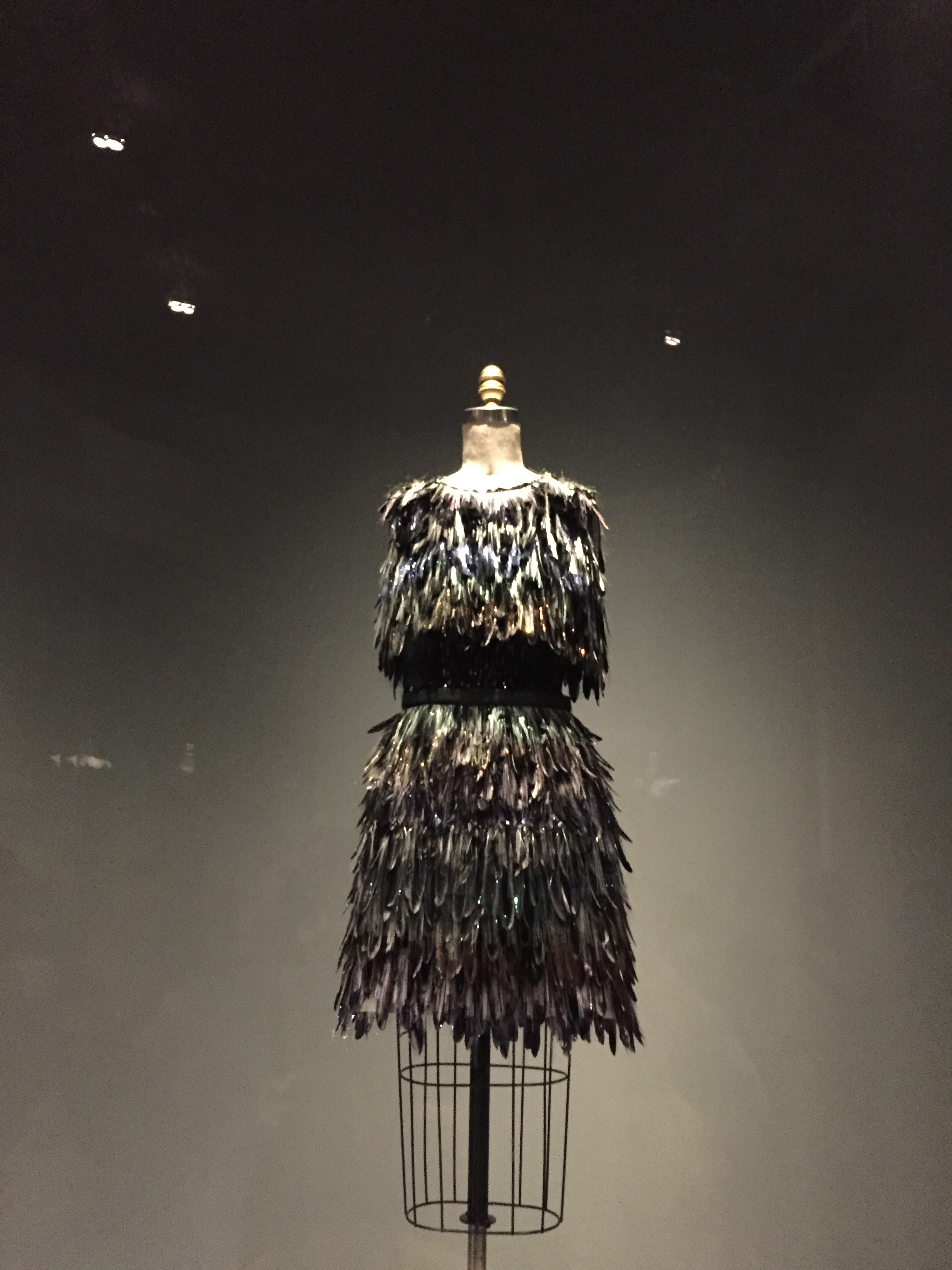



This week Protima and I trekked up to the Metropolitan Museum (rare to find us above 14th Street) to catch “Manus X Machina: Fashion in the Age of Technology.” This stunning exhibit from The Costume Institute explores the marriage between hand-crafted details and machine-made garments. Visitors are immediately greeted by an impeccable wedding dress and train from Karl Lagerfeld for Chanel. (I want it. I need it.) As we explored two floors of breathtaking couture, we looked in awe at the incredible collection (over 170!) of unique ensembles from the likes of Chanel, Dior, Prada, Balenciaga, and many more. If you are in the New York area in the next week, both The New York Times and I would highly recommend stopping by to see this exhibit ahead of its impending closure on September 5, 2016. Try not to run off with any clothing!
Immigrants: Beware of Scams
US Citizenship & Immigration Services (USCIS) this week issued a notice warning immigrants to be aware of scams targeting foreign nationals over the phone and email:
Don’t be one of the victims! Scammers may call or email you, pretending to be a government official. They will say that there is a problem with an application or additional information is required to continue the immigration process. They will then ask for personal and sensitive details, and demand payment to fix any problems.
USCIS notes that their officials and representatives will never ask for payment over the phone or in an email. If they require payment for any reason, USCIS will mail a letter on official stationery specifically requesting payment.
Read moreThe Atlantic: “Will Immigrants Today Assimilate Like Those of 100 Years Ago?”
Immigrants of all races come to the United States in search of the American Dream. But is that so-called American Dream something attainable by any immigrant to the United States? Or does one’s race factor into it? Alexia Fernandez Campbell of The Atlantic delves into the question of assimilation and economic immigrant success. She explores whether it is different now than it was one hundred years ago when “nearly all immigrants arriving to the United States were poor white Europeans,” whereas now the “vast majority of immigrants are people of color from Asia and Latin America.”
While there have certainly been many changes in the United States in the past one hundred years, the wealth gap remains one constant in the American economic landscape. Sociologists from the University of Wyoming and Brown University (Matthew Painter and Zhenchao Qian) studied whether the barriers facing certain races with respect to earned wealth also applied to immigrants in those race categories. What they found, published in the June issue of Sociological Perspectives, was not altogether surprising. Generally speaking, wealth inequality can be traced back to race, with “white families having the largest net worth, followed by Asians, Latinos, and then African Americans.” The research found that the “average net worth for all new immigrants was about $63,000…white immigrants had the highest average net worth ($92,965), followed by Asian immigrants ($83,500), then Latino immigrants ($40,073), and black immigrants ($34,318).”
Painter and Qian also adjusted their data to account for other factors that would affect immigrant wealth, such as the ability to speak English and educational background. With those factors taken into account, Painter and Qian found that “an immigrant’s race is strongly associated with their net worth.” Indeed, it costs Asian, black, and Latino immigrants between “$2,000 and $2,700 in net worth.” While this may seem relatively small, it does indicate that white immigrants “possibly because of their skin color, have an automatic advantage when moving to the United States.” There may be numerous reasons for this economic disparity. Black immigrants, for instance, like many black Americans, may face discrimination in the real-estate market and the ability to obtain favorable mortgage loans, and Latino immigrants may, like Hispanics in general, be less likely to invest in stocks, bonds, and mutual funds. Painter says: “Our results show that white immigrants have made a more successful transition into U.S. society and begin to purchase assets and accumulate wealth.”
The study focused on 8,000 lawful permanent residents who had been living in the United States for less than ten years (and did not account for the nearly eleven million undocumented workers in the US). Painter and Qian note the study did not factor in how much wealth immigrants had when they entered the US and how much wealth they built (or lost) after moving. “Ideally, we would survey them when they arrive at the airport, but that data doesn’t exist,” Painter says in The Atlantic.
While the study by Painter and Qian indicates the difficulties facing many non-white immigrants today, Vivek Wadhwa, a distinguished fellow and professor at Carnegie Mellon University Engineering at Silicon Valley, offers a different point of view. He points out the success of Indian immigrants in particular, noting that the median annual income of US households headed by an Indian immigrant is $103,000—twice the US median. “The greatness of America is that a person who achieves success commands the highest level of respect regardless of his or her background, race, and religion,” he writes. “This is the American Dream: an ethos of freedom that provides anyone who achieves success through hard work with the opportunity for prosperity and equality. There are no absolute barriers to upward social mobility in America; that is why immigrants thrive and why America leads the world.”
Land of Opportunity
Looking Up

Looking Up is hard to miss in its temporary home on 53rd Street and Park Avenue. Beautifully crafted by the artist Tom Friedman, the thirty-three foot tall sculpture “gazes up to the heavens, inviting others to stand at its base and do the same.” The sculpture is made from crushed aluminum foil roasting-pans and still retains the original material's imprint and markings. When I visited the sculpture, I followed its invitation and did look up. What I saw was old windows, towering buildings, people lucky enough to have balconies, and ONE. VERY. HOT. SUN. Looking Up will be on display until September 5, 2016. Hey, New Yorkers…LOOK UP!