
A few years ago, two hungry and adventurous friends decided to do a fun pizza challenge: they were going to visit all five boroughs in one day and eat a slice of pizza in each. And they were going to do it without using any cars, instead traveling only by subway, ferry, bike, and foot. Out of this a tradition was born: the annual 5 Boro Pizza Tour. Now every year participants meet under the arch at Washington Square Park to receive a list of the appointed five pizzerias. Participants must go to each one, in any order, eat a slice and document it on Instagram (with the hashtag #5boropizzachallenge), and race to the finish. In honor of this event taking place tomorrow, Jon skillfully handled and enjoyed a very cheesy slice from local favorite Rocky's.
5 Boro Pizza Tour
An Introduction to E-2 Treaty Investors
Megana, a rising second year law student at Fordham University School of Law, is one of our summer associates. A merit scholarship recipient, she will serve on the Intellectual Property Law Journal this coming year.
While not as well known as an H-1B or O-1, the E-2 Treaty Investor is at times a good option for certain individuals seeking to do business within the United States. The following Q&A will shed some light on the various conditions that must be met in order to qualify as well as general information for this type of visa.
Read moreCNN: "Why we should expand the H-1B visa program"
Rosario Marin, the 41st US treasurer under President George W. Bush and current chair of the American Competitiveness Alliance, a coalition of organizations advocating for immigration reform, is calling for an expansion to the H-1B program. With an H-1B cap that is currently set at 65,000 per fiscal year with an additional 20,000 available to applicants who possess an advanced degree from a US educational institution, this year the government received over 236,000 H-1B petitions (about 3,000 more than last year), which means many presumably qualified applicants are forced to return to their home country or find other ways to remain in the US.
Describing herself as a proud and lifelong Republican, Marin says she is going against her party’s platform and calling for a “strong, sensible immigration reform” that includes expanding the number of H-1Bs issued per year. She says:
There is overwhelming demand from American companies—both large and small—for educated, skilled foreign workers to fill jobs in computer programming, coding, medicine and information technology. These are jobs that would be left largely unfilled if not for international workers, as our domestic workforce doesn't consist of graduates with these skills in the enormous numbers we require. This is why it will be critical for Congress and the next president to push for immigration reform that expands the H-1B program.
A naturalized US citizen herself, she argues that H-1Bs and immigrants are essential to the American economic system. “Without them, companies struggle to locate the specific people with the specific computer and science skills they need to grow, translating into an inability to expand, to create jobs, to scale up,” she writes. “The United States must work to address our shortage of students graduating with advanced science, math and technology skills, but until it does, American companies need high-skilled international workers, not only to compete, but to survive.”
Opponents of the H-1B claim American companies often use the H-1B program to replace higher paid American workers and “lease” out lower-paid foreign national H-1B workers through third-party companies. Another study reveals that the truth about STEM fields is more complicated. The Monthly Labor Review of the Bureau of Labor Statistics states there are both shortages and surpluses of STEM workers, depending on the particular job market segments and geographic location. The study shows that while there is no shortage in the academic job market, in the private sector, positions such as software developers, petroleum engineers, data scientists, and those in skilled trades are in high demand.
In her opinion piece, Marin concludes: “Our power and influence is owed largely to having been the country that gave the world automobiles, personal computers, countless other inventions. And people—well-educated, highly skilled people, many of them immigrants—were behind each and every one.”
What's In a Name?
Happy Birthday, Emma!
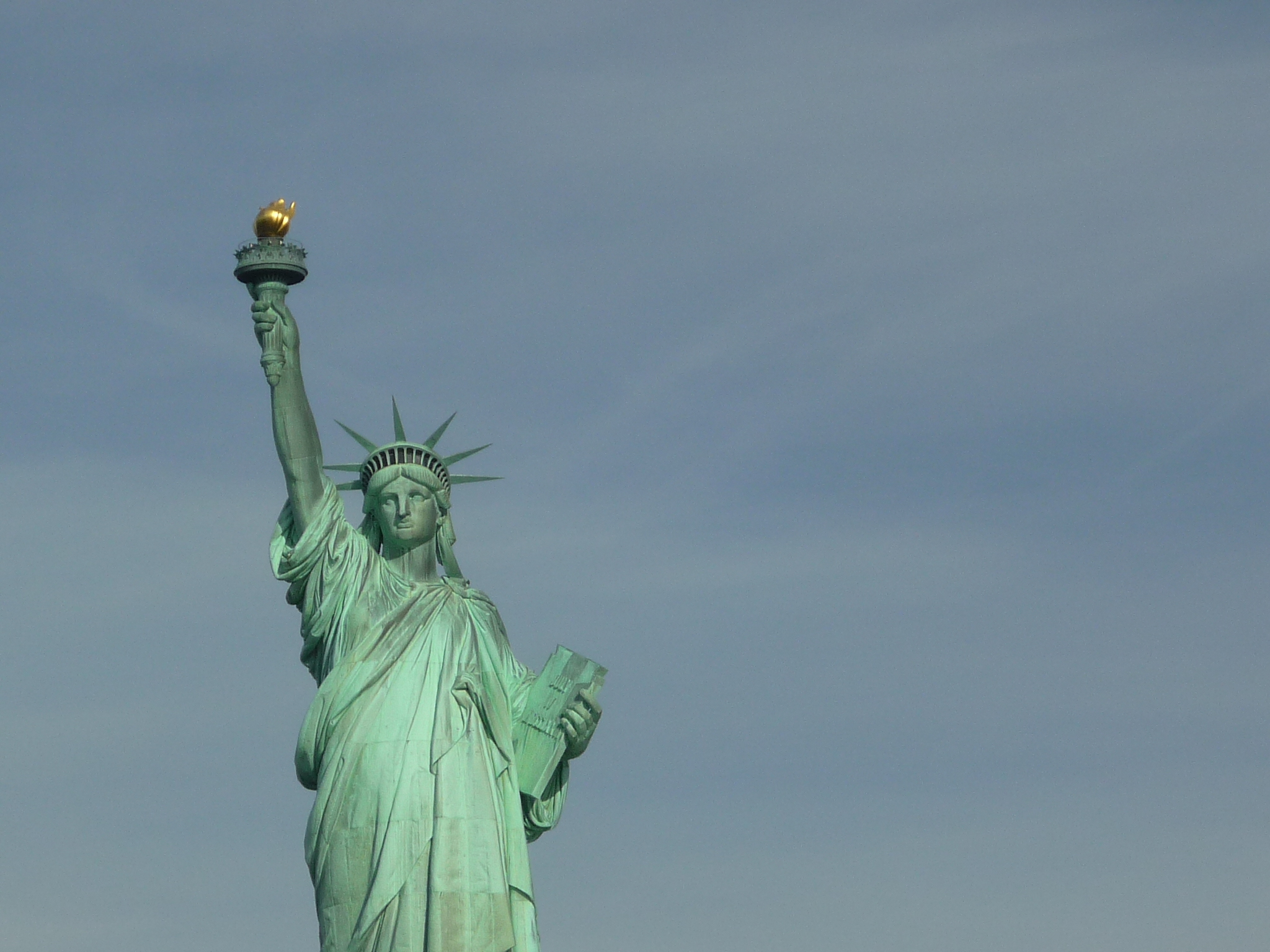
“'Give me your tired, your poor, / Your huddled masses yearning to breathe free, / The wretched refuse of your teeming shore. / Send these, the homeless, tempest-tost to me, / I lift my lamp beside the golden door!'” —Emma Lazarus
On this day in 1849 Emma Lazarus was born into a wealthy New York family descended from Sephardic Jewish Americans. With a clear talent for poetry, she attracted the notice of Ralph Waldo Emerson. Emma Lazarus’s famous poem was originally commissioned for a fund-raising campaign by artists and writers to pay for the statue’s pedestal. Only after her death did it become synonymous with the Statute of Liberty and transformed the statue into the “Mother of Exiles," welcoming new generations of immigrants from all over the world. In 1903, after determined lobbying by a friend of Lazarus who was descended from Alexander Hamilton, himself a famous immigrant, the poem was affixed to the pedestal.
My Immigration Story

Megana, a rising second year law student at Fordham University School of Law, is one of our summer associates. A merit scholarship recipient, she will serve on the Intellectual Property Law Journal this coming year, and was kind enough to share her immigration story.
Throughout my life, I’ve never really considered myself as anything but wholly American, despite my multicultural background. This is due largely to the widely different ethnic backgrounds of my parents and their families. My father is a third-generation Brooklyn Italian, while my mother is an Indian immigrant who eventually wound up in New York City. Though this background has led to some unique experiences (constantly confusing “marsala” with “masala”, for example, or the yummy treat that is naan pizza), overall I have a hard time thinking of myself as either Indian or Italian.
Read moreAssociated Press: “US colleges court foreign entrepreneurs who need visas”
Summer can be a difficult time for H-1B applicants. For those lucky ones who were selected in the lottery, they are nevertheless nervously awaiting the results of their H-1B petition. Those who weren’t selected in the H-1B lottery are most likely busy scrambling to come up with alternatives to possibly allow them to work in the US. As Liz has pointed out, it is frustrating for both foreign nationals and immigration practitioners since the H-1B is the perfect fit for so many people, and the only thing stopping them is that they were not selected in the random lottery.
But there is finally some positive news for certain rejected H-1B applicants. Certain universities in the US are now stepping up to provide solutions to the unreliability of the H-1B lottery process. Since employees of universities—or workers who provide services to universities—are exempt from the H-1B cap and thus can apply for an H-1B at any time and are not subject to the random lottery, schools are creating “global entrepreneur in residence" programs to allow entrepreneurial foreign nationals who qualify for an H-1B to work part-time on campus, often as mentors, while they develop their businesses.
"This movement came about because of challenges that student visa holders were beginning to face when they had completed a program," Bill Stock, a Philadelphia attorney and the current president of the American Immigration Lawyers Association (AILA), tells the AP. "There really aren't a lot of other visas that would allow someone to work temporarily."
One such school to offer this program is University of Massachusetts. Created as part of a 2014 Jobs Bill, the program, called the “Global Entrepreneur in Residence Pilot Program,” aims to “attract and retain more qualified entrepreneurs and their growing companies within Massachusetts” by providing “valuable, relevant part-time work opportunities which will initiate a cap-exempt H-1B visa application process.” The end goal for this program is to encourage and allow new high skill jobs to develop in Massachusetts. To be eligible, candidates must be a start-up entrepreneur in a leadership position (CEO, co-founder, or similar position) within an early-stage venture, have a master’s degree or above in a STEM or related business field, and the candidate’s start-up venture must be headquartered in Massachusetts and able to affiliate with a venture center within UMass Boston or UMass Lowell. Since it started in 2014, the AP reports that the UMass program has helped twenty graduates obtain H-1B visas, and their businesses have created 260 jobs, according to the school.
Critics accuse the universities of exploiting a legal loophole in filing these H-1B petitions, since Congress created the exemption partly to help colleges hire researchers. The AP reports that in a February letter to US Citizenship & Immigration Services (USCIS), Senator Chuck Grassley of Iowa called the practice a "backhanded attempt" to skirt federal rules and a "seemingly unlawful" interpretation of the law.
College officials say they are operating within the law and they’re only addressing the problems created by the H-1B lottery system. As more international students come to US schools—and more schools recruit international students—many of these students who want to stay in the country are instead forced to leave the US due to limited H-1Bs. "Massachusetts says goodbye to over 1,000 graduate students who otherwise want to stay and start a company," William Brah, who leads the global entrepreneur program at the UMass Boston campus, tells the AP. "I mean, it's stupid. You couldn't come up with a more flawed immigration system if you tried."
Along with UMass, smaller entrepreneur programs have recently formed at the University of Colorado-Boulder, the University of Alaska-Anchorage, and Alaska Pacific University, which accept a combined six graduates per year. Babson College is now taking applications for up to ten entrepreneurs, and the City University of New York is looking for eighty business owners from around the world for their program. "We wanted to try to find some way that would make it possible for an entrepreneur to come to the country, without us having to pay them to do it," Andy Holtz, chief of the program, tells the AP.
At Babson, master’s graduate and entrepreneur Abhinav Sureka and his company's two co-founders—both international students—are considering applying for the college's new program. They've raised $73,000 for their company, and are working on plans to produce a high-tech portable tea brewer. "What if we don't get a visa?" Sureka tells the AP. "We can't continue work in the US, and the amount of time we have spent on this project is all wasted."
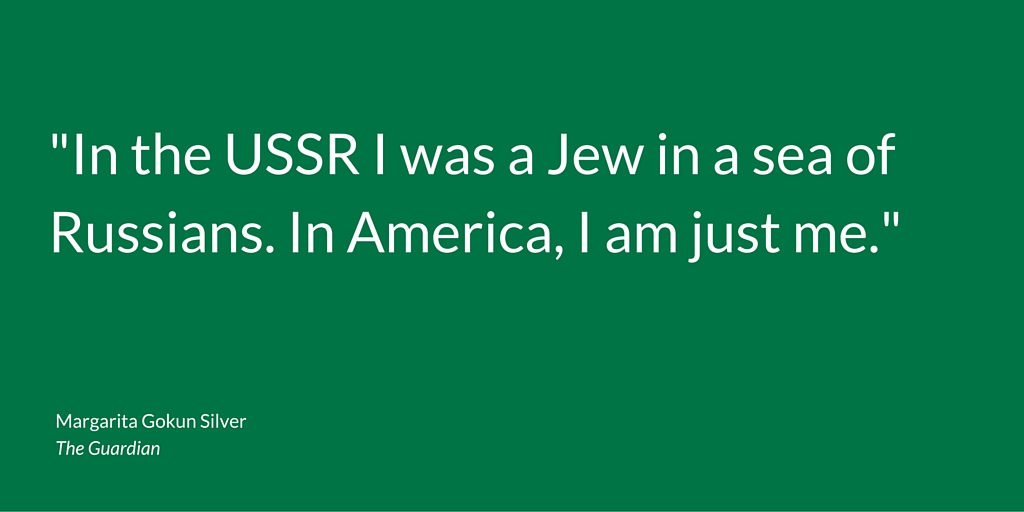
Just Me
Morphous
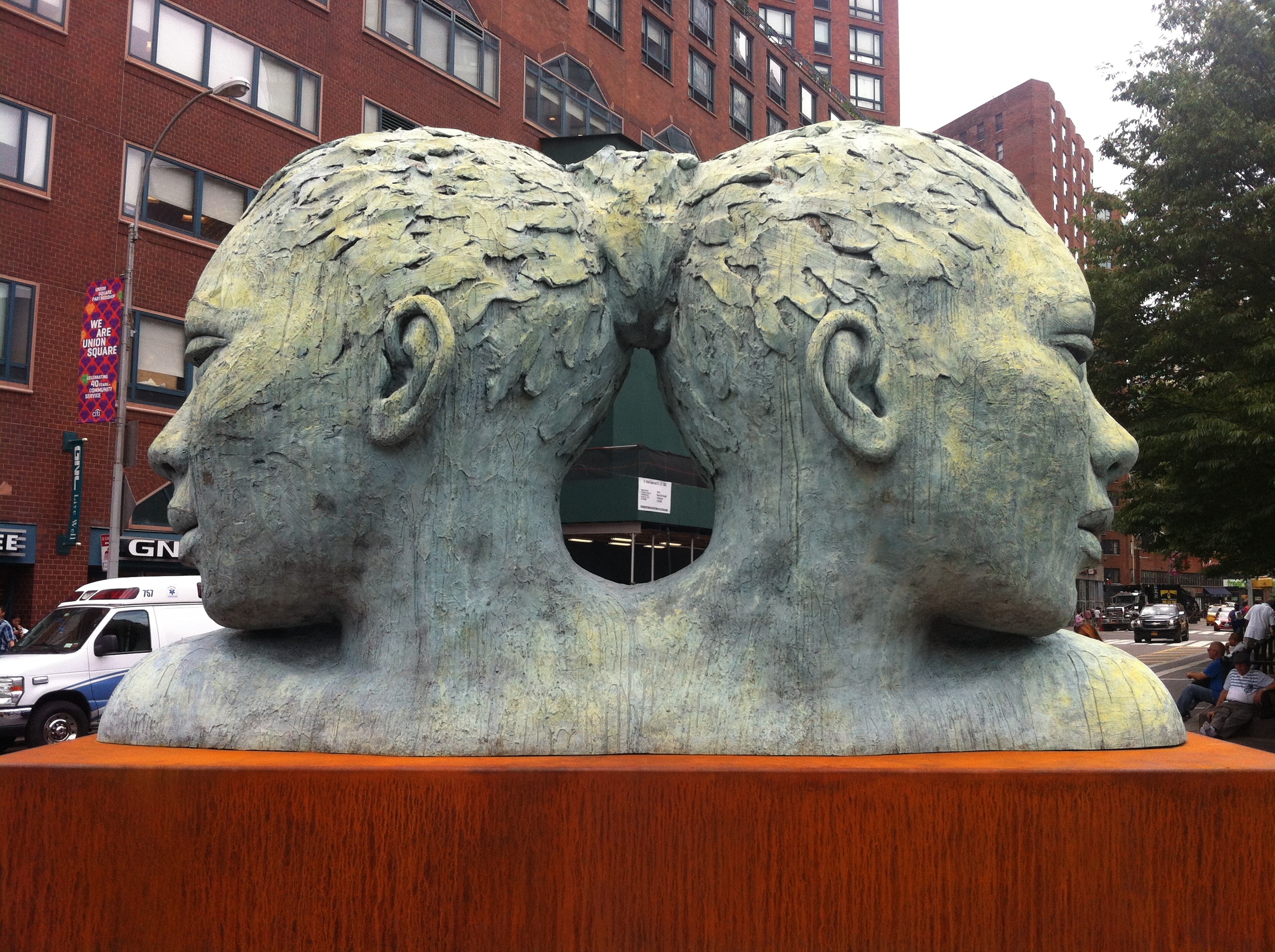
Morphous, a bronze sculpture in Union Square Park by South African artist Lionel Smit, features the conjoined heads of two outward-gazing young women. The sculpture, on display through April 2017, "evokes the question of time, of past and future" and is "a societal commentary without judgment." The work explores hybrid identity and the ever-changing nature of South African's social landscape, both in the future and the past. The faces have a great deal of expression and emotion, and I recommend anyone passing through the Union Square area to take a look at this impressive work, which is the artist's first public installation in the United States.