
Just kidding! Seriously, no need to fear. It's been a busy few weeks but we've sent off all the H-1B petitions yesterday to be received by US Citizenship & Immigration Services (USCIS) for the April 1 opening filing date. And yes, our mood is "Fabulous."
Welcome to the New Ellis Island
“Through the blue door, please.”
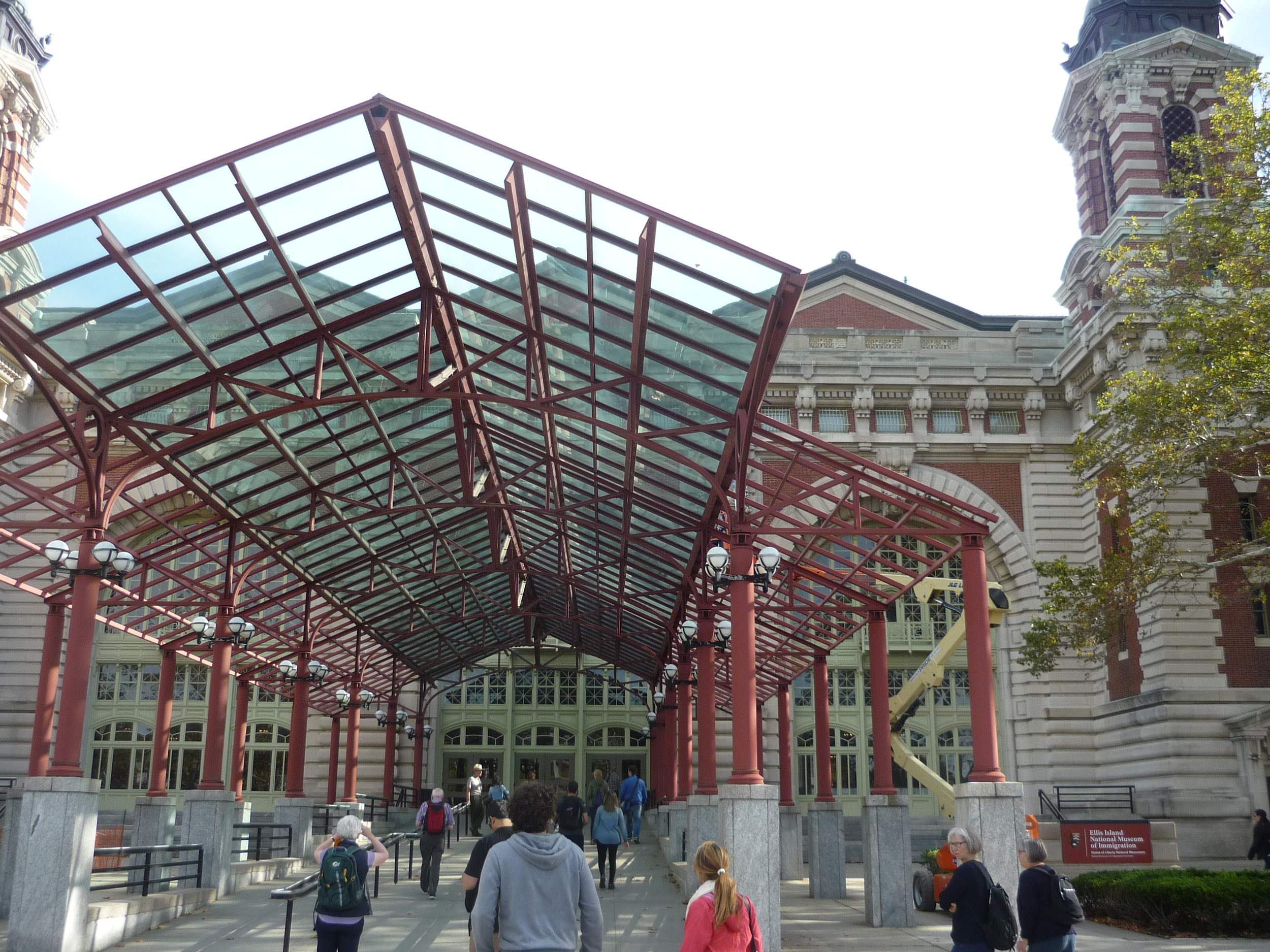
This line from the movie Brooklyn, which incidentally we highly recommend, is said by an American immigration official at Ellis Island to Eilis Lacey (played wonderfully by Saoirse Ronan) after her long and uncomfortable boat trip to America. After Eilis is processed at immigration, and as she makes her way to the blue doors, we see behind those doors a bright and heavenly light shining down, signifying hope and new opportunities in America.
Ellis Island, where those blue doors welcomed immigrants for many years, is one of the most famous American immigration landmarks. This tiny island off the southeast tip of Manhattan served as the nation’s first federal immigration processing center from 1892 to 1954, and millions of Americans (including me) can trace their heritage to ancestors who first arrived here. The National Park Service recently opened the newly-renovated and expanded Ellis Island Museum after extensive damage by Hurricane Sandy, and I decided to check it out.
Read moreFeature Shoot: “A Former Janitor Collects and Photographs the Items Seized from Immigrants and Thrown Away By U.S. Customs and Border Patrol”
While the surge in Central Americans crossing the US/Mexico border has led to increased attention to undocumented immigrants making this harrowing and dangerous journey, it can still be difficult to imagine the human side to these stories. Photographer Thomas Kiefer, however, who worked part-time as a janitor with US Customs and Border Patrol (CBP) in Ajo, Arizona, about forty miles from the US/Mexico border, has given us a way to visualize the plight of these migrants in his photo series titled El Sueno Americano. In his series, translated as The American Dream, Kiefer has photographed personal items and objects that CBP had taken away from undocumented immigrants when they were detained. Kiefer explains the idea behind his project:
Working as a janitor from July 2003 until August 2014 I was greatly disturbed by the volume of food, clothing and personal belongings thrown away at a single U.S. Customs and Border Patrol facility. For many of those years, I was allowed to collect and take the food transported by migrants, that was discarded during the first stages of processing, to our community food bank, an estimated sixty tons by the person who managed it. The personal effects and belongings were another matter: Why would someone throw away a rosary or bible? Why would someone throw away a wallet? Why would a pair of shoes, for all intents and purpose “brand new”, be tossed in the trash? The ideals upon which this country was founded seem to be under attack as never before, two hundred and thirty nine years since we declared ourselves a nation. “The beacon of hope”, fairness, democracy, equality, faith and grace seems more and more like a sales gimmick, limited to certain groups of people.
His photos include everything from belts, shoelaces, and gloves to calling-cards, birth control pills, and rosaries. It’s unsettling to see the volume of personal items slated for the trash and also impossible not to wonder about the lives attached to these items. Thomas Kiefer is represented by The Story INSTITUTE, where the full series of El Sueno Americano has been published.
Outside Looking In

Time for the H-1B Rally Cap
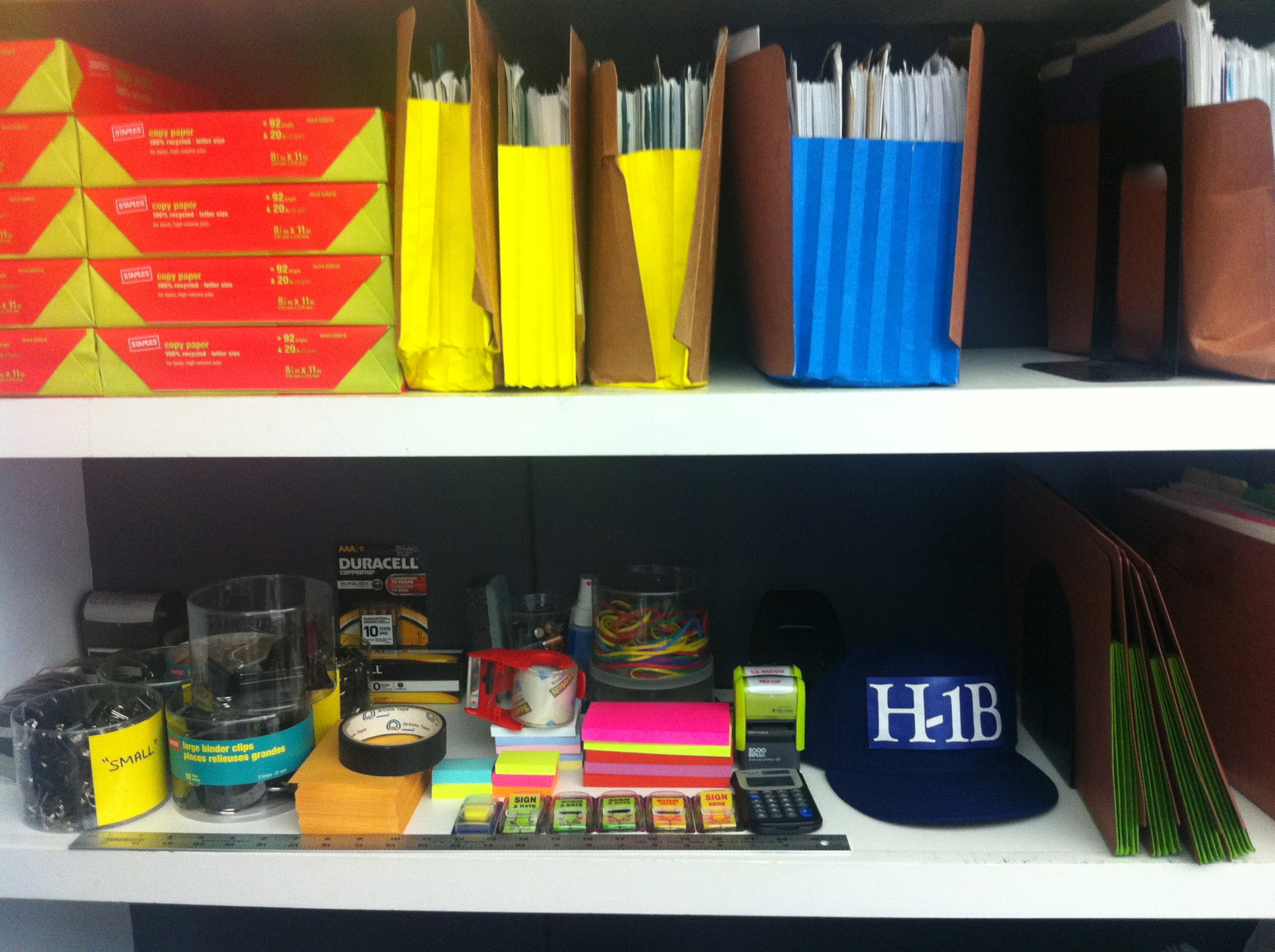
It's that time of year again. We've been hard at work preparing H-1B cap petitions, and like any good immigration practitioner, we have all the necessary office supplies to send the case off to US Citizenship & Immigration Services (USCIS). But unlike pretty much any other immigration practitioner (yes, it's unique to our firm—we know, hard to believe) we have a secret weapon: the H-1B rally cap. And it's coming off the shelf again soon. This cap is known to inspire and motivate like nothing else. Pretty soon we'll hear the familiar refrain around the office: "Get me the H-1B rally cap! I need it. We're almost done. Get me the H-1B rally cap!" Happy cap season, everyone, and good luck!
My Immigration Story
I’m an American Jew, the kind that bleeds first for the Constitution, the Knicks, rock ‘n’ roll, and Levi’s blue jeans, and second, for “the old country” as my father used to call it. I was born in Washington, D.C. and grew up in Northern Virginia and suburban Maryland, but I’ve always felt the breath of my ancestry on my neck. My immigration experience is second-hand, one borrowed from my parents and their parents before them and so on and so forth. From Exodus to exile to Ellis Island—that is my family’s Jewish experience.
Read moreWall Street Journal: “Study: Immigrants Founded 51% of U.S. Billion-Dollar Startups”
A new non-partisan study on entrepreneurship shows that immigrants started more than half of current US-based startups valued at $1 billion or more, lending credibility to the claim that immigration benefits the US economy. The study, from the National Foundation for American Policy, a non-partisan think tank based in Virginia, shows that immigrants play a “key role in creating new, fast-growing companies.” Immigrants, the study shows, have started more than half (forty-four of eighty-seven) of America’s startup companies valued at $1 billion dollars or more; moreover, immigrants are key members of management or product development teams in over seventy percent of these companies. Using public data and information from the companies, the study found that among the billion dollar startup companies, immigrant founders have created an average of approximately 760 jobs per company in the US, and the collective value of the forty-four immigrant-founded companies is $168 billion, close to half the value of the stock markets of Russia or Mexico.
India was the leading country of origin for the immigrant founders of billion dollar companies with fourteen, followed by Canada and the United Kingdom with eight each, Israel with seven, Germany with four, China with three, France with two, Ireland with two, and twelve other countries with one. The three highest valued US companies with immigrant founders include car-hailing service Uber Technologies, data-software company Palantir Technologies, and rocket maker Space Exploration Technologies.
Stuart Anderson, the author of the study and the foundation’s executive director, says the findings show that the US economy could benefit even more from foreign-born entrepreneurs if it were easier for them to obtain visas, since currently it can be difficult for foreign-born entrepreneurs to grow their companies because of the many difficulties and delays in obtaining work visas and Green Cards. The study argues that a “startup visa” to enable foreign nationals who start companies and create jobs would be an important addition to the US immigration system. “Who is going to invest in a company if the founder of the company may not be able to stay in the U.S.?” Anderson said in the Wall Street Journal. Many start-ups also face problems hiring new personnel because of the low quota of H-1B temporary visas, which have been decided by random lottery in recent years and is thus not a reliable category for skilled workers.
Additionally, the study argues that new immigration restrictions would likely prevent many future cutting-edge companies from being established in the United States:
Based on an examination of the biographies of company founders, if S. 2394, a bill by Senators Ted Cruz (R-TX) and Jeff Sessions (R-AL), had been in effect over the past decade, few if any of the billion dollar startup companies with an immigrant founder would have been started in the United States. That measure would impose a variety of hurdles before any foreign national could be employed by a U.S. company on an H-1B visa (typically the only practical way for a high-skilled foreign national to work in America), including, in most cases, working at least 10 years abroad before obtaining a visa in America.
While tech leaders including Mark Zuckerberg and Bill Gates have called for increasing the number of H-1B visas for skilled foreign workers, critics argue that many industries that want more H-1B visas are simply looking for cheaper foreign labor. Mother Jones examined companies who allegedly used the H-1B program to ultimately outsource jobs from US workers, and a recent lawsuit charged that Disney colluded to replace US workers with H-1B foreign workers. The EB-JOBS Act of 2015, introduced last July as one solution for entrepreneurs, proposed to provide a two-year Green Card that would be revoked if certain financial and job-creation requirements are not met, has not proceeded because of the standstill in immigration reform.
Enormous Power
Happy St. Patrick's Day!

Matt, who is so Irish that he speaks Irish and has an Irish passport (yep, pretty Irish), is super excited about St. Patrick's Day. So excited that on his recent trip to Iceland, he did a little St. Patrick's Day dance in the snow. Happy St. Patrick's Day, everyone (one day late)!
Immigrants in the Arts: Australian Playwright and Director Bryan Davidson Blue
One of our firm’s main practice areas is the O-1B nonimmigrant visa and EB-1 immigrant petition based on evidence of the beneficiary’s extraordinary ability in the arts. Many of our clients are international artists from all over the globe, seeking a means to expand their work into the United States, and specifically to move to and work in (either temporarily or permanently) one of the world’s great cultural capitals: New York City. One of the best ways to prepare for such a big move, in addition to speaking extensively to a qualified and experienced immigration attorney, is to read the accounts of those who have already gone through the process.
Read more