
In a heroic act that typifies Lizzie B as a person, she thoughtfully held up the candle to avoid spreading her bad chest cold to everyone when she blew it out. That's just the kind of person she is. She then retreated to her office with a bottle of wine. It's okay, she was done with work for the day.
All About Dependents
Dependents come in all shapes and sizes including spouses, children, and step-children but the word itself, “dependent"—what a label! So many negative connotations! Add the word “alien” and a spouse arriving in the US with their husband or wife may feel rightfully disheartened. Of course, calling a young child who is completely reliant on their parent a dependent makes more sense, yet treating both the same under immigration law does not make the most sense. Nonetheless, in this post we’ll examine key issues relating to both spouse and child dependents.
Read moreDHS Enhances Opportunities for H-1B1, E-3, CW-1 Nonimmigrants, and Certain EB-1 Immigrants
The Department of Homeland Security (DHS) is revising its regulations affecting highly skilled workers in specialty occupations from Chile and Singapore (H-1B1), Australia (E-3), nonimmigrant workers in the Commonwealth of the Northern Mariana Islands (CNMI)-Only Transitional Worker (CW-1) classification, as well as immigrants in the employment-based first preference (EB-1) category for outstanding professors and researchers. Effective February 16, 2016, the amendments will benefit these H-1B1, E-3, and CW-1 nonimmigrant workers as well as EB-1 professors and researchers by “removing unnecessary hurdles that place such workers at a disadvantage when compared to similarly situated workers in other visa classifications.”
Specifically, the amended regulations will:
- Include H-1B1 and principal E-3 classifications in the list of classes of foreign nationals authorized for employment incident to status with a specific employer (as is the case with L-1, O-1, and H-1B classifications, for example), and clarify that H-1B1 and principal E-3 nonimmigrants are permitted to work without having to separately apply to DHS for employment authorization, codifying the standard practice;
- Authorize H-1B1, principal E-3 nonimmigrants, and CW-1 nonimmigrants for continued employment for up to 240 days with the same employer if the employer has timely filed for an extension of stay with US Citizenship & Immigration Services (USCIS), a move that will greatly benefit nonimmigrant workers in the US under those statuses;
- Update filing procedure regulations for extensions of stay and change of status requests to include the principal E-3 and H-1B1 nonimmigrant classifications to harmonize with current published UCSIS instructions; and
- Expand the current list of acceptable initial evidence for EB-1 outstanding professors and researchers to allow petitioners to submit “comparable” evidence, such as important patents or prestigious peer-reviewed funding grants, to prove that the researcher or professor is recognized internationally as outstanding in their academic field.
With these changes, DHS intends to “harmonize the regulations governing these classifications” to address discrepancies, all with the end goal of ensuring productivity and efficiency for employers as well as providing benefits to foreign national employees, such as preventing lost wages. Additionally, DHS hopes that expanding the range of evidence that employers may provide for EB-1 outstanding professors and researchers may result in more effective and wide-ranging recruitment. The final rule change, which was not substantially revised since being submitted to the public for comment, does not impose any additional costs on employers, workers, or any governmental agencies. The majority of public comments supported the rule change, and the published rule reviews them in detail, for those curious.
In the end, DHS states: “Attracting and retaining highly skilled workers is critical to sustaining our Nation's global competitiveness. By attracting the best and brightest from around the world, the United States can harness their talents, skills, and ideas to help the U.S. economy grow.”
Free

Supertrees

I am on my way to Australia to see Roger, and I made a short stop in Singapore, where I visited the incredible Gardens by the Bay, a high-tech "horticultural mega project" featuring 160-feet-high solar-powered supertrees and climate-controlled biomes. The three waterfront gardens are built on reclaimed land, and the Bay South Garden alone is said to have cost more than $720 million. The highlight of the gardens, at least for me, are the so-called supertrees, which are essentially vertical gardens with bromeliads, ferns, and tropical flowering climbers. Two of the trees are connected via a cool aerial walkway, and some trees have photovoltaic cells on their canopies which light up at night, while others act as air exhaust receptacles. The supertrees are meant to "mimic the ecological functions of real trees through their environmentally sustainable features."
The Nonimmigrant Visa Interview - What to Expect
One of the fastest changing areas of immigration law has been the consular nonimmigrant visa application process. What used to be a one-page application and a fairly routine mail-in process has now become an eight-page online form and a fairly rigorous interview process. Where consular officers used to engage with lawyers about their clients’ visa applications, consular officers are now shielded by layer upon layer of administration. Where consular officers used to review papers presented at the interview as part of their adjudication, they now rely more and more on individual applicants articulating the merits of their cases. Certainly some of the new measures are justified but what it means for individual visa applicants is that they will need to carefully prepare their DS-160 visa application form and be prepared for their interview. We have already addressed some of the idiosyncrasies of the DS-160 form, so in this post we hope to provide some simple tips and guidelines for the interview.
Read moreUSCIS Proposes Rule to Improve Employment-Based Nonimmigrant and Immigrant Visa Programs
The Department of Homeland Security (DHS) and US Citizenship & Immigration Services (USCIS) are now seeking public comments on a proposed rule to “modernize and improve certain aspects of employment-based nonimmigrant and immigrant visa programs.” Coming out of President Obama’s 2014 executive actions, these changes could potentially affect a large number of skilled immigrant workers as well as many applying for an employment authorization document (EAD). Specifically, the new rule also proposes to “better enable US employers to hire and retain certain foreign workers who are beneficiaries of approved employment-based immigrant visa petitions and are waiting to become lawful permanent residents (LPRs).”
The rule, published in the Federal Register as Retention of EB-1, EB-2 and EB-3 Immigrant Workers and Program Improvements Affecting High-Skilled Nonimmigrant Workers, proposes many key changes that could have a significant impact on the careers and lives of certain foreign nationals. Among the highlights, USCIS proposes to:
- Discontinue the ninety-day adjudication time limit for the employment authorization document (EAD) application process and instead provide for automatic extensions of timely-filed I-765 applications assuming certain conditions are met;
- Allow a ten-day grace period now available to H-1B workers at the beginning and end of the authorized stay to other non-immigrant categories including E-1, E-2, E-3, L-1, and TN classifications;
- Establish a “one-time” grace period (no working allowed) for up to sixty days for certain highly-skilled nonimmigrant workers under E-1, E-2, E-3, H-1B, H-1B1, L-1, or TN status whenever their employment ends to pursue new employment;
- Allow US employers to employ and retain foreign workers who are beneficiaries of approved employment-based immigrant visa petitions (i.e., I-140 petitions) by allowing these workers to accept promotions, make position changes with current employers, switch employers, and pursue other employment opportunities;
- Improve job portability for certain beneficiaries of approved I-140 petitions by limiting the grounds for automatic revocation of petition approval;
- Explain when applicants may retain their priority date to use when applying for adjustment of status (AOS) to lawful permanent residence, including when USCIS has revoked the I-140 approval because of the employer's business termination or I-140 withdrawal;
- Allow certain highly-skilled individuals in the United States in E-3, H-1B, H-1B1, L-1, or O-1 status to apply for one year of unrestricted employment authorization if they are the beneficiaries of an approved I-140 petition, are unable to adjust status due to visa unavailability, and can provide evidence that compelling circumstances exists which justify issuing an employment authorization document.
These proposed changes wouldn’t take effect until after the comments period ends February 29, 2016, and until after the final rule is published. Individuals should follow the instructions in the notice to submit comments.
Modern Migration
Dana and the Cupcakes
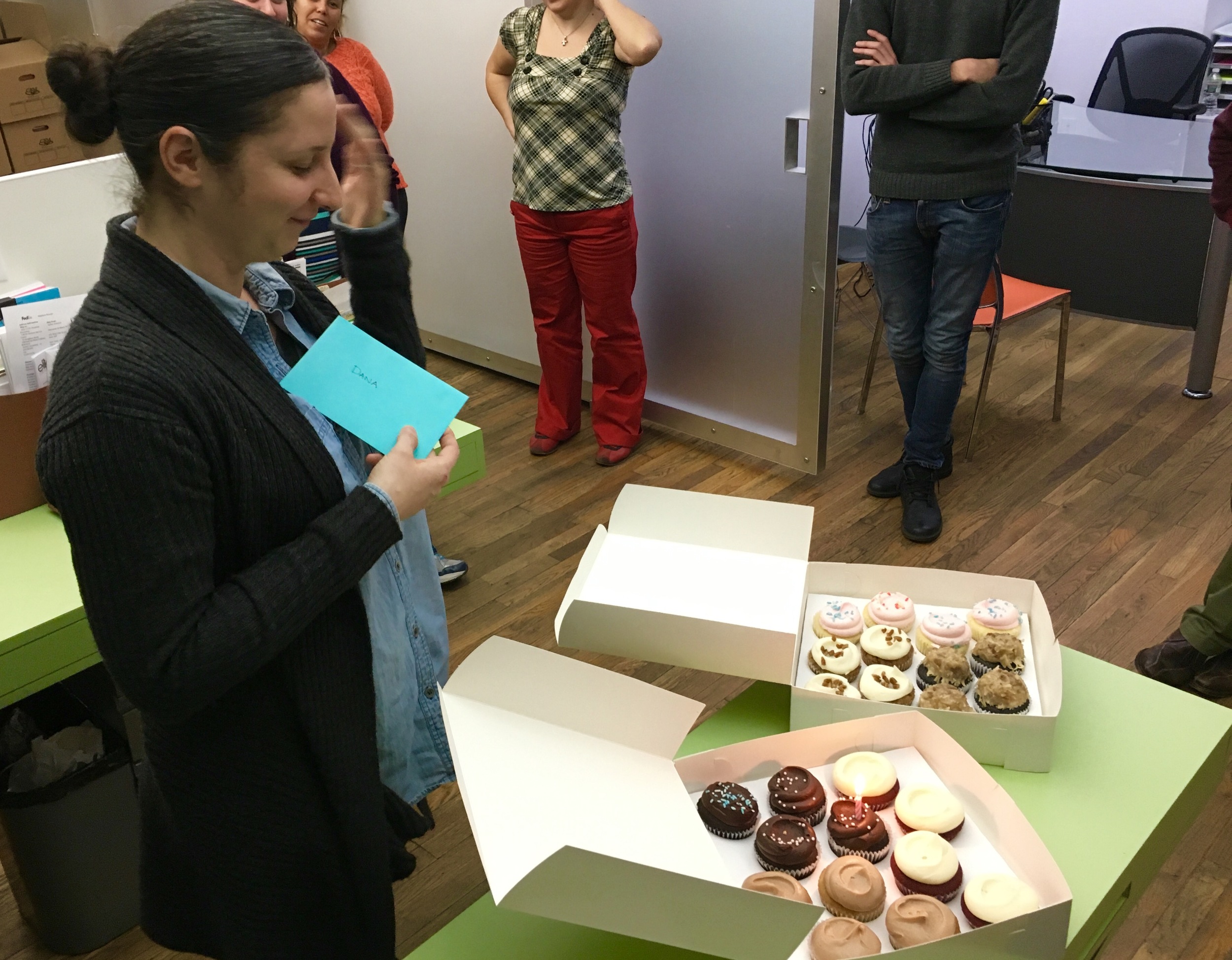
While we have quite a few January birthdays, we haven't yet had a Friday Photo featuring our superbly talented and energetic office manager, Dana, and so on the occasion of her birthday this week, we thought it would be appropriate to honor her. She was, of course, super excited about these cupcakes and had a hard time deciding which she wanted. It's okay, Dana, you can have more than one!
Behind the News Story: Business Insider: "Instagram Almost Lost One of its Cofounders Because He Couldn't Get a Work Visa"
Instagram is one of the world’s most popular social media networks, known for its easy-to-use interface for sharing photographs. Indeed, in December 2014, the company was valued at $35 billion, according to Citigroup analysts. Back in April 2015, Business Insider published an article claiming that the company “almost lost one of its cofounders because he couldn’t get a work visa.” A native of Brazil, Mike Krieger is a co-founder and the chief technology officer at Instagram. According to the article, Mr. Krieger had difficulty transferring his H-1B visa from his previous employer, Meebo, to Instagram in 2010. The process is said to have taken Mr. Krieger over three months—longer than it took to develop the first version of Instagram! Mr. Krieger said he almost was not able to work at Instagram because of the delay, and the article goes onto conflate Mr. Krieger’s visa delay with the annual H-1B cap and lottery.
Read more