
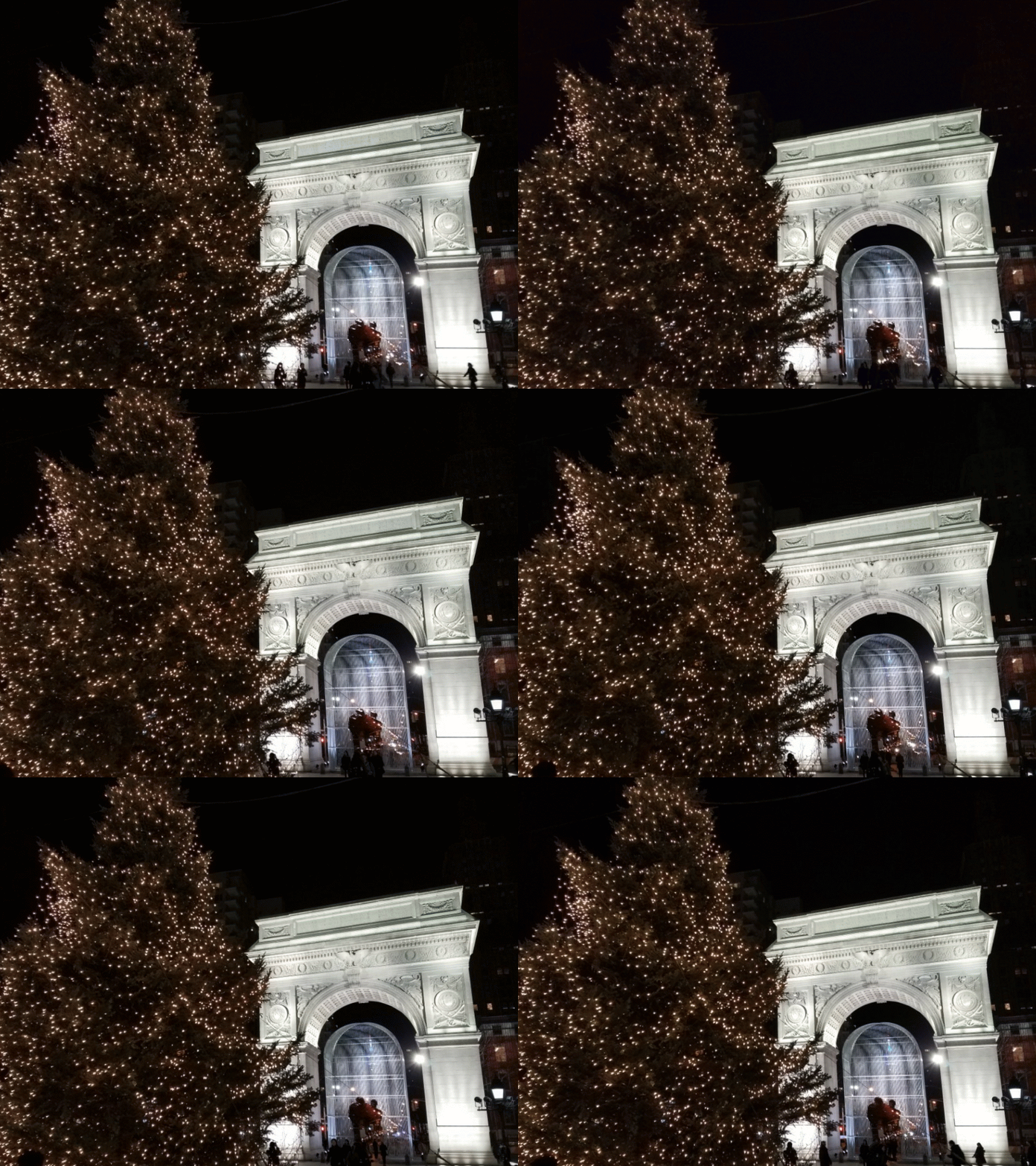
While the holiday tree at Rockefeller Center seems to get all the attention, the tree at Washington Square Park has some serious holiday spirit as well. The forty-five foot Vermont tree stands south of the arch and is lit up beautifully between the hours of 4pm and 1am. The Washington Square Association, founded in 1906, is one of the city’s oldest community organizations, and invites those with sufficient holiday cheer to sing yuletide carols this Christmas Eve at 5pm. For ninety-three years, this association has sponsored carol singing under the arch, and carolers this year will be joined by the Rob Susman Brass Quartet. The association will helpfully distribute a songbook to the singers but, as they point out, "many will know them by heart."
Evening Standard: “A first look inside the new £750m US embassy on banks of Thames”

After more than fifty years in the iconic London Chancery Building in Grosvenor Square, the US Embassy in London is moving to the south bank of the River Thames. The new cube-shaped Embassy, the most expensive in the world at $1 billion USD, has taken four years to complete and features a state-of-the-art architectural design, modern security measures, and environmentally friendly features. Last week, Robert “Woody” Johnson, the US ambassador to the UK (and owner of the New York Jets football team), invited the media to tour the 518,000-square foot, twelve story building at 33 Nine Elms Lane. Ambassador Johnson explained to the media that the newly built US Embassy “is a signal to the world that this special relationship [with the UK] that we have is stronger and is going to grow and get better.”
Read moreA Great Discovery

DLG Holiday Party 2017

This year instead of our usual cooking event at the Institute of Culinary Education (ICE), we held an in-office potluck. We each brought a favorite holiday food or a food celebrating our heritage. Food included kugel with cornflakes from Liz, Scandinavian cardamom bread with candy cane icing (yum!) from Alexis, salpicão (Brazilian chicken salad) and pão de queijo (cheesy bread) from Daniele, sufganiyot (filled doughnuts) and matzo ball soup from Michal, lentils from Matt, Hungarian potato salad and coconut/date cookies from Carolyn, deviled eggs from Olivia, pasta salad from Ashley, miniature Italian pastries from Dana, cookies and cream cake from Briana, cinnamon rolls from Joseph, rosemary potatoes from Alla, brownies from Gaby, and Pio Pio along with the addictive green sauce from Protima. After eating (and drinking), we played several spirited rounds of "Immigration Taboo" (which we created) and then took our own "Immigration, Citizenship, & Geography Quiz." Yes, we do know how to have fun.
The New York Times: “Trump Recognizes Jerusalem as Israel’s Capital and Orders U.S. Embassy to Move”
President Trump reversed seven decades of American foreign policy last week when he formally declared Jerusalem as the capital of Israel and announced that the US Embassy will move from Tel Aviv to Jerusalem. In making the announcement, President Trump said: “Today we finally acknowledge the obvious: that Jerusalem is Israel’s capital. This is nothing more or less than a recognition of reality. It is also the right thing to do. It’s something that has to be done.” Despite this announcement, Trump signed another six-month waiver to delay the Embassy’s move as part of the Jerusalem Embassy Act, a law put in place in 1995 that initiated the process of moving the US Embassy from Tel Aviv to Jerusalem but allows presidents to sign a waiver. Trump administration officials explained that the waiver was signed in order to plan for the move. To that end, President Trump directed the State Department to begin preparing for the move by hiring architects, engineers, and planners so that the new embassy in Jerusalem can be a “magnificent tribute to peace” once completed.
Read moreMake Our Lives Better

16th Annual Holiday Train Show at Grand Central

The New York Transit Museum Gallery Annex and Store at Grand Central Terminal is back with its annual 16th annual Holiday Train Show. The layout features Lionel trains chugging along through a two-level, thirty-four-foot-long miniature New York City, which includes a tiny Grand Central and not so tiny Empire State Building, all the way to the North Pole. (I know, that's quite a commute!) The exhibit features vintage trains from the museum’s collection, including New York Central models as well as Lionel Metro-North and the Polar Express train sets. The trains are on display through February 4, 2018.
Gabriella Jassir: The DLG-Proust-Actors Studio Questionnaire
When Gabriella was seven years old, her family moved from Barranquilla, Colombia, to Tampa, Florida. This experience sparked her first interest in learning about immigration law. As a junior in high school, she attended her naturalization ceremony along with her father and sister at the Tampa Convention Center. “It was really exciting because everyone was so happy,” she says. “The ceremony itself was cool. There was probably around 200 to 300 people, but they called out all the different countries that had people nationalizing: Colombia, Brazil, and many more. It was interesting seeing how diverse everyone was.”
Read moreProPublica: “Extreme Digital Vetting of Visitors to the U.S. Moves Forward Under a New Name”
At a tech industry conference hosted by the Government Technology & Services Coalition last month, Immigration and Customs Enforcement (ICE) invited software providers to begin the process of creating algorithms that would monitor the social media accounts of visa holders deemed to be a high risk in order to assess potential threats to the US. The agency announced that they would need tools equipped with “risk-based matrices” that would continue social media surveillance throughout these visa holders’ stay in the US so that ICE may predict any threats. These requests are the first clear plans showing ICE’s intent to augment tougher visa vetting with the monitoring of social media through a program now named “Visa Lifecycle Vetting.”
Read more