Year of the Rooster

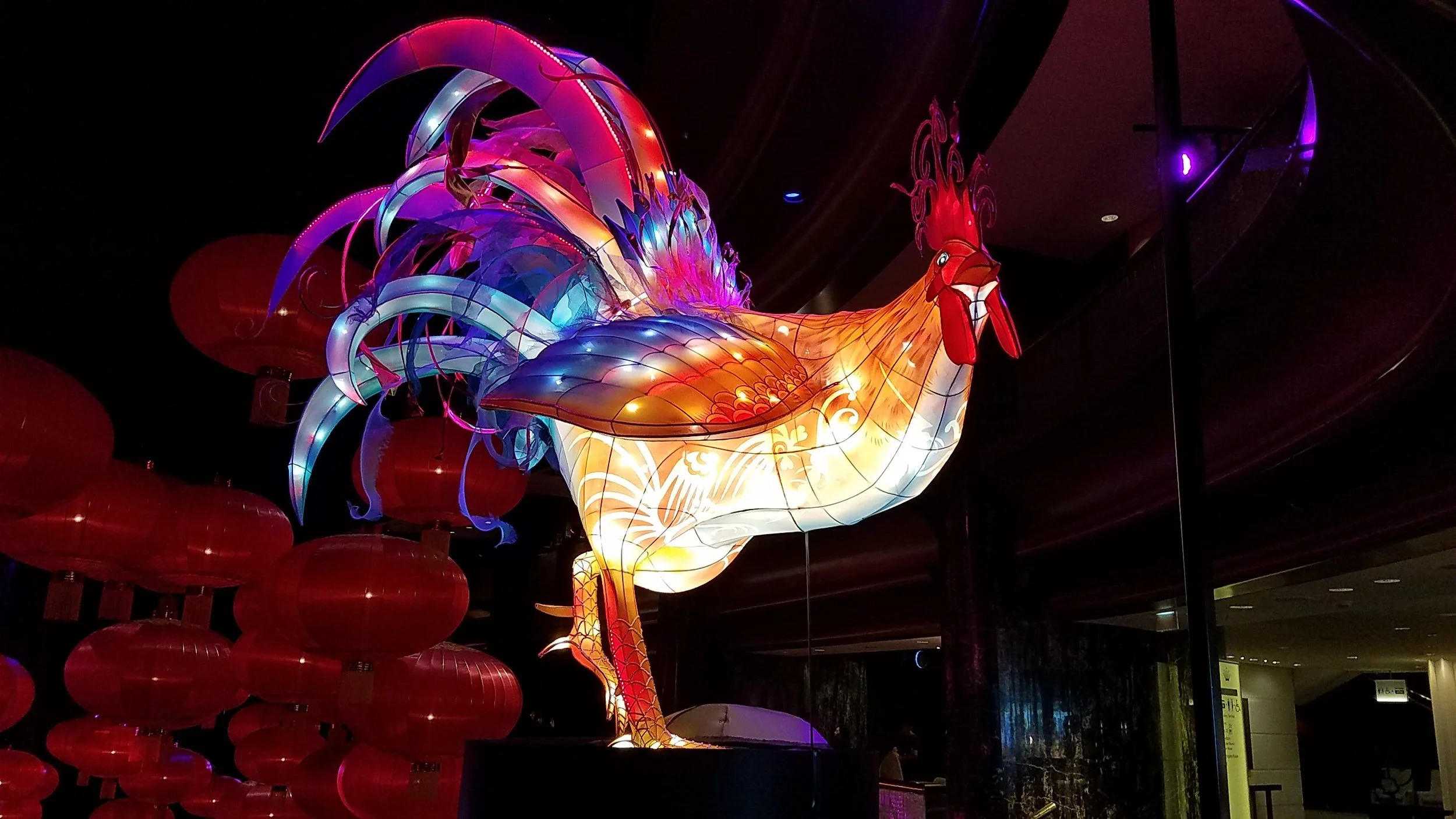
The rooster, part of the Zodiac Spectacular at Crown Towers in Melbourne, Australia.

The rooster, part of the Zodiac Spectacular at Crown Towers in Melbourne, Australia.

It's the Lunar New Year! Communities in the United States and around the world will celebrate the Lunar New Year beginning tomorrow, Saturday, January 28. According to the Chinese zodiac, it will be the Year of the Rooster. The tenth in the twelve-year cycle of Chinese zodiac signs, the rooster represents fidelity and punctuality. In Melbourne, Australia, where Protima is traveling for business, there are many events for the New Year including the Dragon Parade in Chinatown along with the incredibly beautiful Zodiac Spectacular featuring a large-scale display of animals of the Chinese zodiac at the Atrium at Crown Towers.

Back here in New York City, in addition to the New Year’s Day Firecracker Ceremony and New Year Parade, revelers can enjoy the light installation at the Empire State Building tonight as well as the New York Philharmonic Chinese New Year Concert at Lincoln Center next week. However you celebrate, know that according to advice prepared for the Zodiac Spectacular by Master Janene Laird (AFSM) "you should feel empowered this year with a renewed sense of purpose and ready to take on any new challenges or projects which lay ahead." But those born in a Rooster year should be careful since they are "offending the Tai Sui or Grand Duke and this can lead to careless mistakes, lapses in judgment or even knife injuries."

President Trump Signs Executive Orders to Build a Border Wall, Dramatically Increase Deportations, and Enact a Temporary Ban on Refugees

On Wednesday President Trump signed two executive orders to begin construction of a wall on the US-Mexico border, increase border patrol forces as well as the number of immigration enforcement officers who carry out deportations. The orders also intend to strip so-called “sanctuary cities” of federal grant funding and establish new wide-ranging criteria that could make many more undocumented immigrants priorities for removal. "Beginning today, the United States of America gets back control of its borders," President Trump told workers of the Department of Homeland Security at the department's headquarters in Washington, where he signed the orders.

Although in the order President Trump directs the "immediate construction of a physical wall on the southern border," funding for the wall would require Congressional approval. Trump has claimed that Mexico will reimburse US taxpayers for the construction costs, most recently suggesting he would obtain the funds by instituting a twenty percent import tax. Mexican President Enrique Peña Nieto has denied that Mexico will pay for the wall, and canceled a planned meeting in the US with President Trump in protest.

The executive orders call to increase Border Patrol forces by an additional 5,000 agents as well as for 10,000 new Immigration and Customs Enforcement (ICE) officers to carry out removals, again subject to Congress appropriating the sufficient funds. The executive actions also outline new criteria to determine which undocumented immigrants should be prioritized for deportation, potentially placing hundreds of thousands and arguably even millions more people in the federal government's crosshairs to deport. The order states that any undocumented immigrant convicted or simply charged with a crime that hasn't been adjudicated could be deported. (Under former President Obama, only undocumented immigrants convicted of a felony, serious misdemeanor, or multiple misdemeanors were prioritized for removal.) The order also specifies additional new priorities for deportation including undocumented immigrants who abuse public benefits, or simply those who in the “judgment of an immigration officer, otherwise pose a risk to public safety or national security," open-ended criteria that could be applied to many. 

Marielena Hincapié, executive director of the National Immigration Law Center, tells CNN that Trump's actions are "extremist, ineffective and expensive" and says the president is using lies about immigrants to push US policy. “Trump is taking a wrecking ball to our immigration system. It shouldn't come as a surprise that chaos and destruction will be the outcome," Hincapié says, noting that her organization will challenge Trump's moves in court.

Later this week or next President Trump is also expected to sign executive orders to block refugees from Syria and suspend the US refugee program for an initial 120-day period to ensure no admissions are made for those who “pose a threat to the security and welfare of the United States.” The order comes despite the fact that Syrian refugees already undergo intense screening processes that often last eighteen to twenty-four months. The orders, still in draft form, also stipulate that when the refugee program is resumed, it prioritizes refugees who have undergone religious-based persecution, “provided that the religion of the individual is a minority religion in the individual’s country of nationality.” For Muslim-majority countries this would presumably mean Christians, Yazidis, and other religious minorities, even though the majority of those killed, persecuted, and displaced by the Islamic State are Muslims. The total amount of refugees admitted also will total 50,000, decreased from 110,000 that the Obama administration had planned to accept.

The draft order calls for an immediate thirty-day halt to all immigrant and nonimmigrant entry of travelers from certain countries—including Iraq, Iran, Syria, Yemen, Sudan, Libya and Somalia—whose citizens “would be detrimental to the interests of the United States.” The order would allow those with visas to be turned away at US airports and other entry points. Additional provisions under the order would require all travelers to the United States to provide biometric data on entry and exit from the country, instead of current entry-only requirements, and suspends a waiver system under which citizens of certain countries where US visas are required do not have to undergo a face-to-face interview at a US Embassy or Consulate. The draft executive order also calls for visa applicants to be screened for their ideologies. “In order to protect Americans, we must ensure that those admitted to this country do not bear hostile attitudes toward our country and its founding principles,” it reads.

To justify the order, the action claims “hundreds of foreign-born individuals have been convicted or implicated in terrorism-related crimes since September 11, 2001.” The Washington Post notes, however, that most terrorist or suspected terrorist attacks since 9/11 have been carried out by US citizens. Moreover, the 9/11 hijackers hailed primarily from Saudi Arabia, as well as the United Arab Emirates, Egypt, and Lebanon, all which are US allies and not affected by the proposed ban.

Immigrant advocates and human rights groups have criticized the announced actions. “To think that Trump’s first 100 days are going to be marked by this very shameful shutting of our doors to everybody who is seeking refuge in this country is very concerning,” Marielena Hincapié tells the New York Times. “Everything points to this being simply a backdoor Muslim ban."

UPDATE JANUARY 27, 2017: This afternoon President Trump signed the executive order, “Protecting the Nation from Terrorist Attacks by Foreign Nationals,” that according to a draft released earlier this week enacts a temporary ban on refugees and suspends visas to immigrants from seven Muslim-majority countries.

UPDATE FEBRUARY 4, 2017: A judge in Seattle ordered a nationwide halt on Friday to the travel ban after a Boston court refused to extend a stay. The ruling from the Seattle judge, James Robart of the Federal District Court for the Western District of Washington, an appointee of President George W. Bush, is the most far-reaching ruling to date, though courts around the country have stayed certain aspects of President Trump's travel ban.

The federal government was “arguing that we have to protect the US from individuals from these countries, and there’s no support for that,” Judge Robart said in his decision. The judge's temporary ruling bars the administration from enforcing two parts of President Trump’s order: the ninety-day suspension of entry into the US of individuals from seven Muslim-majority countries—Iran, Iraq, Libya, Somalia, Sudan, Syria and Yemen—and the order's limits on accepting refugees, including “any action that prioritizes the refugee claims of certain religious minorities.”

Initially calling the ruling "outrageous," the White House late Friday issued a revised statement saying it would seek an emergency halt to the judge’s stay to restore the president’s “lawful and appropriate" order. Earlier this week the State Department said 60,000 visas had been revoked. A State Department official tells CNN that the department has "reversed the cancellation of visas that were provisionally revoked following the Trump administration's travel ban—so long as those visas were not stamped or marked as canceled." The Department of Homeland Security also said Saturday it has suspended actions to implement President Trump's executive immigration order. Nationals of the affected seven-Muslim majority countries who intend on traveling outside the US or to the US should consult an experienced immigration attorney. We will continue to provide updates as we receive them.
The Guardian: “Canadians traveling to Women's March denied US entry after sharing plans”

Travelers from Canada to the presidential inauguration and Women’s March on Washington say they were denied entry to the US after telling border agents at a land crossing in Quebec about their plans. Sasha Dyck, a thirty-four-year-old nurse from Montreal, was one of a group of eight who tried to cross the US/Canada border at St. Bernard de Lacolle in Quebec and Champlain, New York. When the group—two of whom were French nationals and the rest Canadians—told the US Customs and Border Protection (CBP) agents about their plans, the agents told them to pull over. Agents searched their cars, examined their mobile phones, and each member of the group was fingerprinted and photographed. Agents told the two French citizens that they had been denied entry to the US and that any future visit to the US would now require a visa.

"Then for the rest of us, they said, ‘You’re headed home today,'" Dyck tells the Guardian. CBP warned the group that they would be arrested if they tried to cross the border again over the weekend. “And that was it, they didn’t give a lot of justification.” She made the same journey to attend Barack Obama’s inauguration in 2009. “I couldn’t even get in for this one, whereas at the other one, the guy at the border literally gave me a high five when I came in and everybody was just like, ‘Welcome’. The whole city was partying; nobody was there to protest Obama the first time.” Dyck tells Global News: “I hope it doesn’t represent a closing down or a firming up of the border, or of mentalities south of the border.” 

In a separate incident, UK national Joe Kroese says that he, a Canadian, and two Americans were held at the same border crossing for three hours last Thursday. The group had traveled from Montreal—where Kroese is studying—and when they told agents they were considering attending the Women’s March, they were questioned, fingerprinted, and photographed. Kroese and his Canadian friend were refused entry because they were going to attend what one border agent claimed was a “potentially violent rally.” Kroese says that CBP advised them to not travel to the US for a few months, and that Kroese would need a visa for any future visits to the US. Kroese says another group of Canadians were also refused entry. "They searched the car and then they asked the driver if he practiced Islam and if he spoke Arabic,” he tells the Independent.  They wanted to spook us a bit. It felt like a kind of intimidation." 

In another incident, Montreal resident and McGill-student Joseph Decunha says he was denied entry when he told agents he was attending the inauguration and Women’s March. The group he was traveling with was brought in for secondary processing, where the border agent asked about their political views, Decunha tells the Canadian Broadcasting Corporation. “The first thing he asked us point blank is, ‘Are you anti- or pro-Trump?’” Decunha says he was fingerprinted, photographed and denied entry. “They told me I was being denied entry for administrative reasons. According to the agent, my traveling to the United States for the purpose of protesting didn’t constitute a valid reason to cross,” Decunha says. “It felt like, if we had been pro-Trump, we would have absolutely been allowed entry.”

US CBP says it does not discuss individual cases, and states in an email to the Guardian: “We recognize that there is an important balance to strike between securing our borders while facilitating the high volume of legitimate trade and travel that crosses our borders every day, and we strive to achieve that balance and show the world that the United States is a welcoming nation.” Scott Bardsley, the press secretary to Ralph Goodale, Canada’s public safety minister, in a statement defended US CBP agents for their actions. “When entering another country, including Canada, it has always been the case that goods accompanying a traveler may be searched to verify admissibility. Every country is sovereign and able to make its own rules to admit people and goods to manage its immigration framework, health and safety.”

More than one million individuals every day are admitted into the United States at its air, land, and sea ports, the agency reports, and an average of 600 people a day are denied entry for various reasons including national security concerns. Canadian nationals and nationals of those countries in the Visa Waiver Program are permitted to travel temporarily to the US without a visa for certain valid reasons. Valid reasons for such trips, according to CBP, include vacation, visit with friends or relatives, medical treatment, as well as “participation in social events hosted by fraternal, social, or service organizations.”

Even with reports of some turned away, the Huffington Post notes that in all likelihood many Canadians were able to cross the border to attend the march. According to Aaron Bowker, a public affairs officer for the CBP’s Buffalo field office in New York, the Buffalo office saw a fourteen percent increase in vehicular traffic last Thursday, Friday and Saturday, and that many of these admitted travelers were heading to events in D.C. He says that approximately 41,000 vehicles were processed over that three-day period and more than 100,000 passengers were inspected. Just over 95 people were denied entry, which is less than one percent of travelers who were processed. Bowker says that not all of those travelers denied entry were heading to D.C. Organizers for the Women’s March had arranged for some 650 people in buses from Canada to cross the border on last Friday night, and so far there were no reports these buses were prevented from entering the US.

AP: “Obama ends visa-free path for Cubans who make it to US soil”

President Barack Obama announced last Thursday that he is ending a longstanding US immigration policy allowing Cubans who arrive in the US to stay and become legal residents. The change for this policy, commonly referred to as the "wet foot, dry foot" policy, comes after months of negotiations and is an attempt to “normalize relations” with Cuba. It is contingent upon Cuba agreeing to take back certain Cuban nationals in the US who have been ordered removed. 

In a statement, President Obama called the "wet foot, dry foot" policy outdated. “Effective immediately, Cuban nationals who attempt to enter the United States illegally and do not qualify for humanitarian relief will be subject to removal, consistent with US law and enforcement priorities,” he said. “By taking this step, we are treating Cuban migrants the same way we treat migrants from other countries.” 

Since President Obama is using an administrative rule change to end the policy, President-Elect Trump could undo the change after the inauguration this week; however, ending a US policy that has allowed hundreds of thousands of people to enter the US without documentation would arguably seem to align with Trump’s comments on enacting tough immigration policies.

The Cuban government issued a statement calling the agreed upon policy change “an important step in the advance of bilateral relations” that will guarantee “regular, safe and orderly migration.” The government said the policy encouraged illegal travel in unseaworthy vessels, homemade rafts, and inner tubes.

The "wet foot, dry foot" policy was created by President Bill Clinton in 1995 to revise a more liberal immigration policy that allowed Cubans captured at sea to enter the US and become legal residents in a year. This change to the “wet foot, dry foot” policy comes after President Obama and Cuban President Raul Castro established full diplomatic ties and opened embassies in their respective capitals in 2015. In anticipation of this policy change, there has been an increase in Cuban immigration, particularly across the US-Mexico border. According to statistics published by the Department of Homeland Security, since October 2012 more than 118,000 Cubans have entered at ports of entry along the border, including more than 48,000 people who arrived between October 2015 and November 2016.

As part of the changes, the Cuban Medical Professional Parole Program, started by President George W. Bush in 2006, is also being rescinded. The measure permitted Cuban doctors, nurses, and other medical professionals to seek parole in the US while on assignments abroad, but the president noted these doctors can still apply for asylum at US embassies around the world. "By providing preferential treatment to Cuban medical personnel, the medical parole program…risks harming the Cuban people," Obama said in his statement.

Reactions to the change in policy are varied. "People who can't leave, they could create internal problems for the regime," Jorge Gutierrez, an eighty-year-old veteran of the Bay of Pigs invasion, tells the AP. He adds: "From the humanitarian point of view, it's taking away the possibility of a better future from the people who are struggling in Cuba." Representative Illeana Ros-Lehtinen, a Florida Republican who immigrated to the US from Cuba as a child, says that eliminating the medical parole program is a "foolhardy concession to a regime that sends its doctors to foreign nations in a modern-day indentured servitude." 

Even with this policy change, Cubans are still covered by the 1966 Cuban Adjustment Act, which grants them permanent residency after they have been in the US for one year. Up until the policy change last week, Cuban nationals who made it to the US were given temporary “parole” status for the one year, but this will no longer be granted. While the change in policy is effective immediately, those already in the US and being processed under both the "wet foot, dry foot" policy and the medical parole program will be able to continue the process toward obtaining legal status. Officials also say the change in policy does not affect the lottery that allows 20,000 Cubans to come to the US each year.

DLG's Newest Attorney!

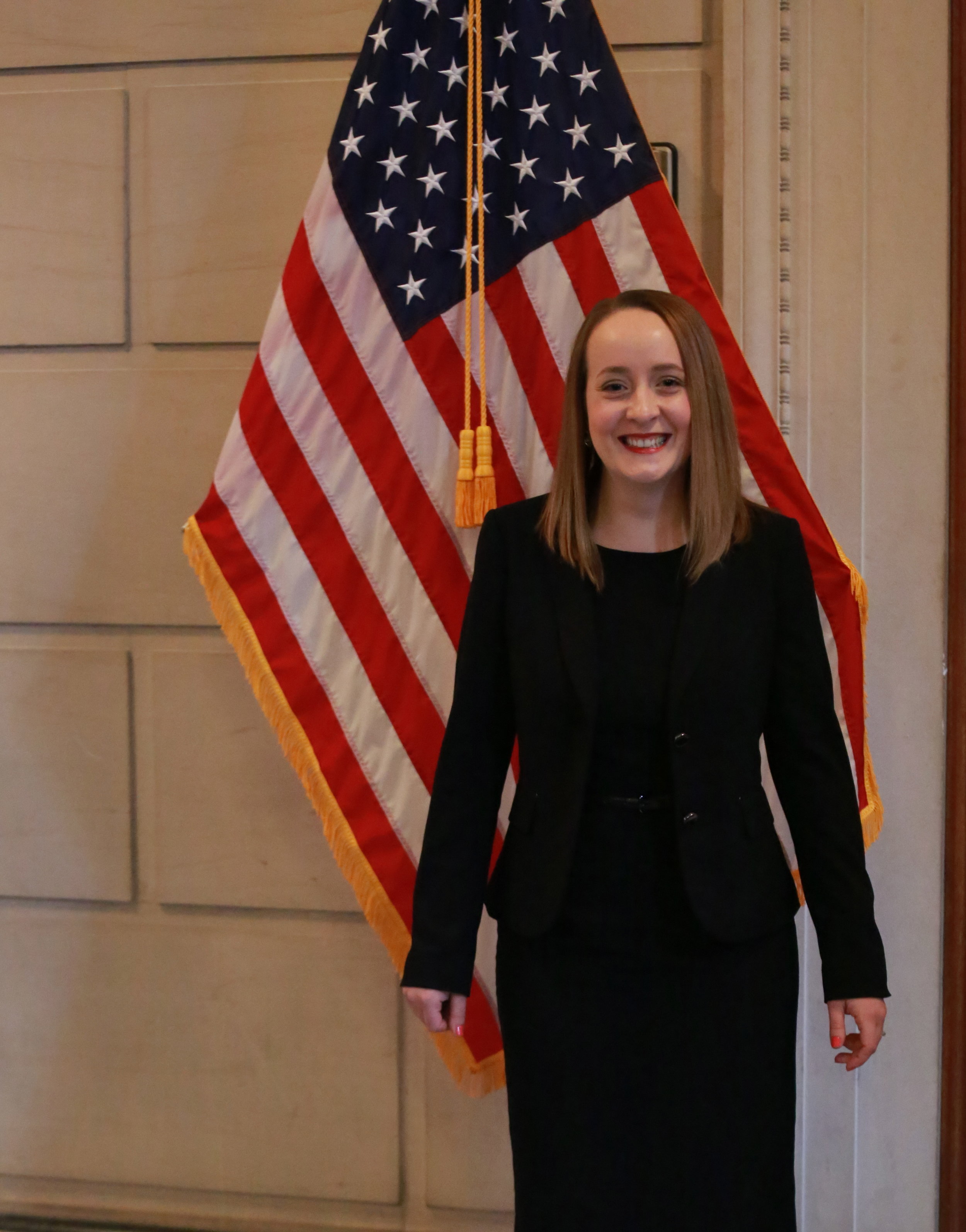
Carolyn in Brooklyn at the Supreme Court of the State of New York, Appellate Division, Second Judicial Department.

Carolyn in Brooklyn at the Supreme Court of the State of New York, Appellate Division, Second Judicial Department.

It's official! We're very excited to announce that Carolyn, who passed the bar last summer and has been working as a legal clerk at the firm, was sworn in as an attorney this week. It's especially exciting since Carolyn has held many positions at this firm, from receptionist to paralegal to law student intern to summer associate and now attorney-at-law. Congratulations, Carolyn Szaiff, Esquire!

OPINION: Trump and Immigration: What to Expect

It is no exaggeration to say that President-Elect Trump made immigration a centerpiece of his campaign, ever since the summer of 2015 when he launched it with his famous speech labeling Mexican immigrants drug dealers and rapists although some might be “good people.” He called for a total ban on Muslim immigration to the US, and applauded the Supreme Court’s ruling upholding the injunction on President Obama’s expanded DACA/DAPA program. But now that he’s been elected, what can we expect from President Trump on immigration beginning next week on January 20?

Read more