
“Why do I need a consultation?” is a question we’re often asked. And we understand. Many prospective clients are eager to get started on their case or want a fee quote over the phone right away or just want “five minutes of your time” to ask this one question about a visa their friend has, and are unsure how a paid consultation helps them. But consultations are an essential part of the overall legal process for both prospective clients and attorneys.
Read moreThe Guardian: “Silicon Valley's reluctant housewives: immigration law bars women from work”
For many people landing a job at a tech company in Silicon Valley is a dream come true. Years of hard work, talent, and education have finally paid off and led to coveted positions at prestigious companies (with sweet perks). But not everyone making the move to the US benefits. The Guardian takes a look at H-4 spouses–that is, the spouses of H-1B visa holders–and in particular, the wives of Silicon Valley workers who “are integral to the continued success of the Valley’s multibillion-dollar computing industry – but also entirely invisible to it.” Many of these H-4 holders are the spouses of engineers from around the world who work at companies such as Apple, Google, and Facebook.
The majority of H-4 spouses are not authorized to work in the US (except those whose spouses have reached a certain step of their Green Card application). Therefore, many H-4 spouses give up careers in their home country to follow their spouses who have been offered dream jobs and salaries too good to refuse in the US. One new H-4 arrival tells The Guardian: “Before, I was very career-focused…my career was my identity. Coming here has forced me to ask questions: who am I? What am I good at? What are my hobbies?”
This issue is of particular importance to Indian nationals in the US, who make up 80% of the 125,000 H-4 dependent visas. Sandhya Ravindran, a thirty-eight-year-old Indian woman who has lived in the Bay Area since 2007, says “99%” of her social network comprises other Indian H-4 wives. “Honestly? If I had known what life on an H4 would be like, I would not have come,” she says in The Guardian.
While last year the US government extended employment eligibility to certain H-4 visa holders of spouses who are seeking permanent resident status, many are still unable to work. Heather Zachernuk, a thirty-three-year New Zealander whose husband works for Apple, hasn’t been able to work since she arrived in Silicon Valley. “I feel guilt. So much guilt – for having this lifestyle...for resenting my situation even while it’s also a luxury.” The Guardian concludes: “Set against millions of vulnerable migrants, H4 visa holders are lucky. They are safe, and they are wealthy. But their experiences highlight a community of women pushed to the edges of Silicon Valley by an immigration system focused only on meeting corporations’ needs.”
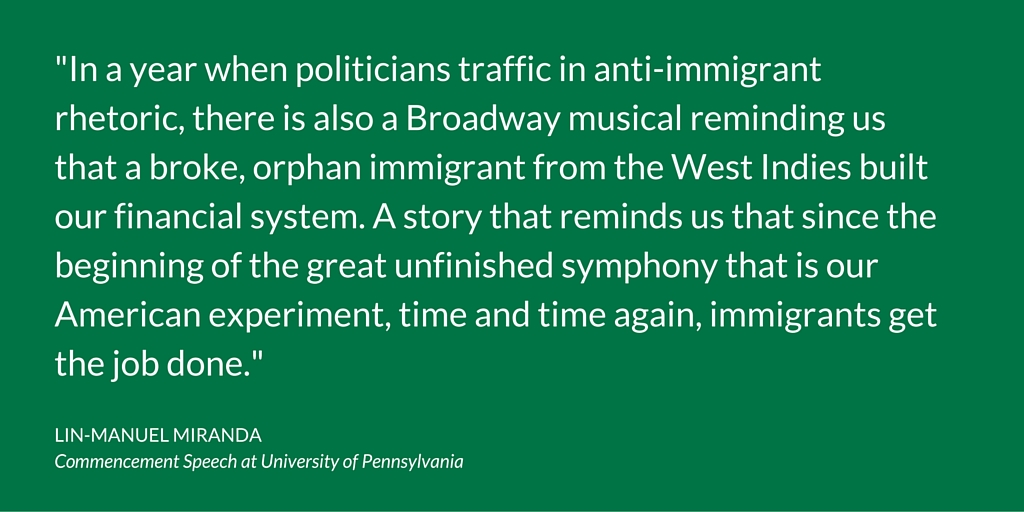
Great Unfinished Symphony
Big Bling

Big Bling at Madison Square Park is a forty-foot high, multi-tiered wood structure wrapped in fine chain-link fence with a gold-leafed shackle secured at the top. The installation, by renowned American sculptor Martin Puryear, is "part animal form, part abstract sculpture, and part intellectual meditation. The artist’s signature organic vocabulary appears in a graceful, sinewy outline and an amoeboid form in the work’s center." According to Hilarie M. Sheets in The New York Times, the structure “will command Madison Square Park in New York like a kind of Trojan horse.” But instead of bringing death and destruction, the structure is sure to impress and delight. “Our goal is to bring world-class art to the public for free," Keats Myer, Executive Director of Madison Square Park Conservancy, says. "Madison Square Park is truly a neighborhood park with a far-reaching cultural perspective.”
An Introduction to Medical Ineligibilities for Immigrant and Nonimmigrant Visas
Whether applying for immigrant (Green Card) or nonimmigrant (temporary) visas, foreign nationals must be found “admissible” to the US. There are many legal grounds of “inadmissibility” that make people inadmissible, including criminal and security grounds. A lesser-known basis of inadmissibility relates to health and medical issues, which is what we will focus on in this post.
Read moreUSCIS Proposes to Raise Fees on I-129, I-140, I-90 and Other Applications by an Average of 21 percent This Summer
US Citizenship & Immigration Services (USCIS) proposed earlier this month to raise certain fees for petitions and applications, and is currently accepting comments for the required sixty-day comment period. USCIS conducts biennial fee reviews, and the latest review indicated that a twenty-one percent average fee increase is necessary to recover operating costs and to maintain “adequate service.” As the money obtained from USCIS filing fees accounted for ninety-four percent of the USCIS budget last fiscal year with the remaining funding coming from other fee accounts and a small Congressional appropriation fund, USCIS estimates a shortfall of $560 million if fees are not raised.
USCIS has “authority to set its IEFA fees at a level that recovers the full cost of providing adjudication and naturalization services. This includes the cost of providing services to asylum applicants or other immigrants without charge and any additional costs associated with the administration of the fees collected.” USCIS last adjusted its fees in November 2010. Some notable fee increases include:
I-129
Currently set at $325, USCIS is proposing to raise the fee for this form, used for such common non-immigrant visa petitions as H-1Bs, L-1s, and O-1s, among others, by over one hundred dollars to $460.
I-140
USCIS wants to raise the fee for this immigrant petition from $580 to $700.
I-90
This application to replace the permanent resident (Green Card) card will go from $365 to $455.
N-400
USCIS proposes to establish a three-level fee tier for this Application for Naturalization, which is very popular these days as people prepare for voting in the upcoming election. First, USCIS wants to increase the standard fee from $595 to $640. Second, DHS would "charge no fee to an applicant who meets the requirements of sections 328 or 329 of the Immigration and Nationality Act of 1952 (INA) with respect to military service and applicants with approved fee waivers." Third, USCIS would charge a reduced fee of $320 for "applicants with family income greater than 150 percent and not more than 200 percent of the Federal Poverty Guidelines."
Form I-924A for EB-5 Investor Visa
Rather than a fee increase, USCIS wants to establish a new fee of $3,035 to recover the full cost of processing this form. While approved EB-5 Regional Centers are required to file Form I-924A annually, there is currently no filing fee and as a result, USCIS does not fully recover the processing costs associated with such filings.
What Will Customers Get in Return for These Fee Increases?
The last time USCIS raised fees, they committed to certain goals and performance improvements toward “increasing accountability, providing better customer service, and increasing efficiency.” USCIS claims some improvements since that time but acknowledges that the “agency has experienced elevated processing times” which have led to backlogs; however, they believe that the fee increases this year would increase “resources to fund the personnel needed to improve case processing, reduce backlogs, and achieve processing times that are in line with the commitments in the FY 2007 Fee Rule, which USCIS is still committed to achieving.”
"When USCIS increases filing fees, our hope is that they will use the increased revenue to improve efficiency and reduce processing times," Justin Storch with the Council for Global Immigration tells the Latin Post, reflecting sentiments shared by many immigration practitioners. Public comments for the fees increase are scheduled to close July 5.
Born to Use My Mind

Joseph?

I was up on the High Line the other day enjoying the gorgeous weather, and I was initially concerned that Joseph had a breakdown after the stresses of H-1B cap season and was scaring the tourists! But don't worry, upon closer inspection, I found out it wasn't Joseph at all. Instead it was a hyper-realistic work titled Sleepwalker by Tony Matelli, a New York-based artist known for his lifelike sculptures. Sleepwalker is a very realistic painted bronze sculpture of a "somnambulant man lost and adrift in the world, meandering about in a deep sleep." Matelli’s work "questions the extent to which any one of us is ever fully aware of our own surroundings, especially considering the constant distraction of the screens that supplement our lived experience." So true. But don't let that dissuade you from reading our blog!
My Immigration Story
As a first-generation Hungarian-American who grew up in a bilingual household, my developing personality was influenced by a hybrid of cultures. I witnessed firsthand the struggles that every immigrant family typically faces in this country. In light of those struggles, my parents instilled in me the values of hard work, compassion, and enthusiasm. From these lessons came a spark that lit a passion within for assisting others, which is how I ended up at the Daryanani Law Group following my graduation from Wesleyan University in 2011.
Read moreNew York Times: “Resettling the First American ‘Climate Refugees’”

Photo by Rainforest Action Network / Creative Commons. Chris Chaisson of the United Houma Nation eyes the waves as water covers half the road to Isle de Jean Charles in the Louisiana bayou.
The US government is assisting a new kind of refugee—this time from within our own borders. Residents of Louisiana’s Isle de Jean Charles, which has seen extensive flooding and erosion by hurricanes and extreme weather as well as damage by oil and logging industries, are recipients of a grant by the Department of Housing and Urban Development (HUD) to help communities respond to climate change. While HUD is also providing grants to communities to build stronger levees, dams, and drainage systems, with Isle de Jean, the agency is attempting to relocate an entire community. With the grant, the island’s residents will be resettled by 2022 to a drier community that is still to be determined. “We see this as setting a precedent for the rest of the country, the rest of the world,” Marion McFadden, who is overseeing the HUD program, tells the New York Times.
The resettlement program, which is completely voluntary, is not without difficulty. There are not only logistical and practical issues but also personal and moral dilemmas. “We’re going to lose all our heritage, all our culture,” Chief Albert Naquin of the Biloxi-Chitimacha-Choctaw, one of the island’s tribes, says to the New York Times. “It’s all going to be history.” Hilton Chaisson, who raised ten sons on the island and wants his twenty-six grandchildren to also have the option to stay, concedes the flooding is getting worse, but says they always find a way. “I’ve lived my whole life here, and I’m going to die here,” he says.
The New York Times explains the history of the island:
For over a century, the American Indians on the island fished, hunted, trapped and farmed among the lush banana and pecan trees that once spread out for acres. But since 1955, more than 90 percent of the island’s original land mass has washed away. Channels cut by loggers and oil companies eroded much of the island, and decades of flood control efforts have kept once free-flowing rivers from replenishing the wetlands’ sediments. Some of the island was swept away by hurricanes…Already, the homes and trailers bear the mildewed, rusting scars of increasing floods. The fruit trees are mostly gone or dying thanks to saltwater in the soil. Few animals are left to hunt or trap.
With raising sea levels, stronger storms, increased flooding, hasher droughts, and decreased freshwater supplies, governments around the world are dealing with climate change that could potentially displace 50 million to 200 million from their homes. Climatologist say that Syria's drought, exacerbated by climate change, destroyed crops, killed livestock, and displaced as many as 1.5 million Syrian farmers, and contributed to the social turmoil that led to the country’s devastating civil war, which created even more refugees. Climatologists believe the same could happen in other parts of the Middle East, the Mediterranean, and other parts of the world. Climate change is already affecting islands in the Pacific Ocean, where some islands and its residents are dealing with rising sea levels.
“The changes are underway and they are very rapid,” US Interior Secretary Sally Jewell says in a speech. “We will have climate refugees.” Walter Kaelin, the head of the Nansen Initiative, a research organization working with the United Nations to address extreme-weather displacement, tells the New York Times that planning ahead is essential. “You don’t want to wait until people have lost their homes, until they flee and become refugees,” he says. “The idea is to plan ahead and provide people with some measure of choice.”
This is exactly what HUD officials are hoping to do with the climate refugees of Isle de Jean. While there are those who don’t wish to move, some of the island’s residents are eager to relocate. Violet Handon Parfait lives with her husband and two children in a small trailer behind the remains of their house, destroyed by Hurricane Gustav in 2008. Floods ruined their stove and family computer, and Parfait, who has lupus, tells the New York Times she is concerned about access to doctors if the bridge connecting them to the mainland floods. She also hopes her two children are able to attend college, but they often miss their school when the flooding prevents the bus from picking them up. “I just want to get out of here,” she says.