US News & World Report: “Foreign-Born STEM Workers Get to Stay in U.S.”

Since the federal government opened up public comments on the US Department of Homeland Security’s (DHS) proposed rule to expand the amount of time foreign STEM students are authorized to work in the US on a student visa, they’ve received over 3,000 comments, many of them positive.

The draft rule, incorporating President Obama’s executive action proposals, would make various changes to the F-1 science, technology, engineering, and mathematics (STEM) Optional Practical Training (OPT) program, most notably increasing the STEM OPT extension from seventeen to twenty-four months on top of the initial twelve months of OPT eligibility, for a total of three years of post-graduation work eligibility. As the public comments indicate, many are welcoming the extension as it would increase chances for OPT workers to obtain an H-1B visa since their employers would be able to enter the lottery (by filing an H-1B petition on their behalf) more than once.  

The proposal comes after a District of Columbia judge ruled this past August that the Department of Homeland Security (DHS) must vacate a 2008 rule that granted F-1 STEM students OPT extensions for seventeen months beyond the normal twelve months of OPT since DHS did not provide the necessary public notice and comment.

Since invalidating the rule effective immediately would have created a "major labor disruption” for technology-related industries as well as "substantial hardship" for thousands of international students, the judge imposed a six-month stay until February 12, 2016, a move that allowed DHS to correct—and thereby incorporate Obama’s executive directives including the STEM extension—for the necessary public notice and comment.

What’s in the proposed rule apart from the extension that is generating so many public comments? Some notable highlights include:

  • Employers must implement formal mentoring and training plans for STEM OPT workers as well as an evaluation process;
  • If students use the STEM OPT for a twenty-four-month period and then enroll in a new higher level STEM program, they would be entitled to a new twenty-four month STEM extension in addition to the standard twelve months of OPT;
  • As part of the US worker protections included in the program, employers must show that they are not laying off US workers as a result of hiring a STEM OPT worker, they have ability to provide the necessary mentoring and training, and that the training must be in the student’s field;
  • Moreover, duties, hours, and wages of an employer’s STEM practical training opportunity must be comparable to similarly situated US workers and wage information must be provided to DHS;
  • The existing E-Verify requirements remain unchanged along with cap-gap extension program;  
  • Only accredited schools may participate in the STEM OPT program;
  • DHS is permitted to conduct on-site inspection.

Not everyone is thrilled with this proposed rule. One commenter wrote that even with a STEM degree from Cornell University, he has been struggling to find work. "Companies don't want to hire Americans and they abuse [H1-B] and OPT to hire cheap immobile labor instead of hiring anyone over the age of 35, especially in software or tech areas," he wrote.

Ron Hira, a public policy professor at Howard University, said in ComputerWorld that for STEM graduates there "is no justification to treat them as interns in need of further training." He went on: "The duration of 'training' being proposed by the Obama administration has no basis in any theory, data, or analysis…It is pure fiction that someone with a master's degree in electrical engineering needs an additional three years to work as an intern to be a productive professional.”

One computer science Ph.D. student, however, commented that without the proposed STEM extension that applicants are either "lucky to get an H-1B or just go home." With the proposed STEM extension, he says: "I will have three years in total to evaluate my career and have the freedom to work for the country[.]"  

The thirty-day comment period on the new rule ends November 18, 2015, and so for those who have something to add, don’t delay.

10 THINGS TO REMEMBER ABOUT THE I VISA

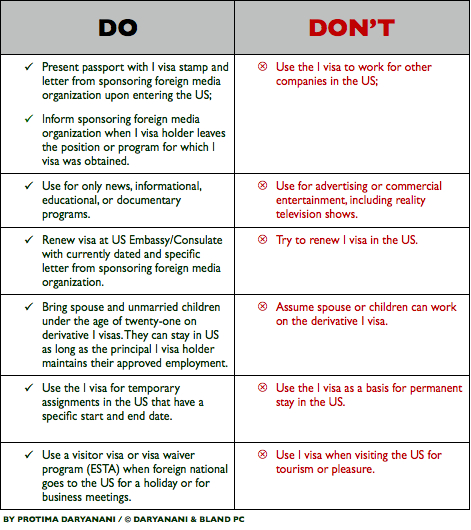
Our beautiful I visa chart (click to download as a PDF) summarizes key points about the I visa.

Our beautiful I visa chart (click to download as a PDF) summarizes key points about the I visa.

1. What is the I visa?

An I visa is a temporary visa which allows representatives of foreign press, radio, film, or other foreign information media to enter the US in connection with the news gathering process, as well as informational or educational documentary films or a television series. It is a temporary visa that should not be used as a basis for a permanent stay in the US.

2. Who can use the I visa?

Reporters, members of a media or documentary film crew, video tape editors, employees of independent production companies, freelance journalists working under contract, or anyone essential to the foreign information media function may be eligible for this visa. Both print and film activities are included in this category. The foreign media organization which the I visa applicant is representing should have a home office outside the US.

3. Who cannot use it?

If the applicant is working on commercial, entertainment, or advertising productions, they will not qualify for "I" classification visas. Stories that involve reenactments or staged events, scripted or dramatized events such as reality television and quiz shows, are not primarily informational and, as such, cannot be the basis of an I visa application.

4. What are the limitations?

The I visa is company-specific and project-specific, so the I visa holder may only work for the foreign media organization that sent them over to the US on the project and in the capacity that was outlined in the I visa application. It is only intended for temporary work in the US on behalf of the foreign media organization that sponsored the application and should not be used if the applicant intends to take up residency in the US. An I visa holder can travel in and out of the US as many times as needed to complete the relevant project, as long as the visa remains valid.  

5. How to apply for one?

I visas must be applied for directly at a US Embassy/Consulate in the applicant’s home country. The applicant must make a visa appointment at the US Embassy/Consulate, complete and submit the DS-160, and pay the applicable visa processing fee. The applicant must present their passport (valid for at least six months beyond period of intended stay in the US) and valid documentation, including a letter signed by the foreign media organization sponsoring the application outlining how the applicant qualifies for the I visa, as well as a valid employment contract. Applicants should allow enough time for the Embassy/Consulate to process the visa stamp (typically three to ten business days).

6. How long is the I visa valid?

I visas can be approved for up to five years; however, some Embassies and Consulates have recently begun issuing shorter term visas (six months to one year) depending on the amount of time they believe the applicant will need to finish the project or production outlined in the visa application. As long as the I visa holder enters the US during the validity period of the I visa stamp, they will be admitted to the US for “duration of status,” which means that they can remain in the US for as long as they work on the approved project. The visa will cease to be valid if the I visa holder works for a company other than the foreign media organization that sponsored their I visa application.

7. What about family?

An I visa holder’s spouse and child (under twenty-one) may also apply for derivative I visas that will allow them to accompany the I visa holder to the US. Spouses and children are not authorized to work in the US with the derivative I visa, but they may attend school or university while in the US, although the school may suggest they obtain a student visa (F-1).

8. What if the I visa holder receives a job offer with a new employer in the US?

If an I visa holder identifies a new work opportunity in the US with a new employer, they must discuss their visa options with their prospective employer. They may apply for a change of status to a new visa classification with the new employer. But they cannot commence working with the new employer until the change of status petition is approved.

9. What happens if the I visa holder leaves the foreign media organization sponsor?

If the I visa holder leaves the foreign media organization that sponsored the I visa, the I visa will no longer be valid as it is specific to their work for the foreign media organization that sponsored their application.  Even though the visa stamp may still be valid, if the I visa holder is not working with the sponsor, they are no longer in valid status.  

10. What if the I visa holder wants to stay in the US permanently?

If an I visa holder wishes to remain in the US permanently, they should consider an immigrant visa, more commonly known as a Green Card.  Generally, they must be sponsored either by a US employer or a by a US citizen family member, if applicable. It is best to discuss Green Card options with a lawyer in order to determine the best plan of action.

NY Times: "The Great ‘Sanctuary City’ Slander"

San Francisco / Protima Daryanani

San Francisco / Protima Daryanani

The US Senate is set to vote today on a controversial bill sponsored by David Vitter of Louisiana to punish so-called “Sanctuary Cities” by denying them federal law enforcement funds. The bill—a version of which passed the House in July—came about after the tragic death of Californian Kathryn Steinle who was shot in San Francisco by an undocumented immigrant with prior drug convictions who had been deported previously.  

“Sanctuary cities and the associated violent crimes by illegal immigrants are reaching a critical point, and we cannot wait any longer to take action to protect Americans here at home,” said Vitter in a press release. “There is simply no incentive for these localities to enforce current immigration laws, and my legislation will make sure sanctuary cities are no longer rewarded for their failures to uphold the law.”

Not everyone agrees with this assessment. The New York Times editorial board says the bill scapegoats eleven million immigrants based on the actions of a few and is based on the lie “that all unauthorized immigrants are dangerous criminals who must be subdued by extraordinary means.”

What Are ‘Sanctuary Cities?’

The American Immigration Council, whose mission is to shape a rational conversation on immigration and immigrant integration, explains that the phrase comes from the “church-centered” movement in the 1980s when many Central American refugees fleeing civil wars were denied asylum. Religious institutions banded together to oppose the return of the refugees to where they had been persecuted and this became known as the “Sanctuary Movement.”

The American Immigration Council points out that the term “sanctuary city” is a “misnomer when used to describe community policing policies which attempt to eliminate fear from those who worry that reporting a crime or interacting with local law enforcement could result in deportation.”

“Sanctuary cities” do not ensure that immigrants in those communities are insulated from any immigration enforcement action against them; their residents are still subject to federal enforcement actions and in fact, many “sanctuary cities” have enacted community policing policies to ensure that immigrant communities interact with the police and that law enforcement officers do not detain persons they have no legal authority to hold. Many sanctuary city policies came about after the Obama-instituted “Secure Communities,” which shared information between state and local law enforcement and federal authorities, and “shattered trust” between immigrant populations and law enforcement agencies.

Tom Manger, Chief of Police for Montgomery County and President of the Major Cities Chiefs Association, explains

To do our job we must have the trust and respect of the communities we serve. We fail if the public fears their police and will not come forward when we need them. Whether we seek to stop child predators, drug dealers, rapists or robbers—we need the full cooperation of victims and witness. Cooperation is not forthcoming from persons who see their police as immigration agents. When immigrants come to view their local police and sheriffs with distrust because they fear deportation, it creates conditions that encourage criminals to prey upon victims and witnesses alike.

What Does the Bill Do? 

The Stop Sanctuary Policies and Protect Americans Act proposes to withhold certain funds and grants from “sanctuary jurisdictions” and require that these funds are re-allocated to other jurisdictions that allow local law enforcement to cooperate with federal policies, among other things, and includes “Kate’s Law,” which establishes a mandatory minimum sentence of five years for undocumented immigrants who are convicted of re-entering the US after being convicted of an aggravated felony or being convicted of having illegally re-entered the US twice prior.

While co-sponsor Pat Toomey calls the bill “commonsense legislation” to protect Americans, the New York Times argues that “sanctuary city” policies perform an important function by ensuring that law-abiding immigrants don’t fear and shun the police, and allowing them to be a productive part of the community in which they reside. “The answer to an immigrant population in the shadows is — as it has been throughout our history — integration and welcome instead of scapegoating and oppression,” the New York Times states. “And leaving local law enforcement free to focus on catching criminals and protecting public safety.

Washington Post: “Homeland security secretary tells politicians to cut back on the rhetoric”

At a conference hosted by Latino lawmakers, US Department of Homeland Security (DHS) Secretary Jeh Johnson called for presidential candidates and politicians to tone down the inflammatory rhetoric regarding immigrants and immigration. As reported in the Washington Post, he said: 

All of us in public office, those who aspire to public office and who command a microphone owe the public calm, responsible dialogue and decision-making…Not overheated, over simplistic rhetoric and proposals of superficial appeal. In a democracy, the former leads to smart and sustainable policy. The latter can lead to fear, hate, suspicion, prejudice and government overreach. These words are especially true in matters of homeland security and they are especially true in matters of immigration policy.

Secretary Johnson said despite the perception that the number of undocumented immigrants was increasing, undocumented entries by immigrants into the US have declined overall—despite the recent surge in Central American migrants—to levels not seen since the early 1970s.  

In his speech, Secretary Johnson also decried the suggestion of building a wall on the US/Mexico border, and said that deporting eleven million undocumented immigrants—as Trump and other GOP candidates have proposed—is not feasible. “We’re not going to deport a population equal in size to New York City and Chicago,” he said in the Washington Post. "They live among us, we know them, they’re becoming integrated members of society.”

That said, Johnson recommends that the federal government should invest more in “technology for border security” as well as the ability to have in-country processing agencies in Central America to allow immigrants to more easily and safely bring children or spouses into the country. In addition, he continues to support the Obama administration’s calls for Congress to include a $1 billion aid package for Guatemala, El Salvador, and Honduras in the next spending bill to address the underlying causes of migration from Central America.

Johnson’s plea for a more civil political discourse comes amid the release of a report that shows immigrants are assimilating and integrating to the US effectively, arguably at a faster rate than previous immigrant generations. The extensive 400-page report, from the National Academies of Sciences, Engineering and Medicine, examines various factors from English proficiency, education levels, and family structure to health, crime, and employment. The report states:

Across all measurable outcomes, integration increases over time, with immigrants becoming more like the native-born with more time in the country, and with the second and third generations becoming more like other native-born Americans than their parents were. 

The reports also has some other interesting conclusions: integration into American society is happening at a faster pace than with previous generations since many immigrants typically now come to the US with some level of English proficiency; the "increased prevalence of immigrants is associated with lower crime rates—the opposite of what many Americans fear;” lastly, the “least educated immigrants” are “more likely to be employed than comparably educated native-born men, indicating that they are filling an important niche in our economy.”