
Small businesses that rely on specialized talent have long turned to the H-1B visa as the primary route to hire foreign professionals. The new requirement that employers pay a $100,000 fee for many H-1B cases filed after September 21, 2025 has changed that calculation. For large corporations, this new cost may be absorbable but for startups, boutique firms, local clinics, research labs, engineering shops, technology innovators, and other small employers, the fee can make the H-1B category functionally unavailable. Many employers who would ordinarily pursue H-1B sponsorship are now searching for realistic alternatives. This shift does not eliminate the possibility of hiring foreign talent. It does require creative, early planning to determine whether another visa classification aligns with the company’s needs and the candidate’s background. The goal is to match the role, the qualifications, and the business structure to a category that supports employment without triggering the $100,000 H-1B entry fee.
Read moreProtections for Immigrants

Lizzie B Climbed a Volcano

Now that Lizzie B is a partner at the firm, she can do pretty much anything, including climbing volcanoes. Here she is at the Villarrica Volcano, one of Chile's most active volcanoes.
Oh to be Australian, Canadian, Mexican, Chilean, or Singaporean
The H-1B is one of the most common visa categories that foreign nationals utilize to come to the United States to work for a US employer in a professional position. The H-1B, however, is limited by Congress at an annual cap each year. Currently there are 65,000 H-1B visas available for those with a bachelor’s degree (or the equivalent) with an extra 20,000 set aside for those with a US master’s degree. Since it’s one of the most popular visa options, it is common for more people to apply than there are numbers available. This has resulted in an annual lottery of H-1B petitions. In previous years, the lottery pool has included petitions submitted on the first five business days the numbers become available (which is April 1st each year). Of course, this often means that unless a foreign national is one of the lucky people to “win” one of the allotted H-1B numbers, she/he must wait and submit a new H-1B petition when the next year’s numbers become available. There are, however, special exemptions to the cap number as well as H-1B-like visa options for certain foreign nationals, namely those whose country of citizenship is Australia, Canada, Mexico, Chile, or Singapore. I examine these exemptions and options in the chart below (click on chart to open in PDF):
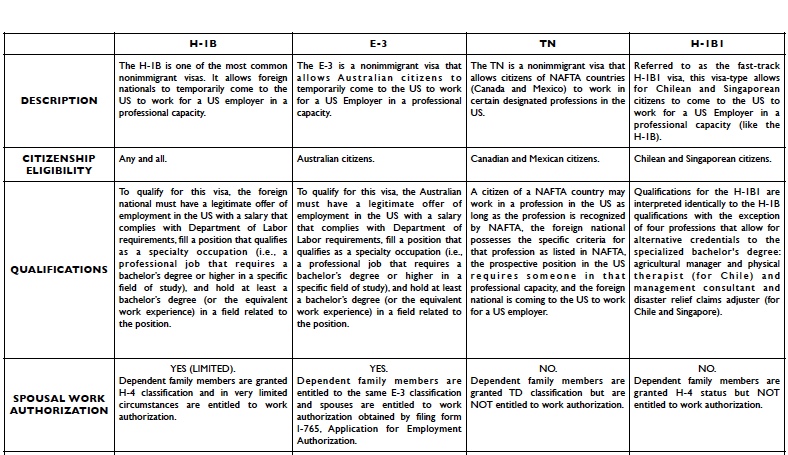
Through all the differences between the various visa categories, one thing is certain: it is good to be from a country that allows you options should an H-1B number not be available. In fact, depending on the situation, these may be even better options than the H-1B.
Donec id justo non metus auctor commodo ut quis enim. Mauris fringilla dolor vel condimentum imperdiet.