


I am in Australia for three reasons: 1) business meetings; 2) to see Roger play at the Australian Open; and 3) well, to look at beautiful sunrises over the Sydney Harbor and the iconic Opera House. Before riding ferries to and from my business appointments (seriously, love the ferries), I was able to take in this gorgeous sunrise. Australia is one of my favorite places to travel. If only I could have shared this sunrise with Nangua, the cutest Francois’ Langur monkey whom I met last year at the Taronga Zoo. Next time, Nangua, next time.
Sydney at Sunrise
AP: “Obama ends visa-free path for Cubans who make it to US soil”
President Barack Obama announced last Thursday that he is ending a longstanding US immigration policy allowing Cubans who arrive in the US to stay and become legal residents. The change for this policy, commonly referred to as the "wet foot, dry foot" policy, comes after months of negotiations and is an attempt to “normalize relations” with Cuba. It is contingent upon Cuba agreeing to take back certain Cuban nationals in the US who have been ordered removed.
In a statement, President Obama called the "wet foot, dry foot" policy outdated. “Effective immediately, Cuban nationals who attempt to enter the United States illegally and do not qualify for humanitarian relief will be subject to removal, consistent with US law and enforcement priorities,” he said. “By taking this step, we are treating Cuban migrants the same way we treat migrants from other countries.”
Since President Obama is using an administrative rule change to end the policy, President-Elect Trump could undo the change after the inauguration this week; however, ending a US policy that has allowed hundreds of thousands of people to enter the US without documentation would arguably seem to align with Trump’s comments on enacting tough immigration policies.
The Cuban government issued a statement calling the agreed upon policy change “an important step in the advance of bilateral relations” that will guarantee “regular, safe and orderly migration.” The government said the policy encouraged illegal travel in unseaworthy vessels, homemade rafts, and inner tubes.
The "wet foot, dry foot" policy was created by President Bill Clinton in 1995 to revise a more liberal immigration policy that allowed Cubans captured at sea to enter the US and become legal residents in a year. This change to the “wet foot, dry foot” policy comes after President Obama and Cuban President Raul Castro established full diplomatic ties and opened embassies in their respective capitals in 2015. In anticipation of this policy change, there has been an increase in Cuban immigration, particularly across the US-Mexico border. According to statistics published by the Department of Homeland Security, since October 2012 more than 118,000 Cubans have entered at ports of entry along the border, including more than 48,000 people who arrived between October 2015 and November 2016.
As part of the changes, the Cuban Medical Professional Parole Program, started by President George W. Bush in 2006, is also being rescinded. The measure permitted Cuban doctors, nurses, and other medical professionals to seek parole in the US while on assignments abroad, but the president noted these doctors can still apply for asylum at US embassies around the world. "By providing preferential treatment to Cuban medical personnel, the medical parole program…risks harming the Cuban people," Obama said in his statement.
Reactions to the change in policy are varied. "People who can't leave, they could create internal problems for the regime," Jorge Gutierrez, an eighty-year-old veteran of the Bay of Pigs invasion, tells the AP. He adds: "From the humanitarian point of view, it's taking away the possibility of a better future from the people who are struggling in Cuba." Representative Illeana Ros-Lehtinen, a Florida Republican who immigrated to the US from Cuba as a child, says that eliminating the medical parole program is a "foolhardy concession to a regime that sends its doctors to foreign nations in a modern-day indentured servitude."
Even with this policy change, Cubans are still covered by the 1966 Cuban Adjustment Act, which grants them permanent residency after they have been in the US for one year. Up until the policy change last week, Cuban nationals who made it to the US were given temporary “parole” status for the one year, but this will no longer be granted. While the change in policy is effective immediately, those already in the US and being processed under both the "wet foot, dry foot" policy and the medical parole program will be able to continue the process toward obtaining legal status. Officials also say the change in policy does not affect the lottery that allows 20,000 Cubans to come to the US each year.
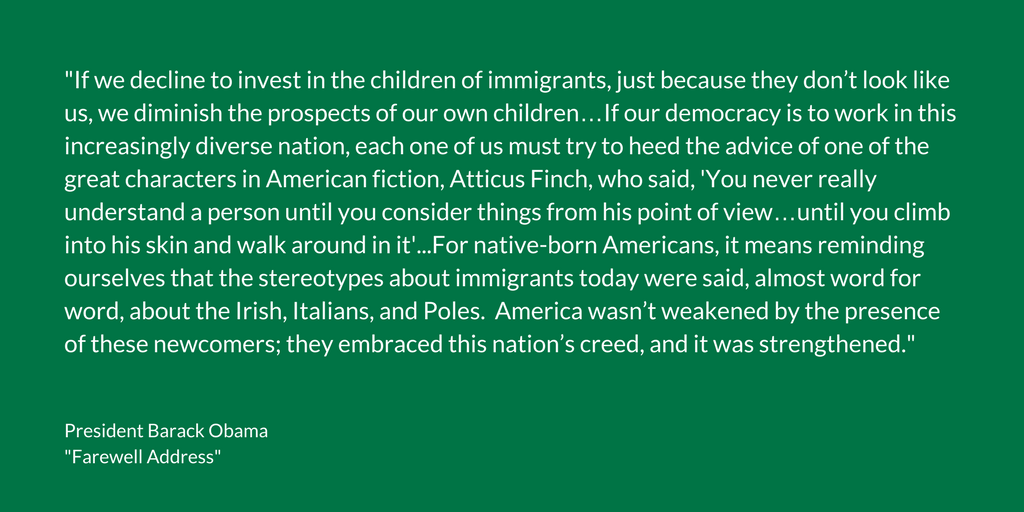
Immigrants and Democracy
DLG's Newest Attorney!
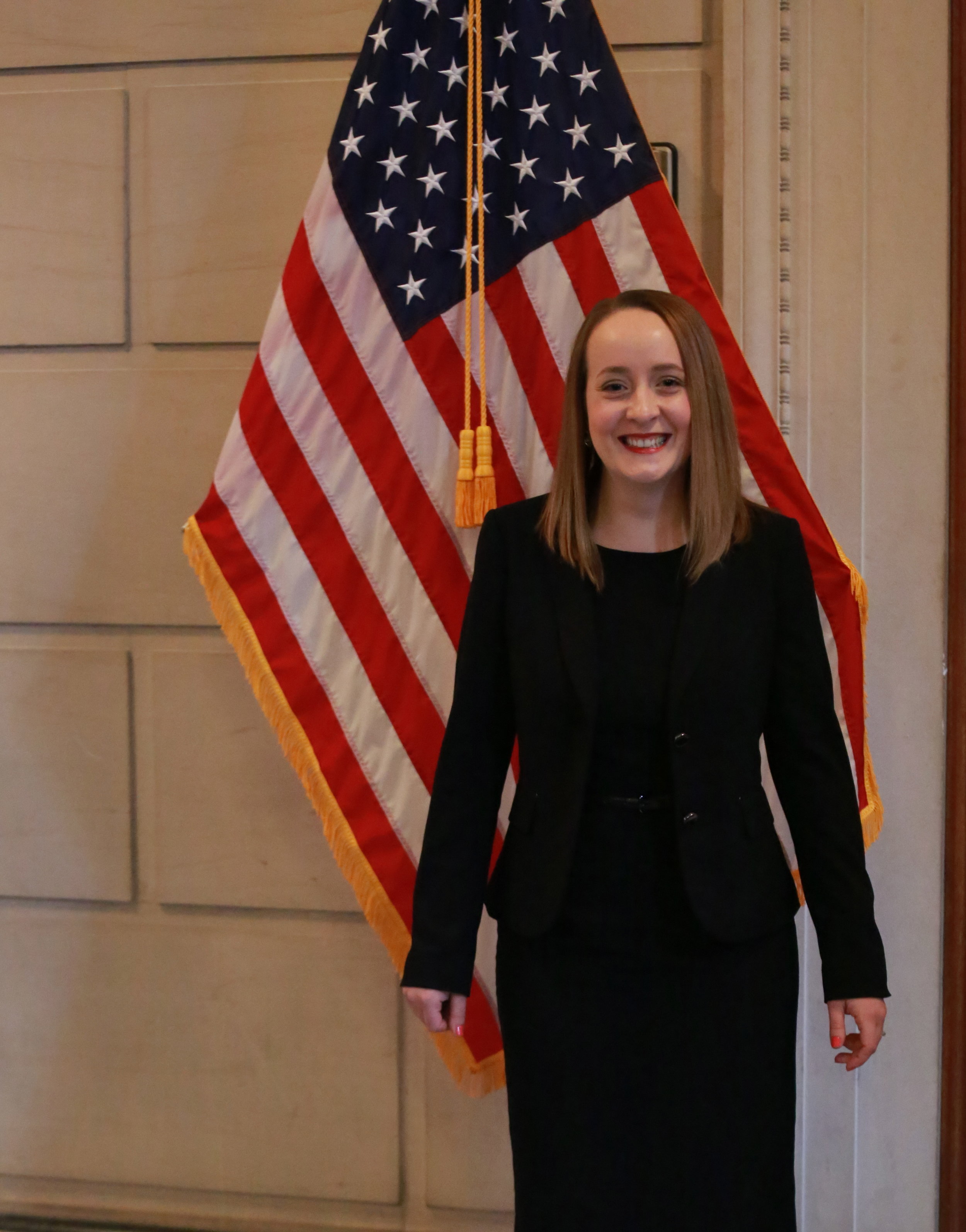
Carolyn in Brooklyn at the Supreme Court of the State of New York, Appellate Division, Second Judicial Department.
It's official! We're very excited to announce that Carolyn, who passed the bar last summer and has been working as a legal clerk at the firm, was sworn in as an attorney this week. It's especially exciting since Carolyn has held many positions at this firm, from receptionist to paralegal to law student intern to summer associate and now attorney-at-law. Congratulations, Carolyn Szaiff, Esquire!
OPINION: Trump and Immigration: What to Expect
It is no exaggeration to say that President-Elect Trump made immigration a centerpiece of his campaign, ever since the summer of 2015 when he launched it with his famous speech labeling Mexican immigrants drug dealers and rapists although some might be “good people.” He called for a total ban on Muslim immigration to the US, and applauded the Supreme Court’s ruling upholding the injunction on President Obama’s expanded DACA/DAPA program. But now that he’s been elected, what can we expect from President Trump on immigration beginning next week on January 20?
Read moreNew York Times: “Ailing Vermont Town Pins Hopes on Mideast Refugees”
In late 2015, when thirty governors from states across the country announced they didn’t want to resettle Syrian refugees, Christopher Louras, the mayor of Rutland, Vermont, sent the state’s Democratic governor a text. That text was to see if they could bring refugees to Rutland, a small town in rural Vermont. In September last year the State Department officially selected the city as a resettlement site. “I saw that as an opportunity to grow our population, bring in individuals, families, new Americans from Syria who have a strong work ethic, who were fleeing for their lives and looking to rebuild those shattered lives,” Louras tells the New York Times.
Rutland, with a population of 15,824, has lost residents since 2000. Some Rutlanders including Mayor Louras see refugee resettlement as an economic remedy to their shrinking city, while others are concerned about whether the city can absorb the newcomers. “Rutland’s demographic condition right now is not just one of a declining population, but it’s also a graying population,” says Louras, who became the mayor as a Republican, but is now an independent. “We need people.”
The plan has divided the city. Rutland First, an organization opposed to the refugee resettlement, says that they “are a group of sympathetic and deeply concerned Rutland residents, who understand the sufferings and displacements not only of Syrians but of other in strife-torn areas of the world” but that nevertheless “do not think this decision should be based on feelings of kindness.” They explain:
We are aware of burdens experienced by some communities who have accepted refugess as well as difficulties of those resettled. We think we must understand facts that have not been forthcoming and must consider the consequences of refugee resttlement in our City. Rutland has numerous unaddressed problems.
Members of Rutland First claim their concerns are strictly economic. “We’re kind of stuck out here, with our level of economic depression, with our level of crime and drug issues,” Timothy Cook, a doctor and an Army Reserve colonel who is part of Rutland First, says. “We’re the ones who are gonna have to foot the bill for this.” There are, of course, others who oppose Syrian resettlement. President-Elect Trump made a campaign process to suspend the resettlement of Syrian refugees in the US.
Rutland isn’t the only city welcoming refugees and immigrants for economic reasons. Cities in the Rust Belt, such as Pittsburgh and Dayton, Ohio, as well as in Maine and upstate New York, have set up services and organizations to connect immigrants and refugees with job opportunities. “Over the last couple of decades, especially in the last ten years, places have started to develop strategies to attract and retain immigrants and resettle refugees in order to boost their economic activity,” Audrey Singer, a senior fellow at the Urban Institute who has studied refugee resettlement in American cities, tells the New York Times. “We’ve seen a few neighborhoods kind of turn around because of immigrants and refugees moving in,” Melissa Bertolo, the coordinator for Welcome Dayton, says. She says that cities in the Rust Belt are “all looking at how immigrant integration plays a part in the revitalization of a city.”
“I think we’re right on the beginning of the cusp of serious, serious labor problems,” Art Woolf, an associate professor of economics at the University of Vermont, says. He believes that the state’s unemployment rate, at 3.6 percent, is a sign of trouble to come. “We’re low because there’s nobody available to work.” Additional population loss could potentially make it more difficult for the remaining major employers, including General Electric plants that make aircraft engine parts and the Rutland Regional Medical Center, to stay. Resettlement, says Lyle Jepson, the executive director of the Rutland Economic Development Corporation, is “supporting people when they need help.” But he says: “Frankly, we need help. We need people to join our community.”
A Bunch of People From Other Places

Refugees Welcome

Madrid's Gothic City Hall (formerly the post office) in Plaza de Cibeles has a sentiment that we should all support this coming year. With 60 million refugees worldwide, the world is facing the largest refugee crisis since the end of World War II, and "it is more important than ever that communities around the world open their hearts and doors to refugees seeking safety and a chance to rebuild their lives."
Ways to Support Immigrants and Refugees in America
It’s now been nearly two months since the US presidential election. Since that time, immigration attorneys have been discussing among themselves what they can do to help immigrants and refugees before and during the Trump presidency. Our firm’s attorneys will certainly be doing all we can, but it’s not only those with a law degree who can help and support immigrant members of our communities.
Read more