Daniele Pinto speaks three languages: Portuguese, Spanish, and English—all of which come in handy during her work as a paralegal for the firm. She is also an excellent cook and baker, a fact to which we can all attest as we’ve been lucky enough to sample her home-baked goods. (Seriously, Daniele, bring some more tres leches cake for the office to share! Please?)
Read moreMarketplace: “Immigration a concern amid looming Brexit vote”
On June 23, the United Kingdom will hold a referendum—referred to as the “Brexit” vote—to decide whether Britain should leave or remain in the European Union (EU). The referendum comes after Prime Minister David Cameron bowed to pressure from his own Conservative MPs before his general election last year and said: "It is time for the British people to have their say. It is time to settle this European question in British politics."
Immigration is an important issue in the referendum, as the EU guarantees the free movement of people between the twenty-eight member countries. Many Brits are worried about the record influx of immigrants who have come to the UK. Last year, there was a net inflow into the UK of more than 330,000 immigrants with half of them from elsewhere in the EU. Elisa Padilla from Spain, who has lived in London for three years, is concerned about the EU referendum. “It is a bit scary,” she tells Marketplace, “because underneath it all, I feel there is some sort of rejection of immigrants. English people don’t want more people from abroad coming here.”
While some claim that immigrants are affecting public services like healthcare, education, and housing, Italian immigrant Daniela de Rosa, who runs an Anglo-Italian website, is surprised by the referendum. “I wouldn’t have believed when I moved to London eleven years ago that one day someone would question our staying in Britain—as Europeans,” de Rosa tells Marketplace.
Deporting the 2 million EU migrant workers already in the UK wouldn’t make economic sense since they pay more in taxes than they take from the government and many dispute their supposed drain on resources. Michal Zdunczyk, a printing equipment engineer from Poland, disputes the charge that EU migrants are putting Brits out of work. “We basically fill the gap where the British people will not accept those jobs for that kind of money,” Zdunczyk tells Marketplace.
Gisela Stuart, a Labour MP and Vote Leave chair, says that British people are feeling the strains of “uncontrolled migration” and should vote leave in order to take back control from the EU. “As an immigrant myself, I am conscious of benefits immigration brings to this country," she says in the Guardian. "I have been very clear that I would like to see the introduction of an Australian Points based system—something that would also serve to end the discrimination inherent in the current system. But the fact of the matter is that the democratically elected UK parliament is prevented from doing any such thing because of the EU’s obsession with open borders.”
Prime Minister David Cameron claims it would be “madness” to try to reduce the number of migrants to the UK by voting to leave the EU and Hilary Benn, the UK shadow foreign secretary, says that a vote to leave the EU will not put a stop to the high levels of immigration, as foreign workers are needed in the country. “Immigration into Britain will continue whether we stay or go, as the Leave Campaign have now admitted,” he says. “And anyone who thinks that voting leave will bring the numbers down significantly will in time be bitterly disappointed.”
While many view the Leave Campaign as anti-immigrant, support for Brexit comes from many unusual sources including many chefs and curry house owners, predominantly from Bangladesh, who want to leave the EU since they claim current immigration laws and EU-mandated salary requirements make it extremely difficult for them to hire the skilled workers for their restaurants. Four or five of Britain's 12,000 curry houses are closing their doors every week, says Oli Khan, vice president of the Bangladeshi Caterers Association. "It's not that we think Europeans shouldn't have a chance in Britain, it's just that we feel the country should choose who it needs, what kind of skills they need, so that industries like ours are not short handed," Khan tells CNN. Meanwhile, the rest of the EU waits nervously for the outcome.
In It Together

Congratulations Carolyn and Andrew!
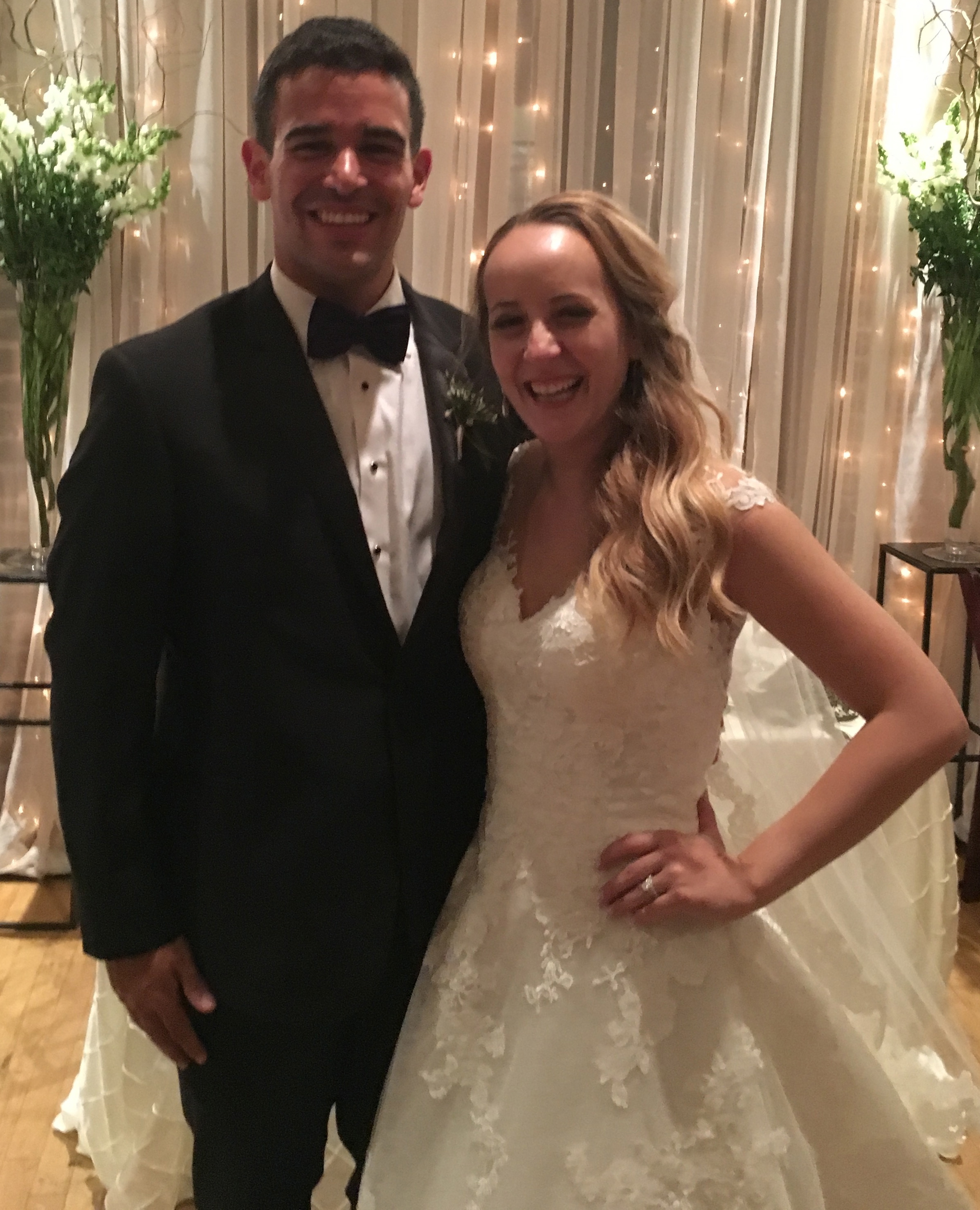
Our former receptionist, then paralegal, then summer associate, and now Associate, Carolyn married her fiancé Andrew last weekend in Brooklyn. Carolyn worked for us many years rising from receptionist to a key member of the team, before she went onto law school, and we're pleased that she will start with the firm as an Associate (after taking the bar admission) this fall. Carolyn and Andrew will both be studying for the bar exam this summer. We know, so romantic! Congratulations, you two!
The 101 on L-1s
Transferring an employee from a company’s foreign office to their US office is common in today's global world. Conveniently, US immigration law contains a visa for that purpose: the L-1. While some aspects of L-1s can present hurdles (as discussed in more detail below), ultimately, it potentially remains a great visa-type for companies and their employees.
Read moreNebraska Service Center Will Begin Accepting Certain I-129 H-1B and H-1B1 Extension Petitions on July 1
Effective July 1, 2016, the Nebraska Service Center (NSC) will begin accepting certain Form I-129 H-1B and H-1B1 (Chile/Singapore Free Trade) extension petitions if the petitioner is requesting an extension with the same employer (on the Form I-129, the box is listed as: “Continuation of previously approved employment without change with the same employer”) with one of the following requested actions:
- Notify the office in Part 4 so the beneficiary can obtain a visa or be admitted;
- Extend the stay of the beneficiary because the beneficiary now holds this status; or
- Extend the status of a nonimmigrant classification based on a free trade agreement.
The NSC will also accept the following forms filed concurrently with these I-129 extensions:
- H-4 Form I-539, Application to Extend/Change Nonimmigrant Status, and
- Form I-765, Application for Employment Authorization, for certain H-4 nonimmigrants.
Those filing a standalone Form I-539 and/or Form I-765 for H-4 nonimmigrants should refer to the direct filing addresses for Form I-539 and Form I-765.
Although not currently listed on the Direct Filing Addresses for Form I-129—we imagine it will be updated closer to the July 1 date—the NSC addresses are:
For US Postal Mail Service:
USCIS
Nebraska Service Center
PO Box 87129
Lincoln, NE 68501-7129
For Fed-Ex, UPS, etc:
USCIS
Nebraska Service Center
850 ‘S’ Street
Lincoln, NE 68508
In their press release, USCIS does not comment specifically on whether premium processing will be available for these petitions, though it is possible that it will be, as NSC does have a Premium Processing Unit that adjudicates I-140 petitions.
USCIS states that the California Service Center (CSC) and the Vermont Service Center (VSC) “may” continue to accept I-129 H-1B and H-1B1 extension petitions during the transition period, which ends August 31, 2016. With this linguistic uncertainty, it may be best to submit the relevant H-1B and H-1B1 extension petitions to the NSC to avoid any possible processing delays. While USCIS has not commented specifically on why this change is made, generally when a service center begins accepting new petitions or applications the intent is to free up other service centers and decrease processing times. The Vermont Service Center is currently processing H-1B extensions received August 31, 2015, which translates to approximately a very significant ten-month delay.
Petitioners should continue to file all other H-1B/H-1B1 petitions with the CSC and the VSC based on the instructions on the Direct Filing Addresses for Form I-129. Regardless of work locations, petitioners should always send the following types of petitions to the CSC:
- H-2A;
- R-1;
- H-1B petitions where the employer is statutorily exempt from the cap; or
- E-1 and E-2, petitions for extension of stay or change of status only.
Moreover, regardless of work locations, petitioners should always send the following types of petitions to the VSC:
- H-1C;
- E-3, Petitions for extension of stay or change of status only;
- Free Trade Nonimmigrants (H-1B1 aliens from Chile/Singapore and TN aliens from Canada or Mexico), petitions for extension of stay or change of status only;
- P-1, Major League Sports Organizations.
Magical Things
National Doughnut Day

National Doughnut Day was created by The Salvation Army in 1938 as a fundraiser to help those during the Great Depression as well as to honor members who provided aid and supplies—including doughnuts—to soldiers during World War I. We bought some doughnuts from the Donut Pub (open twenty-four hours!), and many stores are giving away free doughnuts, so hurry up and celebrate!
10 Street Photographers of New York

We love photography. Weegee and André Kertész are two favorites and ever since we saw the photographs of Vivian Maier, the great street photographer who lived and worked in Chicago (the documentary about her is fascinating), we've been following more and more street photography on Tumblr, Instagram, and elsewhere on the web. Here we thought we'd take a look at ten photographers working today who focus on our great city of New York, which seems to provide endless inspiration.
Read moreNew York Times: "Afghan Lovers Begin an Asylum Odyssey in New York"
Zakia and Mohammad Ali are a young couple from different sects in Afghanistan. After they eloped two years ago against the wishes of their parents, Zakia’s family members, from the Tajik ethnicity and Sunni sect of Islam, attempted to murder Zakia. For her family, Zakia’s marriage to Mohammad, an ethnic Hazara and a Shiite, was a dishonor worthy of death. Running for their lives, the young couple, described as Afghanistan’s Romeo and Juliet, faced exile in the high mountains of Afghanistan, fled briefly to Tajikistan where they were robbed of their possessions and savings, and spent time in jails and safe houses.
Now, in the next chapter of their harrowing story, they have arrived with their seventeen-month-old daughter, Ruqia, in New York City on a ninety-day visa granted by the American Embassy in Kabul. An international aid group plans to assist the couple in applying for asylum. “Since their case had become politicized and has received so much media attention, we knew that their lives would be endangered as long as they remained in Afghanistan,” Manizha Naderi, the executive director of Women for Afghan Women, who assisted the couple, told the New York Times. “They couldn’t live anywhere in peace. Zakia’s family would hunt them down.”
Like many asylum seekers, they face a difficult battle. Even if they win their asylum case in the United States, both are illiterate with little work experience beyond farming in their home of the Bamian Province. Not only do many asylum seekers face the often difficult task of wining their case, they also must learn English, obtain relevant job skills and education, and assimilate into US communities, which may be hard for those with close families and support communities in their home country.
Zakia and Mohammad Ali’s story has been profiled in countless publications across the globe, and New York Times correspondent Rob Nordland, who first learned about the couple when he was researching honor killings, wrote a book about them, titled The Lovers. “We submit to God—we tried everything here, but the situation did not change,” Mohammad Ali told the Times before his flight from Kabul. “[In the US] at least we will be able to live in security and safety.”