

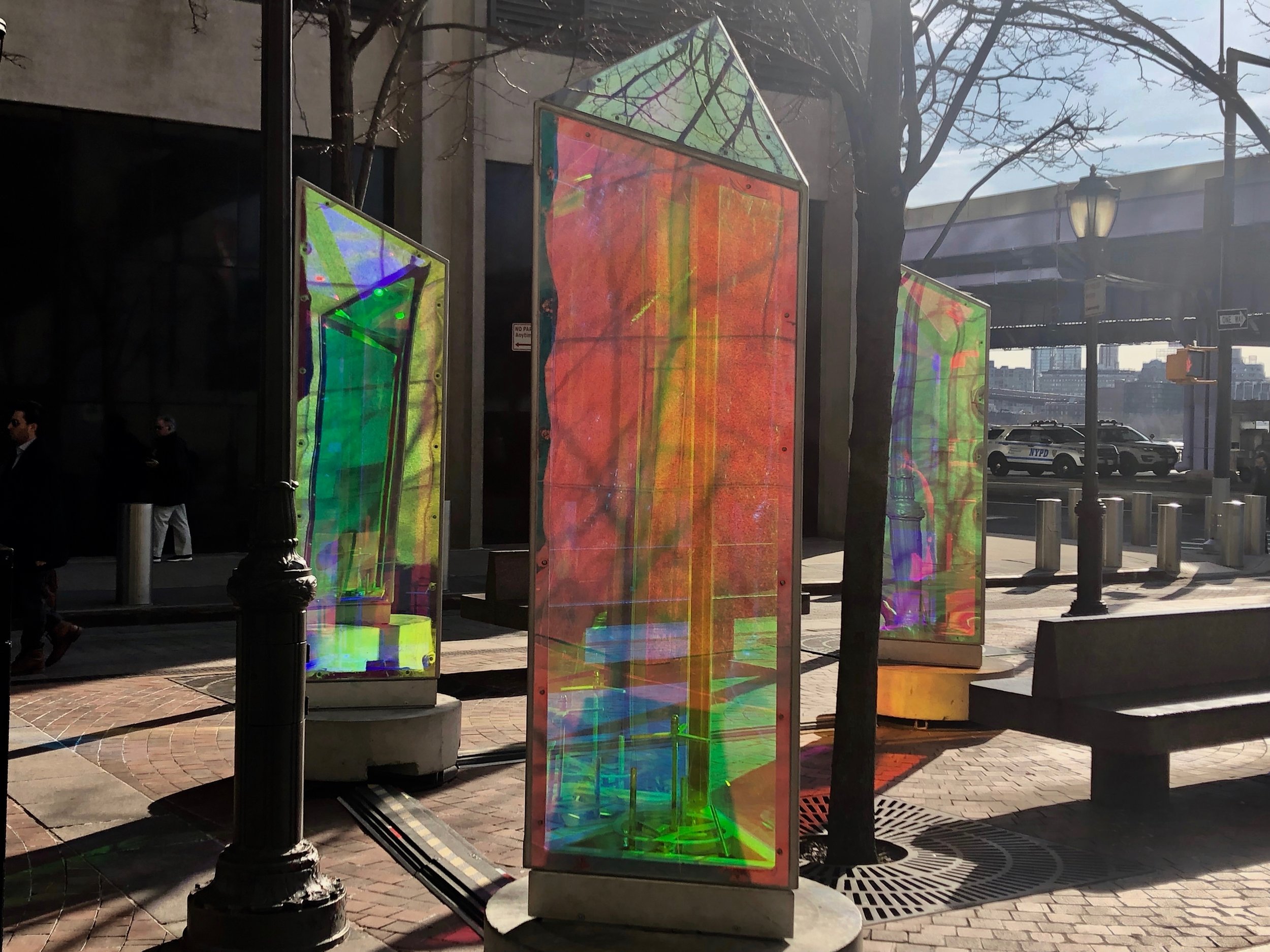
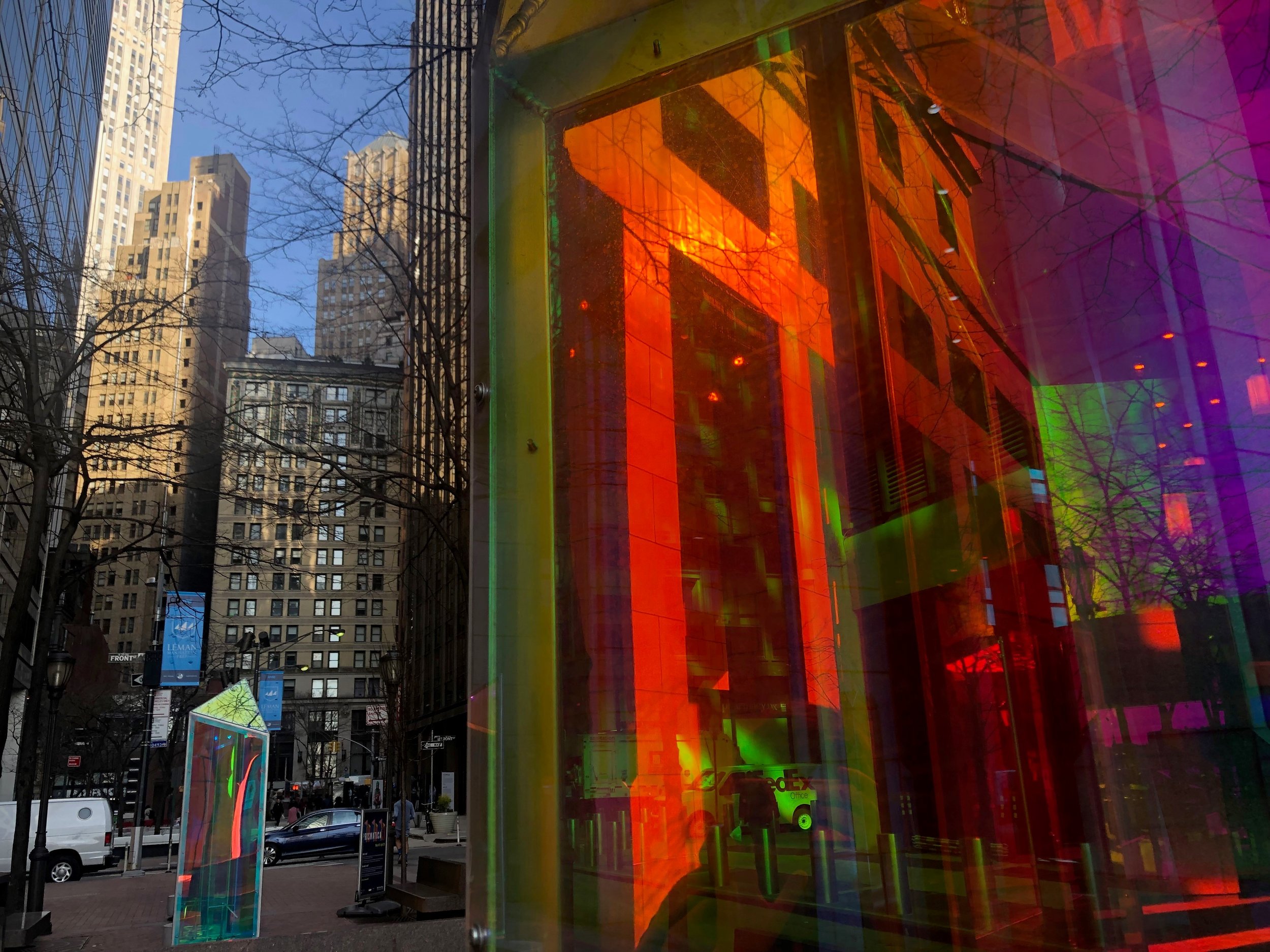
Prismatica is an interactive “art trail” of twenty-five kaleidoscopic prisms located in three public plazas in downtown Manhattan: 75 Wall Street, 77 Water Street, and 32 Old Slip. The seven-foot-tall prisms are covered in a dichroic film and, depending on the angle and light hitting the prism, can reflect every color in the visible spectrum. During daytime the prisms, which are able to spin, glimmer under natural light and send explosions of color over the surroundings. At night they provide atmospheric and colorful lighting. The project was originally created by Canadian architecture firm RAW Design for the 2014 Luminothérapie Competition in Montreal, and has since traveled across North America to such places as Ottawa’s Parliament Hill, Washington’s Potomac River, and Niagara Falls. Roland Rom Colthoff, director of RAW Design, says that they “wanted people to play around” and “have fun” with the prisms. Prismatica’s stay in New York will end after five weeks on April 21st.
Prismatica


The Washington Post: “Parents separated from their kids returned to the U.S. to be reunited. They’ve been detained for almost a month.”
Twenty-nine parents who were separated from their children and removed to their home countries in Central America last year traveled to the US/Mexico border last month with the hope of reuniting with their children in the US. The twenty-nine parents, some who have been separated from their children for nearly a year, presented themselves at the US/Mexico border on March 2. The parents asked to be allowed back into the US to resume their asylum applications and to be reunited with their children, who are in American foster homes, shelters, or with relatives.
Read moreStill Here

H-1B Blood, Sweat, and Tears
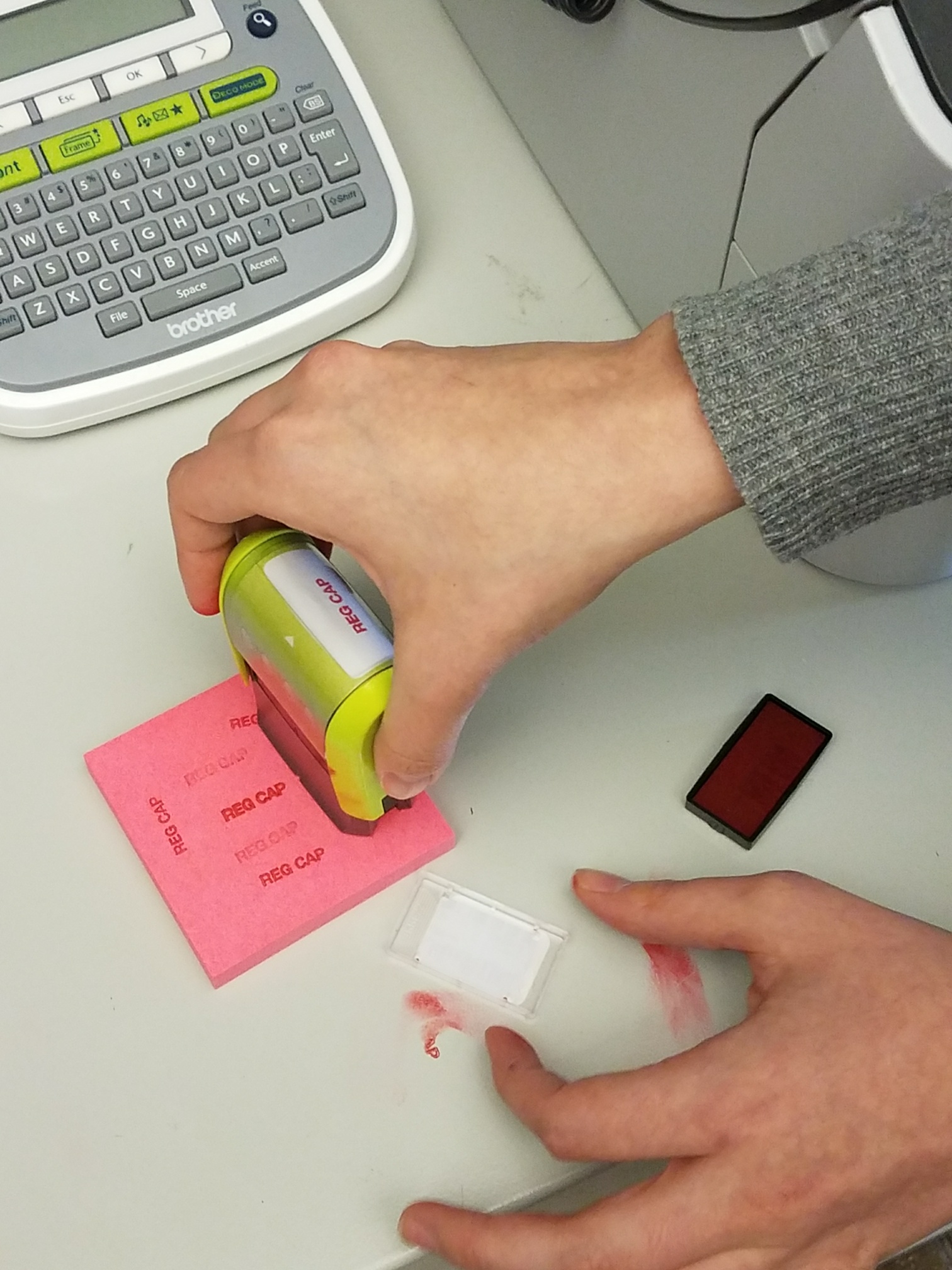
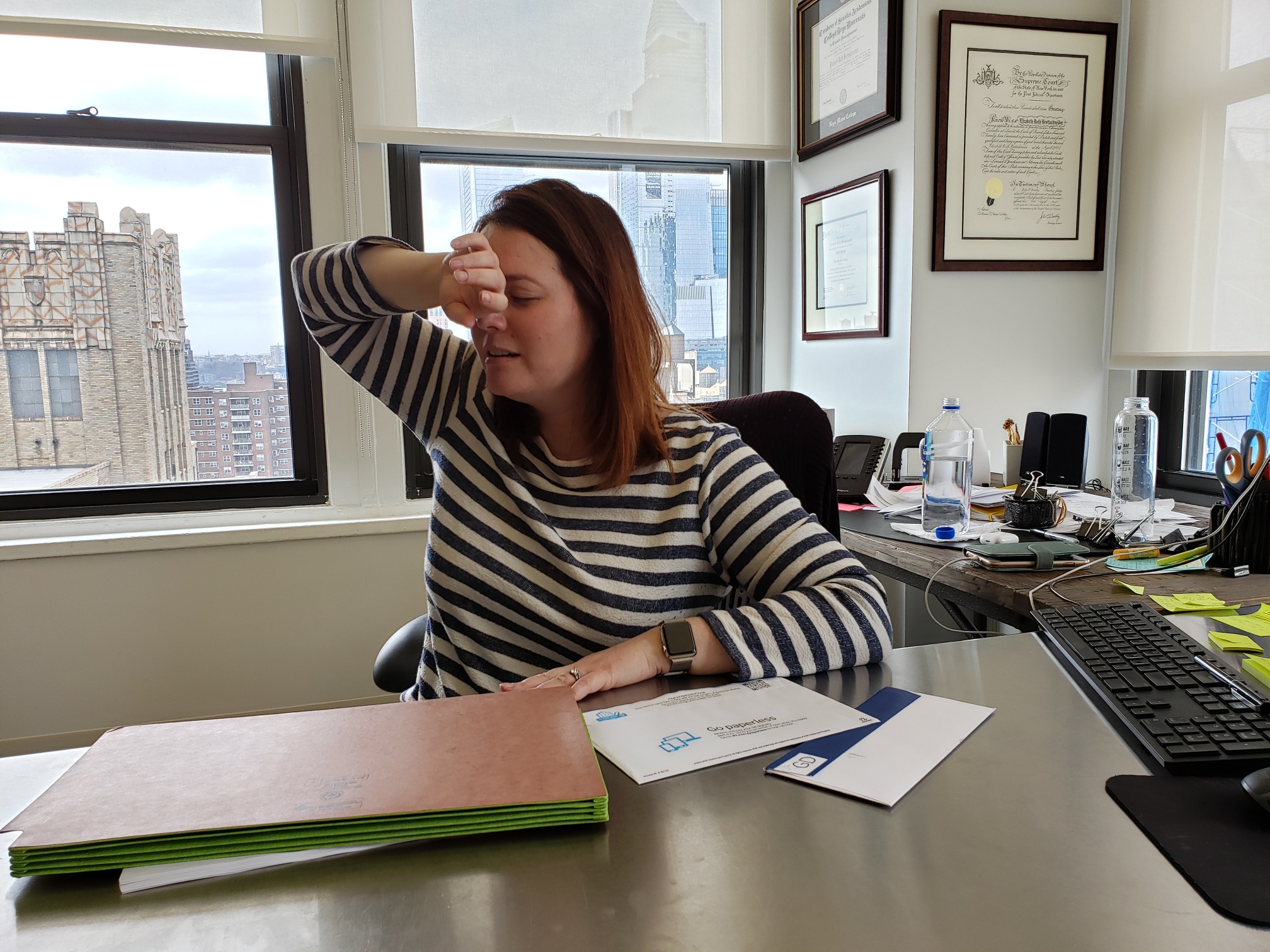
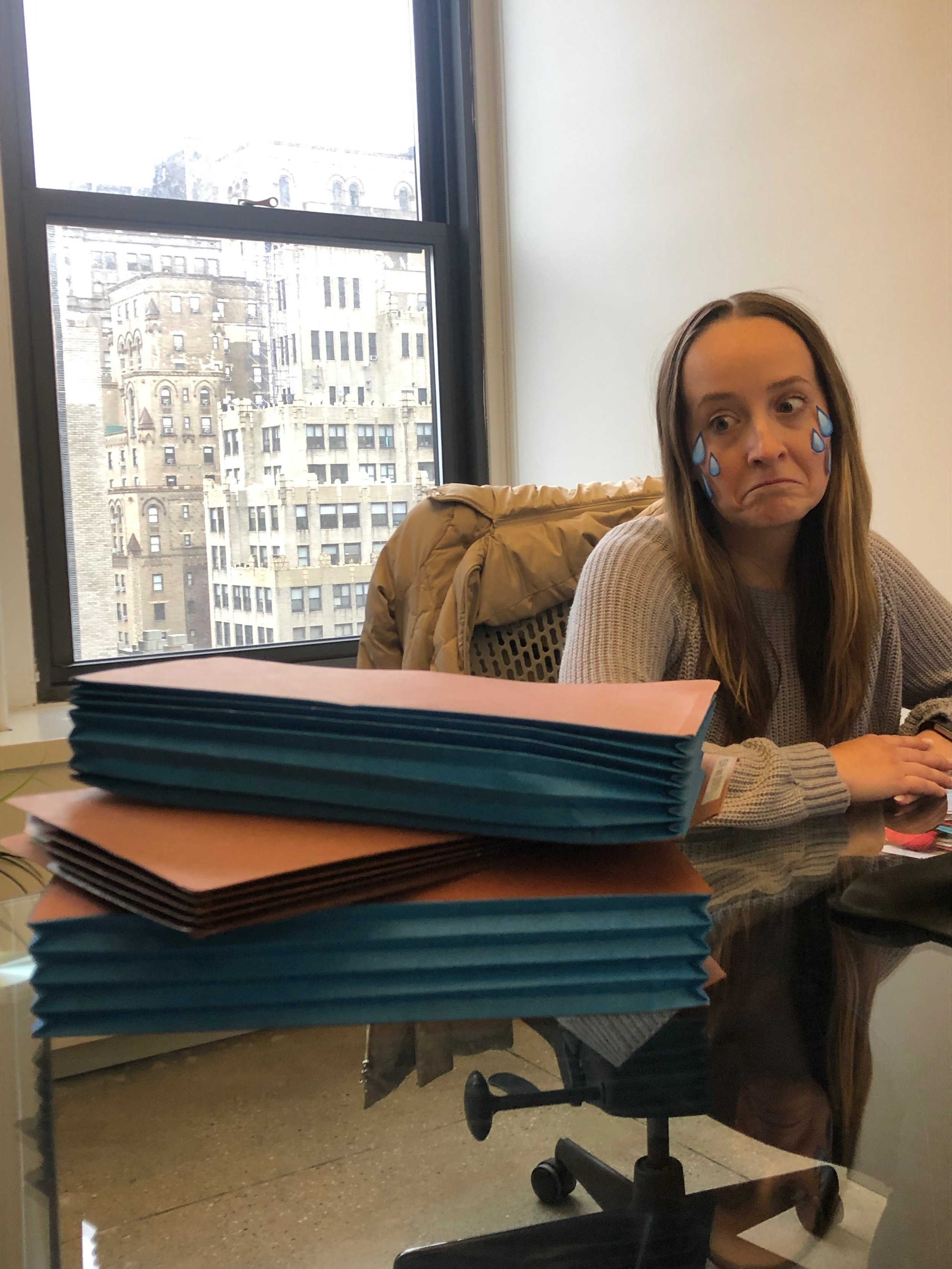
H-1B cap season is tough (as our previous Friday Photos over the years have shown). This week the firm pushed to put the final touches on all our cap petitions that will be filed starting April 1.
In preparation for sending out our H-1Bs, Gaby got into a bloody fight with our REG CAP stamp, Liz broke a sweat from running around to check in with our paralegals, and Carolyn bid some petitions a tearful goodbye. Nothing says a labor of love like some blood, sweat, and tears!
The Washington Post: “How a flight attendant from Texas ended up in an ICE detention center for six weeks.”
DACA beneficiary Selene Saavedra Roman from Peru, who has lived in the US for twenty-five years and is a flight attendant for Mesa Airlines, was detained shortly after she landed in Houston on a return flight from Mexico in February. Saavedra Roman remained in custody for six weeks and was released last Friday, but advocates are pointing to her case as an example of how the Trump administration’s attempts to end DACA continue to confuse program beneficiaries, their families, government agencies, and private employers.
Read moreNever Without Cost

Pegasus

In ancient legend, Pegasus is the “mythical creature who sprang from the blood of Medusa’s neck.” In famed contemporary artist Damien Hirst’s version, Pegasus is a flying horse encrusted completely with crystals residing in the Brasserie of Light, the Martin Brudnizki-designed restaurant in the British department store Selfridges. The sculpture, standing at twenty-four feet with a thirty-foot wingspan, is Hirst’s largest artwork in London, but isn’t the first time he has used this mythical creature in his work. Businessman Richard Caring says of his latest restaurant in Vogue UK: "The Brasserie of Light is a new look spectacle where the input of Damien Hirst, Martin Brudnizki and the absolute strength of Selfridges; this mix has resulted in what I believe to be something very beautiful. It is about light, make-believe and dreams." Hirst explains: “I love the myth of the Pegasus and this is such an exciting project and I love the scale of it. I hope it’s going to look like something beautiful from another world.”
USCIS: Fiscal Year (FY) 2020 H-1B Cap Season To Begin April 1, 2019
Today, USCIS officially announced April 1, 2019 as the start date of FY 2020 H-1B cap season. USCIS also explained changes to the H-1B application process itself, including how premium processing will work, the agency’s new H-1B data hub, and an update to the order in which cap cases are selected.
Premium Processing
Rather than fully suspending the premium processing requests, the agency has decided to offer it in two phases: first to FY 2020 cap-subject H-1B petitions requesting a change of status, and then secondly to all other FY 2020 cap-subject petitions. Premium processing for the first phase will commence on May 20, 2019.
Applicants wishing to use premium processing for their H-1B petitions requesting a change of status may concurrently file Form I-907 with the H-1B petition on April 1. These petitions will not be processed by USCIS until after all data entry on cap cases has been completed, around May 20, 2019. Petitioners may also convert cases filed as a change of status and picked in the H-1B lottery to premium processing after May 20, 2019 if they prefer. The rest of the FY 2020 cap-subject H-1B petitions will likely be able to upgrade to premium processing in June 2019.
H-1B Data Hub
The new H-1B Employer Data Hub — available on April 1st — will allow the public to search for H-1B petitioners by fiscal year, NAICS industry code, company, name, city, state, or zip code. The hub is meant to allow members of the public to calculate approval and denial rates as well as review which employers are using the H-1B program, therefore increasing transparency between the agency and the public.
Selection Process
As previously noted, the Department of Homeland Security has reversed the order in which USCIS will select petitions. The purpose of the reversal is to increase the chances that more advanced degree H-1B petitions will be selected in any lottery.
The New York Times: “Trump Administration Plans to Close Key Immigration Operations Abroad.”
Director L. Francis Cissna, of the United States Citizenship and Immigration Services (USCIS), recently informed senior staff members that the international division of USCIS operating in more than twenty countries will likely shut down by the end of the year, cutting a key support system for those applying overseas to relocate to the United States. The move to shut down is allegedly intended to provide more resources to handle the lengthy backlog in asylum applications domestically, but it could come at the expense of legal migration.
Read more