
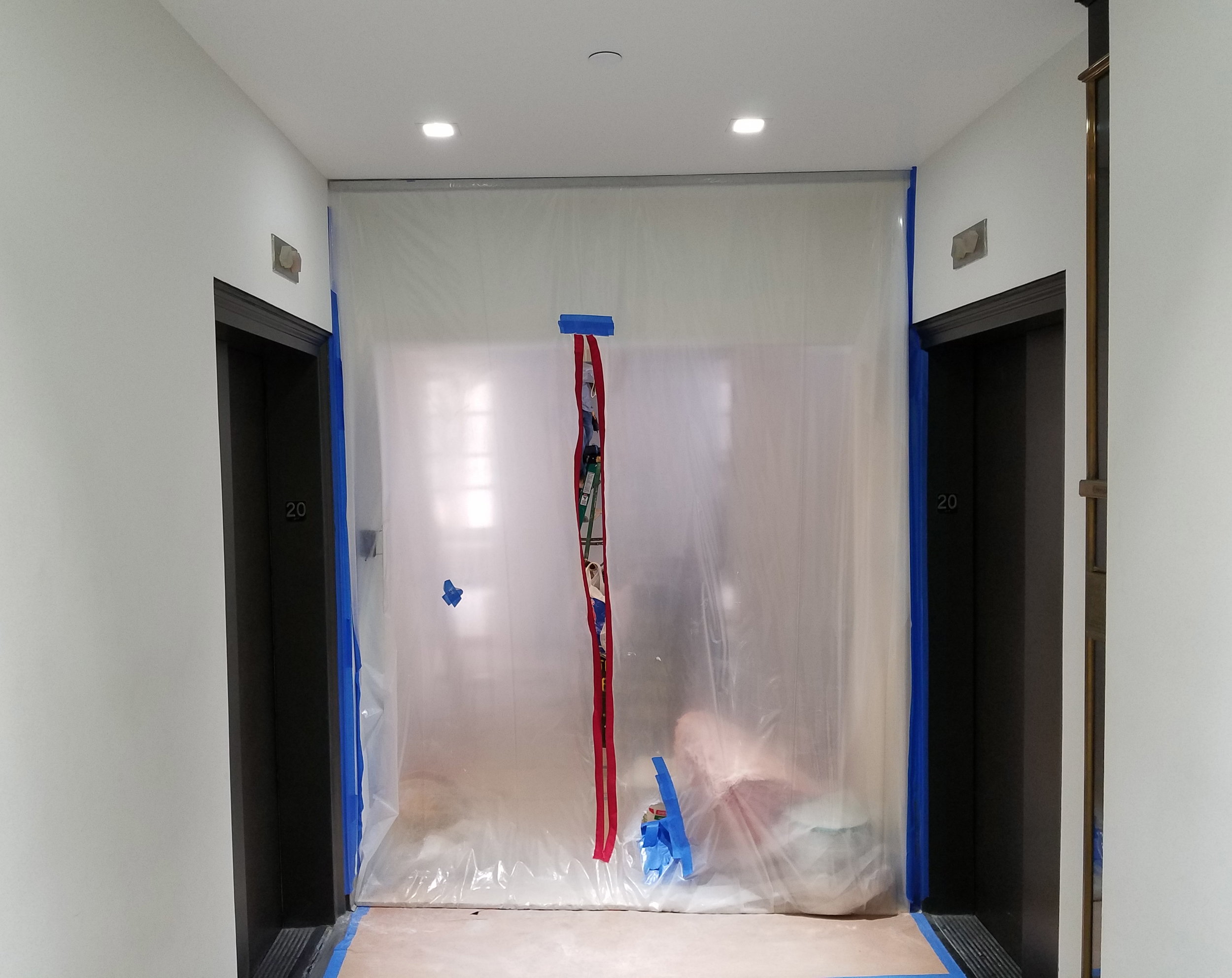
Okay, not quite. It still needs a little work. But it will all be done by next week, right? Maybe? But seriously, we are excited to announce that we are moving effective October 28th to a new space in Chelsea in Manhattan. We will post further updates and pictures next week. Yay, moving!
Our Brand New Office!
Key Differences between EB-1-1 Immigrant Petitions and O-1 Nonimmigrant Petitions
Jessica, a third year law student at Fordham University School of Law, is our fall associate. She is currently the Senior Notes Editor for the Fordham Journal of Corporate and Financial Law and a student attorney at the Immigrant Rights Clinic.
We regularly work with “extraordinary” individuals. And we don’t just mean “extraordinary” in the normal sense of the word—rare, phenomenal, and special—but also the type of “extraordinary” that fits US Citizenship & Immigration Service’s (USCIS) legal standard. That’s right, we’re talking about the O-1 nonimmigrant visa classification for individuals with “extraordinary” ability or achievement and the EB-1-1 immigrant visa classification for individuals who demonstrate “extraordinary” ability in the sciences, arts, education, business, or athletics through sustained national or international acclaim.
Read moreThe Washington Post: “Louisiana isn’t letting immigrants get married”
A new state law passed earlier this year in Louisiana has effectively made it illegal for thousands of immigrants to get married. Last year, after losing the fight over the legalization of gay marriage, legislators in Louisiana claimed undocumented workers—and even terrorists—had discovered they could exploit Louisiana’s marriage laws to gain citizenship, leading to a so-called epidemic of “marriage fraud.” In response, legislators passed a law stating that any foreign-born person wanting to get married in Louisiana must produce both a birth certificate and an unexpired visa (although a federal court ruled that marriage licenses cannot be denied based on immigration status).
The law has effectively prevented undocumented immigrants as well as many legal immigrants from marrying in the state. Louisiana is home to thousands of refugees, predominantly Vietnamese and Laotians who received asylum in the 1970s and 1980s after escaping war and communism, and even though these Louisianans often have Green Cards and even US citizenship, many have no access to their original birth documents. Xanamane, a US permanent resident in the process of applying for citizenship who was born in a village near Savannakhet, Laos, in 1975, the year the country fell to communism, never received a birth certificate. Although Xanamane and his partner, US-born citizen Marilyn Cheng, were married in a Buddhist temple in 1997, like many in the local Laotian community, they never obtained an official marriage license. When Xanamane was diagnosed with cancer this summer and was asked to provide evidence of his marriage, they attempted to get married in Louisiana and were twice turned away, even though they presented Xanamane’s Green Card, refugee documents, and driver’s license, “They told me I have to go back to Laos and get my birth certificate,” Xanamane tells the Washington Post. “But there isn’t any birth certificate there, either.” The couple opted for a last-minute courthouse wedding in Montgomery, Alabama, a seven-hour drive away, which takes appointments for courthouse marriage ceremonies and accepts Green Cards as proof of identity.
Since the law went into effect in January this year, six to eight couples each month have been turned down for a marriage license in Orleans Parish, the Times-Picayune reports, demonstrating how the law has affected marriage applicants. “My parents don't have birth certificates. They came over as refugees,” Minh Thanh Nguyen, executive director of the Vietnamese Young Leaders of New Orleans, which works with immigrant communities, tells the Times-Picayune. “They are born in rural areas and, I mean, who is going to produce a birth certificate for you? That is just a reality of immigrant communities. They come from rural areas…It's not as formal as the United States."
Only individuals born in the US or a US territory can apply to a judge for a waiver for the birth certificate requirement, but that is not an option for foreign-born applicants. "I think it is going to get worse and worse," State Senator Conrad Appel, who fought the bill’s restriction on immigrants, tells the Times-Picayune. "If people want to get married, I want them to get married."
The legislation's sponsor, Representative Valarie Hodges, said the law’s purpose is to prevent marriage fraud. Hodges told the House Civil Law committee that she introduced the bill because “one of her friends had accidentally married a man who was also married to someone else.” But other supporters of the legislation were clear what impact it would have on immigrants. Gene Mills, the leader of the Louisiana Family Forum organization, told a committee he backed the legislation because it "prevents persons who are in the United States illegally from marrying in Louisiana."
"If you are trying to use marriage as an immigration (regulation) tool, I think that's a mistake," Appel told his fellow Senators before they voted on the legislation last year. There are now discussions about introducing a bill to allow legal immigrants to get a marriage license without a birth certificate, but the earliest this would happen is in the next legislative session starting in April 2017. Fernando Lopez, a community organizer at the New Orleans Center for Racial Justice, says the organization is filing a lawsuit on behalf of those denied marriage licenses.
This Is Your New Country

I want a president

Just in time for the upcoming presidential election, artist Zoe Leonard's I want a president, installed on the High Line under the Standard Hotel through November 17, 2016, is a "poignant portrait of the cultural and political climate in the early ‘90s in New York City with words that still resonate today." Leonard wrote I want a president in 1992 in the same year that poet Eileen Myles ran for president as an independent candidate alongside George H.W. Bush, Bill Clinton, and Ross Perot. Leonard admits that I want a president is not the text that she would write today, but says: “I am interested in the space this text opens up for us to imagine and voice what we want in our leaders, and even beyond that, what we can envision for the future of our society. I still think that speaking up is itself a vital and powerful political act.”
My Immigration Story

Many people come up to me and say, “Joseph, how did you get your start in immigration law? I know that now you edit the law firm blog and work in human resources, but what was it like to be an immigration paralegal? And how does your hair get such great volume and bounce?”
Read moreCBP Makes Online I-94 Application Payment Available to Travelers Arriving at a Land Port of Entry
US Customs and Border Protection (CBP) have announced an enhancement to the I-94 website that allows travelers to apply and pay for their I-94 online prior to arriving at a US land port of entry. Travelers can now speed up their entry into the US by providing their biographic and travel information and paying the $6 fee for their I-94 application online up to seven days prior to their US entry. Note at this time this online I-94 application only applies to entries via land, not air and sea.
First implemented over fifty years ago, the I-94 is a document given to foreign nationals that (1) tracks arrivals and (indirectly) departures to and from the United States, and (2) is evidence of legal status in the US for foreign nationals in their category of admission (for example, H-1, O-1, L-1, F-1, and so on). The I-94 document is distinct from both a foreign national’s visa stamp (the stamp processed into a passport by a US Embassy/Consulate abroad) and the admission stamp (which is the ink stamped into a foreign national’s passport noting the date and place of entry and expiration of stay along with the handwritten category of admission).
Back in 2013, CBP made a major change with the I-94 procedure by eliminating the issuance of paper I-94 cards when foreign nationals arrived in the US. Upon entry to the US, instead of receiving a paper I-94 card, most foreign nationals receive only an admission stamp in their passport. This admission stamp notes the date and place of entry, category of admission, and expiration of stay. CBP uploads the foreign nationals’ information into its electronic I-94 system, and foreign nationals can, at a later time, print their I-94 document. Now, with the most recent advancement of the I-94 application, after submitting their information and payment on line, travelers will receive a “provisional I-94.” The I-94 online application will collect information that is otherwise collected in-person at the land port of entry, and includes biographic information (name, date of birth, country of citizenship), passport details, visa details (if applicable), and petition/Student and Exchange Visitor Program (SEVIS) number (if applicable).
CBP Commissioner R. Gil Kerlikowske explains the reasons for this change in a statement:
We continue our commitment to transforming the international arrivals experience with this new I-94 offering that expedites entry into the US at land ports of entry, while maintaining the highest standard of security. This automated functionality increases the efficiency of the entry process and reduces administrative duties for CBP officers—ultimately resulting in shorter waits for travelers requiring an I-94.
After online submission of all pertinent details, to finalize the I-94 issuance process, a traveler must present themselves at a land port of entry within seven days of their application and submit biometrics, if applicable, and be interviewed by a CBP officer. Travelers should be prepared to show evidence of their residence, employment, and/or travel plans, if requested by the CBP officer. If the traveler does not complete their I-94 issuance process within seven days of their application, their provisional I-94 will expire and they will have to reapply and pay the fee again. There are no refunds if the I-94 is not issued within the seven-day period or if the traveler is denied entrance to the US.
The secure I-94 website is designed to be user friendly and payment can be made with a credit card, debit card, direct debit, or through PayPal. Benefits of this process include “increased efficiencies during processing, decreased paper usage, a streamlined CBP inspection process for the traveling public and reduced operating costs.” Again, the online I-94 application only applies to US land port of entries at this time. There is no indication if and when it will extend to air and sea entries.
CBP claims the previous paperless online automation of the I-94 Arrival/Departure Record has greatly improved the traveler experience while saving the US government an estimated $34.5 million in its first two years, and this additional change should expedite the I-94 process even more, while this remains to be seen. For more information regarding the I-94 land automation or to access an electronic Form I-94, visit www.cbp.gov/I94, and to apply for the I-94 online, visit http://i94.cbp.dhs.gov.
Many Different Nations
Welcome Back, Ada!
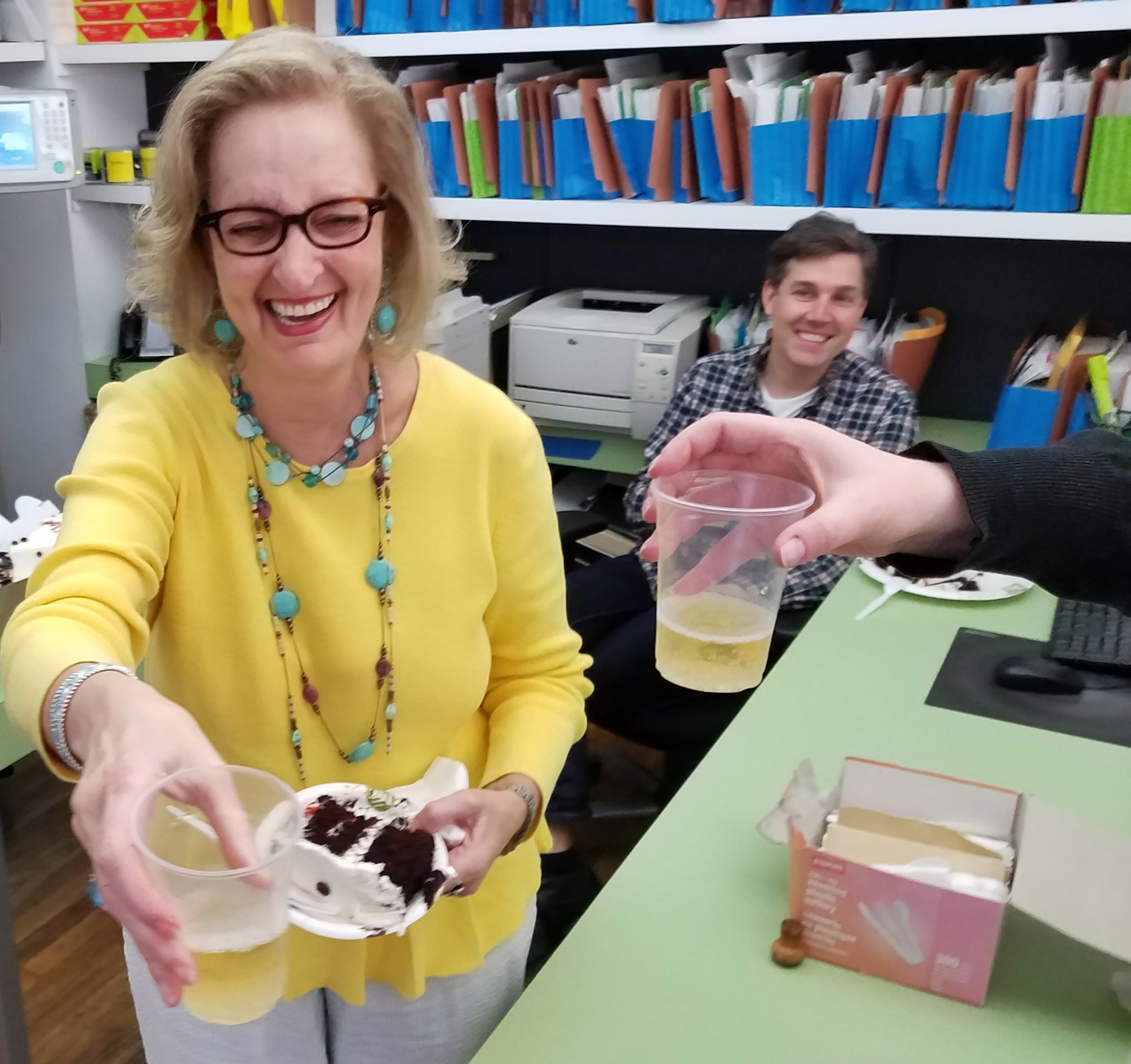
She was gone for a short time over the summer, and we are absolutely thrilled to have Ada, our longtime bookkeeper, back in the office. We celebrated with some black and white cake from Amy's Bread and some champagne (not too much, though, because it is a place of business even though it's Friday). We missed you, Ada! Welcome back!