

Just in time for the upcoming presidential election, artist Zoe Leonard's I want a president, installed on the High Line under the Standard Hotel through November 17, 2016, is a "poignant portrait of the cultural and political climate in the early ‘90s in New York City with words that still resonate today." Leonard wrote I want a president in 1992 in the same year that poet Eileen Myles ran for president as an independent candidate alongside George H.W. Bush, Bill Clinton, and Ross Perot. Leonard admits that I want a president is not the text that she would write today, but says: “I am interested in the space this text opens up for us to imagine and voice what we want in our leaders, and even beyond that, what we can envision for the future of our society. I still think that speaking up is itself a vital and powerful political act.”
My Immigration Story

Many people come up to me and say, “Joseph, how did you get your start in immigration law? I know that now you edit the law firm blog and work in human resources, but what was it like to be an immigration paralegal? And how does your hair get such great volume and bounce?”
Read moreCBP Makes Online I-94 Application Payment Available to Travelers Arriving at a Land Port of Entry
US Customs and Border Protection (CBP) have announced an enhancement to the I-94 website that allows travelers to apply and pay for their I-94 online prior to arriving at a US land port of entry. Travelers can now speed up their entry into the US by providing their biographic and travel information and paying the $6 fee for their I-94 application online up to seven days prior to their US entry. Note at this time this online I-94 application only applies to entries via land, not air and sea.
First implemented over fifty years ago, the I-94 is a document given to foreign nationals that (1) tracks arrivals and (indirectly) departures to and from the United States, and (2) is evidence of legal status in the US for foreign nationals in their category of admission (for example, H-1, O-1, L-1, F-1, and so on). The I-94 document is distinct from both a foreign national’s visa stamp (the stamp processed into a passport by a US Embassy/Consulate abroad) and the admission stamp (which is the ink stamped into a foreign national’s passport noting the date and place of entry and expiration of stay along with the handwritten category of admission).
Back in 2013, CBP made a major change with the I-94 procedure by eliminating the issuance of paper I-94 cards when foreign nationals arrived in the US. Upon entry to the US, instead of receiving a paper I-94 card, most foreign nationals receive only an admission stamp in their passport. This admission stamp notes the date and place of entry, category of admission, and expiration of stay. CBP uploads the foreign nationals’ information into its electronic I-94 system, and foreign nationals can, at a later time, print their I-94 document. Now, with the most recent advancement of the I-94 application, after submitting their information and payment on line, travelers will receive a “provisional I-94.” The I-94 online application will collect information that is otherwise collected in-person at the land port of entry, and includes biographic information (name, date of birth, country of citizenship), passport details, visa details (if applicable), and petition/Student and Exchange Visitor Program (SEVIS) number (if applicable).
CBP Commissioner R. Gil Kerlikowske explains the reasons for this change in a statement:
We continue our commitment to transforming the international arrivals experience with this new I-94 offering that expedites entry into the US at land ports of entry, while maintaining the highest standard of security. This automated functionality increases the efficiency of the entry process and reduces administrative duties for CBP officers—ultimately resulting in shorter waits for travelers requiring an I-94.
After online submission of all pertinent details, to finalize the I-94 issuance process, a traveler must present themselves at a land port of entry within seven days of their application and submit biometrics, if applicable, and be interviewed by a CBP officer. Travelers should be prepared to show evidence of their residence, employment, and/or travel plans, if requested by the CBP officer. If the traveler does not complete their I-94 issuance process within seven days of their application, their provisional I-94 will expire and they will have to reapply and pay the fee again. There are no refunds if the I-94 is not issued within the seven-day period or if the traveler is denied entrance to the US.
The secure I-94 website is designed to be user friendly and payment can be made with a credit card, debit card, direct debit, or through PayPal. Benefits of this process include “increased efficiencies during processing, decreased paper usage, a streamlined CBP inspection process for the traveling public and reduced operating costs.” Again, the online I-94 application only applies to US land port of entries at this time. There is no indication if and when it will extend to air and sea entries.
CBP claims the previous paperless online automation of the I-94 Arrival/Departure Record has greatly improved the traveler experience while saving the US government an estimated $34.5 million in its first two years, and this additional change should expedite the I-94 process even more, while this remains to be seen. For more information regarding the I-94 land automation or to access an electronic Form I-94, visit www.cbp.gov/I94, and to apply for the I-94 online, visit http://i94.cbp.dhs.gov.
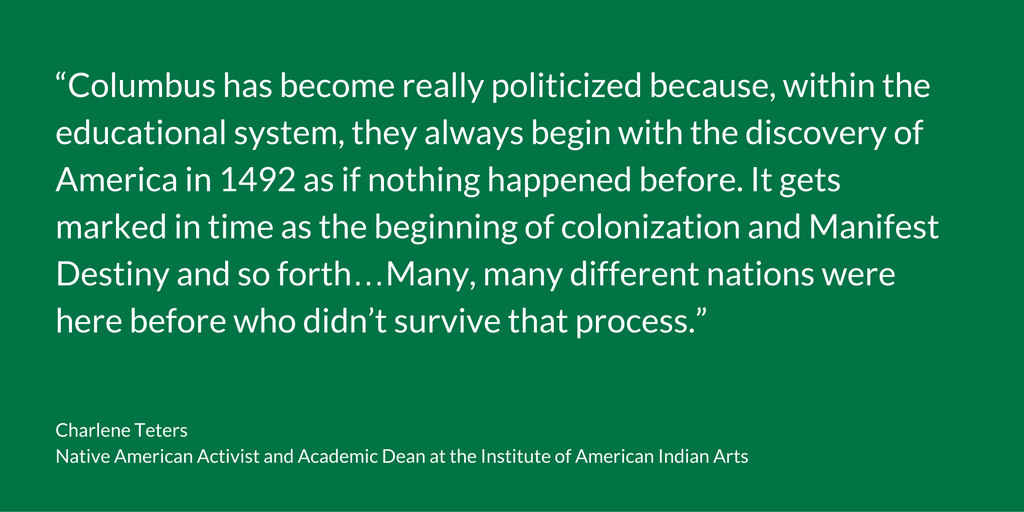
Many Different Nations
Welcome Back, Ada!

She was gone for a short time over the summer, and we are absolutely thrilled to have Ada, our longtime bookkeeper, back in the office. We celebrated with some black and white cake from Amy's Bread and some champagne (not too much, though, because it is a place of business even though it's Friday). We missed you, Ada! Welcome back!
All about Visa Reciprocity
Reciprocity is a principle of international law stating that the benefits, privileges, and penalties granted by one country to citizens of another country should be returned in-kind when the reverse occurs. In immigration law, this means that when a foreign government imposes certain fees or conditions on US citizens for certain visa types, the US government will impose the same fees or conditions on nationals of that country for similar visa types.
Read moreNY TIMES: “Haitian Men Cut Off From Families as U.S. Tightens Entry Rules”
As Hurricane Matthew, a dangerous Category 4 storm with devastating 145mph winds, hits Haiti and the Caribbean, Haitian families are also dealing with a sudden change in US entry rules that is dividing family members trying to enter the US. Late last month the US government decided to fully resume deportations of undocumented Haitian immigrants after previously allowing undocumented Haitians to enter the US and apply for temporary humanitarian parole, which was instituted in response to the devastating 2010 earthquake in Haiti. The policy change announced September 22 is a response by the Obama administration to a recent large influx of Haitian migrants who have traveled north from Brazil to Mexico to seek entry to the US at various points along the border.
Until late last month, most Haitian undocumented immigrants have been given permission to remain in the country for as long as three years under the humanitarian parole provision, immigrant advocates said. With the policy change, however, Haitians who arrive at the border without visas will be put into expedited removal proceedings. Jeh Johnson, the Secretary of Homeland Security, justified the move in a statement by noting that Haiti had “improved sufficiently to permit the U.S. government to remove Haitian nationals on a more regular basis.”
The sudden deportation policy change has separated wives from husbands and children from their fathers, stranding men in Mexico. “I’m hoping God makes miracles,” Sandra Alexandre, who was allowed into the US last month ahead of her boyfriend and gave birth three days later, tells the New York Times. Immigrant advocates in San Diego have reportedly identified more than fifty families in that city alone separated due the policy change, and are making appeals to Homeland Security officials to help reunite the families. “The bottom line is that this was not a well-conceived policy,” Andrea Guerrero, executive director of Alliance San Diego, a group helping Haitians who have crossed the border, tells the New York Times. “It seemed to have come down from one day to the next without a clear understanding of what was going on and what kind of impact it would have.”
Part of the reason for why families are being separated is that border officials have been using an appointment system giving priority to women and children. Men, even when accompanying their partners and children, usually had to wait for later appointments in overcrowded shelters. Sandra Alexandre, for example, arrived in the border city of Mexicali with her boyfriend, Volcy Dieumercy, after a ten-week trip from Curitiba, Brazil. Because she was pregnant, Mexican and American border officials granted Alexandre an earlier appointment but denied the couple’s request that Dieumercy be processed on the same day. Alexandre entered under a three-year humanitarian parole, and soon learned that Dieumercy had been barred from entering under the new policy. If Dieumercy is not allowed into the country she is unsure of what she would do. “I haven’t thought that far ahead,” she says. “Right now, I’m only thinking positively.” Dieumercy knows that if he tries to enter the US at a port of entry, he will probably be deported to Haiti. “I need my family,” he says. “I can’t wait any longer. I’m very sad.”
Haitian nationals currently covered by Temporary Protected Status are unaffected by this change in policy, the Department of Homeland Security says. Specifically, Haitian nationals who have been continuously residing in the US since January 12, 2011 and currently hold TPS may remain in the United States and are not subject to removal. At this time it is uncertain if a potentially devastating Hurricane Matthew would cause the US government to reverse the recent deportation policy change. We will provide updates as we receive them.
UPDATE OCTOBER 14, 2016:
US Secretary of Homeland Security Jeh Johnson announced this week at an event in Mexico City that after Hurricane Matthew ravaged Haiti, killing at least a thousand people and leaving 1.4 million in need of humanitarian assistance, it has temporarily suspended deportations. "We will have to deal with that situation, address it, be sympathetic to the plight of the people of Haiti as a result of the hurricane," Johnson said at the event. "But after that condition has been addressed, we intend to resume the policy change," he added, though he did not specify a time frame.
Bravery

Positano
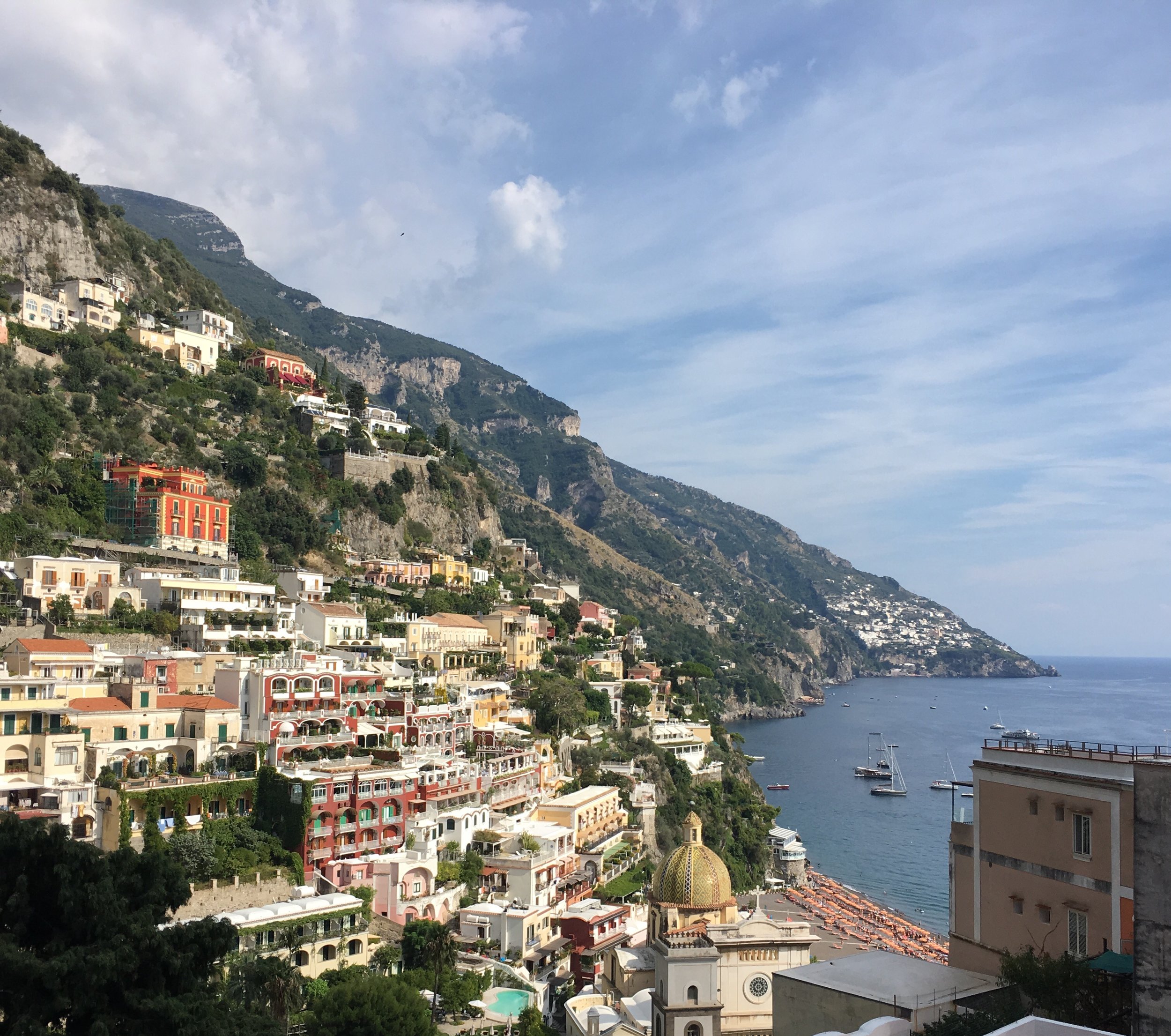
Positano is one of my favorite places. I was able to enjoy a few days of holiday in this tiny town on the Amalfi Coast in Italy. With Moorish-style architecture that rises up steep slopes (get ready to climb some stairs!), Positano has many stylish boutiques, a charming shoreline and pebble beach, and excellent restaurants. The majolica-tiled dome of the Chiesa di Santa Maria Assunta can be seen from all over town. A local legend explains where the name "Positano" originated. In ancient times, when a Turkish boat became beached off the shores of what is now the town, the captain heard a painting of the Virgin Mary that was on the ship whisper, "Posa, posa" ("Set me down, set me down"). When the captain threw the image into the sea, miraculously, the ship floated upright. The locals built the church at the place where the painting washed ashore, interpreting the event as a sign that the Virgin had chosen their town as a resting place. Which would not be surprising. Because it's truly a wonderful place to rest.
USCIS Is Going Paperless (Someday): What Could Possibly Go Wrong?
They say the art of letter writing is dead, and yet every week we send carefully penned letters, laboriously printed on reams of dead trees and lovingly hand-signed in blue or black ink, a choice that can be surprisingly important to the receiving agent at US Citizenship & Immigration Services (USCIS). Many US government agencies have implemented electronic forms for everything from paying your taxes to registering to vote. And, of course, many people have been conducting much of their personal business online for decades now—from ordering lunch to banking to managing their 401(k).
Read more