
WSJ: “Immigration and the Pope From the New World”

Amid the continued heated rhetoric about immigration and immigrants among the presidential contenders—and especially from Donald Trump who introduced an anti-immigration platform—many are wondering how Pope Francis (who just landed in the US this afternoon) will address the issue of immigration in his historic and much anticipated papal visit to the United States.

Will the Pope Encourage Immigration Reform?

In a Wall Street Journal Op-Ed, the Most Rev. José H. Gomez, archbishop of Los Angeles and author of Immigration and the Next America: Renewing the Soul of Our Nation, believes that the pope will use his brief time in the US to encourage immigration reform. A sign of this is his decision to canonize America’s first Hispanic saint, Junípero Serra, a Franciscan who spent nearly forty years in the mid-1700s “spreading the Gospel, defending the native peoples, and laying the foundations for a vibrant civil society and Christian civilization, first in Mexico and later in California.”

Noting that Pope Francis is himself the son of an immigrant father—who fled fascism in Italy to settle in Argentina—the archbishop believes the pope understands that “the immigrant spirit is a wellspring for economic and moral revitalization,” and consequently the pope is “hoping to inspire Americans to rediscover their nation’s Hispanic and Christian foundations—at a moment in our history when these foundations are being put to the test.” He goes on:

We see this in the protracted debates over immigration reform, with their undeniable racial undertones. These debates have exposed deep apprehensions about our national self-identity—caused not only by the presence of millions of undocumented Hispanics but also by the uncertainties of globalization and the country’s changing racial and ethnic profile.

100 Women, 100 Miles

While not everyone is thrilled with the canonization of Junípero Serra—some activists hold Serra responsible for the enslavement and deaths of numerous indigenous people and as a person “emblematic of the dangers of colonialism” and are strongly against the canonization—many other US clergy and immigration reform activists are also hoping that Francis’ congressional visit could lead “to the beginning of an honest debate of how to fix the broken immigration system.” In a recent press conference in Washington D.C., activists and clergy from numerous faiths expressed their hope that Congress will heed the pope’s message. “We don’t know what the Holy Father [will say]… but he’s been a strong defender for persons on the move—immigrants, refugees, trafficking victims,” Cardinal Theodore E. McCarrick, Archbishop Emeritus of Washington, D.C., said at the press conference.  

A group of female immigration activists is walking to Washington D.C. and hope their message will be heard by Pope Francis. Organized by We Belong Together, a non-profit immigration organization, the march is called 100 Women, 100 Miles, and includes numerous activists, such as Rosi Carrasco, an undocumented immigrant from Chicago. “The pope represents for us a hope for dignity and respect,” she said in the Patriot News. “I think he will listen to our stories and our message…I hope the people in this country will hear that things need to be different and people need to be treated with dignity.”

The Pope’s Record on Immigration

Pope Francis has a strong record of speaking out for immigrants and migrants. He has called on Europe and the United States as well as Catholic parishes, convents, and monasteries to aid Syrian migrants. And he warned European lawmakers: “We cannot allow the Mediterranean to become a vast cemetery!”

While he will not be visiting the US-Mexico border as originally hoped too, he does plan to meet with immigrants (some undocumented) on his America tour. He is expected to be, at the very least, the “anti-Donald Trump.” 

Matt and Protima at the Vermont Service Center

Excuse me, where I can deliver this H-1B petition?

Excuse me, where I can deliver this H-1B petition?

Matt and Protima are in beautiful New England for the Vermont Service Center Fall Stakeholder Event. These stakeholder events are important since they allow US Citizenship & Immigration Services (USCIS) to discuss key immigration issues and topics with lawyers and other stakeholders. On the agenda for today were roundtable events related to business-related immigration case types, family-based immigration case types, student-based case types, customer service issues and concerns, as well as—the best part really—a tour of the Vermont Service Center (VSC)! For security reasons, the VSC doesn't allow photos of their buildings, but this street sign is perfect: the regular Vermont Service Center is on Lower Welden Street and H-1B cap processing is on Lemnah Drive—this truly is one of the great crossroads of the immigration world!

5 of the Best Plays About the Immigrant Experience

Immigration has been a subject of art and storytelling for as long as stories and borders have existed. One of the most fundamentally dramatic human experiences, the act of moving one’s whole life to another country or continent brings with it a wide range of emotions, opportunities, and obstacles, which are the natural stuff of great theatre.

Read more

USCIS Introduces Emma, Their New Virtual Assistant

Emma wants to help you with your immigration questions!

Emma wants to help you with your immigration questions!

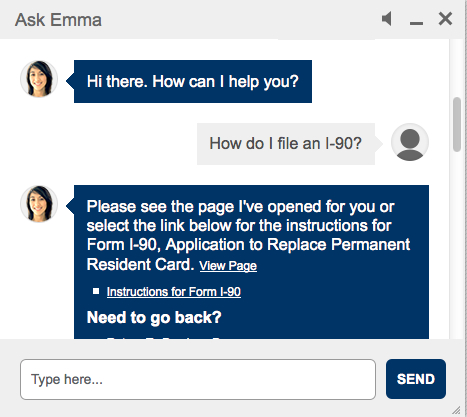
US Citizenship & Immigration Services (USCIS) is getting ready to debut Emma, their new virtual assistant. Billed as an “innovative way to help you find information” on USCIS.gov, Emma will be located at the top right of the USCIS.gov homepage and when clicked, will open up into a chat window. As indicated in the preview, Emma gives an immediate written and spoken response to questions and will also look for specific pages on USCIS.gov and automatically refer the user to these pages for more information.

According to USCIS’s email announcing Emma’s debut: “Emma is still learning so that in the future she can answer many different questions about the services USCIS provides.” USCIS is thus encouraging users to ask Emma questions as the more questions Emma is asked, the “smarter” Emma will become.

Hi, Emma!

We tested Emma out briefly this afternoon with some questions:

“How do file an I-90?”

Emma sent us to the I-90, Application to Replace Permanent Resident Card page. Nice job, Emma!

“How do I apply for employment authorization?”

Emma sent us to the I-765, Application for Employment Authorization page. Again, nice work!

“My O-1 has been pending for two months. How do I quickly get the case adjudicated?”

Emma provided information on the O-1 page but didn’t address what action to take to either convert the case to premium processing or file a service request for cases pending outside normal processing times. Something to work on, Emma.

“My case is outside normal processing times. What do I do?”

This time Emma was a little more helpful. She said: “We usually processes cases in the order received. Please check our website for the normal processing times for your case type. If your case has been pending longer than the processing time posted on our website, select the link below to submit an inquiry...

“How do I sponsor my employee?”

Emma rather unhelpfully gave us information on the Affidavit of Support, Form I-864, normally used for family-based immigrants to show they have adequate means of financially support. So this is another question where Emma could definitely improve her response.

“When will comprehensive immigration reform pass?”

We decided to get a little more advanced. Emma gave us the pages for applying for a Green Card and for citizenship, which doesn't quite answer it. More relevant pages would include USCIS.gov's page on President Obama's executive actions and also the Deferred Action for Childhood Arrivals (DACA) page.

"Do you read dbvisablog.com?"

Emma's response was thoughtful if disappointing: "I don't have a favorite book, but I do enjoy reading A Guide to Naturalization. It is extremely helpful if you are becoming a U.S. citizen."

A New Way of Thinking

According to USCIS, Emma’s development team will examine every question Emma answers incorrectly or is unable to answer and then “teach” Emma how to answer that question in the future. USCIS is hoping the expanded database will mean better customer service when Emma is ready to debut and, we believe, serve as an alternative to USCIS’s 1-800 representatives, which historically have not always been as helpful or well informed in responding to clients’ more complicated questions.

USCIS states: “Emma is an example of a new way of thinking about making our online tools and services as useful as possible. Your insights and collaboration throughout this process will help make this happen.” At this time, Emma works best with Chrome, Safari, Firefox, or Internet Explorer 9, USCIS reports. (We had a slight issue using Emma with Firefox, though Chrome seemed to work fine).  Users are also encouraged to send any issues or problems they experience using Emma to askemma@uscis.dhs.gov.

We look forward to working with Emma in the future!

UPDATE DECEMBER 4, 2015: Emma is live! After a few months of testing, USCIS has launched Emma this week on USCIS.gov. Emma answers questions in English with the goal of appropriately navigating users to relevant USCIS web pages. While Emma can answer many basic questions, her knowledge base is still growing, and as customers ask more questions, Emma gets smarter and can better assist future customers.
 
At this time, Emma can be accessed on a desktop or laptop, but soon she’ll be expanding to mobile devices. Her Spanish language capabilities will be arriving early next year. To ask Emma a question go to USCIS.gov and click “Ask a Question” in the upper right-hand corner of the page.

USCIS Announces Revised Procedures for Determining Visa Availability for Certain Applicants Waiting to File for Adjustment of Status

US Citizenship & Immigration Services (USCIS) along with the Department of State (DOS) is revising the procedures for determining visa availability for applicants waiting to file for employment-based or family-sponsored preference adjustment of status. The revision in the process means that certain people will be eligible to file their adjustment of status applications (and the interim benefits that go along with that filing including work cards and travel permission) earlier than the date their Green Card priority date becomes current. USCIS states that the "revised process will better align with procedures DOS uses for foreign nationals who seek to become U.S. permanent residents by applying for immigrant visas at U.S. consulates and embassies abroad."
 
Implementing President Obama's November 2014 executive actions on immigration—as detailed in the White House report, Modernizing and Streamlining Our Legal Immigration System for the 21st Century—the revised process will enable foreign nationals (and their spouses) to obtain work cards and travel permission faster than they might have, and enable DOS to more accurately predict overall immigrant visa demand and determine the cut-off dates for visa issuance published in the monthly Visa Bulletin. All this, according to USCIS, will "help ensure that the maximum number of immigrant visas are issued annually as intended by Congress, and minimize month-to-month fluctuations in Visa Bulletin final action dates."

What Is the Visa Bulletin?

Every month the DOS publishes the current immigrant visa availability in a monthly Visa Bulletin. This Visa Bulletin indicates when statutorily limited visas are available to prospective immigrants based on their individual priority date for both the family-based and employment-based preference categories. The priority date is generally the date when the applicant’s relative or employer properly filed the immigrant visa petition on the applicant’s behalf with USCIS; or, if a labor certification was required to be filed with the applicant’s immigrant visa petition, the priority date is when the labor certification application was accepted for processing by the Department of Labor. Availability of an immigrant visa means eligible applicants are able to take the final steps in the process of becoming US permanent residents—namely, applying for an immigrant visa at a US Embassy or Consulate abroad or else applying for an adjustment of status to permanent residency if in the US.

What is Changing in the Visa Bulletin?

Effective in the October Visa Bulletin, there are now two charts per visa preference category:

  • Application Final Action Dates (dates when immigrant visas may finally be issued); and
  • Dates for Filing Applications (earliest dates when applicants may be able to apply for adjustment of status).

Applicants can use the charts to determine when they are eligible to file their Form I-485, Application to Register Permanent Residence or Adjust Status. USCIS states that to determine whether additional visas are available they will compare the number of visas available for the remainder of the fiscal year with:

  • Documentarily qualified visa applicants;
  • Pending adjustment of status applications; and
  • Historical drop-off rate, including denials, withdrawals, and abandonments.

Who is Affected?

The October Visa Bulletin introduces the new adjustment filing date chart and allows many people who have been waiting for their Green Card priority date to become current to now file for the adjustment of status. Significantly the "Dates for Filing" for China-born and Indian-born nationals in the EB-2 category is May 1, 2014 and July 1, 2011, respectively, which is years ahead of these Green Card priority dates (January 1, 2012 and May 1, 2005, respectively). The changes also affect family-based visa applicants. Therefore, someone who has been waiting for a priority date for their Green Card may be able to apply for adjustment of status earlier. They will not get their Green Card unless the Green Card priority date becomes current but they will enjoy the benefits of being an adjustment applicant, namely the interim work card and travel permission that they can keep while their adjustment of status application remains pending.

For those eligible to apply, USCIS has more information about filing the adjustment of status. One of the most sought after benefits and advantages to filing adjustment of status is that applicants can concurrently file employment authorization and travel permission applications. An experienced immigration attorney will be able to advise if foreign nationals are eligible to file for adjustment of status and what the next steps would involve.

UPDATE SEPTEMBER 25, 2015: The Department of State (DOS) has today unexpectedly published an updated and revised October 2015 Visa Bulletin. This bulletin supersedes the bulletin for October 2015 that was originally published on September 9, 2015, and the revised dates affect priority and filing dates for certain nationalities. US Citizenship & Immigration Services explains:

Following consultations with the Department of Homeland Security (DHS), the Dates for Filing Applications for some categories in the Family-Sponsored and Employment-Based preferences have been adjusted to better reflect a timeframe justifying immediate action in the application process. The Dates for Filing Applications sections on pages 4 and 6, which have been adjusted, have been identified in bold type and highlighted.

Applicants are advised to use the revised chart when determining eligibility to file adjustment of status applications. Applicants are advised to consult with qualified immigration attorneys for questions about eligibility and the revised visa bulletin. We will post more information as we receive it.

UPDATE SEPTEMBER 8, 2015: Immigrants are protesting the amendments to the October Visa Bulletin by sending flowers to the Department of Homeland Security (DHS). Inspired by the nonviolent protest methods of Mahatma Gandhi, immigrants are sending bouquets and letters of protest decrying the bulletin reversal that affected thousands of excited applicants who were preparing to file their adjustment of status applications. Many applicants spent between $2,000 to $5,000 to prepare for the applications, not to mention countless hours and often days tracking down often difficult to obtain paperwork.
 
"We started making plans," Sridhar Katta, a mechanical engineer and M.B.A. who lives in Seattle with his wife and sixteen-year-old twin boys, said to CNN. "All our hopes were dashed within a matter of days." So far the Department of Homeland Security has only issued vague comments about the sudden turn-around. One DHS spokeswoman told CNN: "Further analysis of a recently published Visa Bulletin, intended to improve the issuance of green cards, showed that some of the new filing dates in that bulletin did not accurately reflect visa availability." Whatever happens, one can only hope that the sweet smell of the flowers will remove the sour taste left in our mouths.

UPDATE SEPTEMBER 22, 2015: In the latest Kafka-esq development in the ongoing saga stemming from the October 2015 Visa Bulletin updates and revisions that have affected thousands of immigrants, USCIS announced that beginning with the November 2015 DOS Visa Bulletin, if USCIS "determines that there are more immigrant visas available for a fiscal year than there are known applicants for such visas" they will state on the USCIS website that applicants may use the "Dates for Filing Visa Applications" chart. Otherwise, immigrants will need to use the the "Application Final Action Date" to determine when to file their adjustment of status applications. USCIS states that they anticipate making this determination each month and posting the relevant chart on their website within one week of visa bulletin publication.

The Syrian Migrant Crisis

The horrific images of the drowned Syrian boy, three-year-old Aylan Kurdi, as well as images of refugees stranded in the Budapest train station and other tragic news reports including the seventy-one migrants who suffocated to death in a refrigerated truck in Austria, all have led to renewed calls for more action to be taken on behalf of approximately four million displaced Syrians.

“The migrant crisis in Europe is essentially self-inflicted,” Lina Khatib, a research associate at the University of London and former head of the Carnegie Middle East Center in Beirut, said in the New York Times. “Had European countries sought serious solutions to political conflicts like the one in Syria, and dedicated enough time and resources to humanitarian assistance abroad, Europe would not be in this position today.”

Europe, Iceland, St. Louis, and the Pope Offer Help

German Chancellor Angela Merkel said that Germany is investing six billion euros ($6.7 billion) to cope with the migrant crisis, France has committed to receiving 24,000 migrants, and Britain has announced a plan to accommodate 20,000 Syrian migrants.

In addition to these actions by major European nations, one of the first countries to offer increased help came from Iceland, whose population is just over 300,000. After the government pledged to assist just fifty Syrians, author and professor Bryndis Bjorgvinsdottir asked Icelanders on Facebook to speak out if they wanted the government to do more. More than 12,000 people responded to her Facebook group, “Syria is calling,” to sign an open letter to their welfare minister, Eygló Harðar. “I think people have had enough of seeing news stories from the Mediterranean and refugee camps of dying people and they want something done now,” she said to Iceland’s RÚV television. Icelanders offered to house refugees and provide clothes, assist in job training, and give language lessons.

Demonstrating how strongly the plight of Syrian migrants have affected people all over, another grass roots offer to help has come from St. Louis. Greg Johnson, a Presbyterian pastor, said that St. Louis should welcome at least 60,000 migrants, citing the city’s “track record of welcoming Muslims into our city and trusting them with our communities.” Johnson pointed out that when St. Louis previously accepted 60,000 Bosnian refugees, the city hugely benefited. “Entire neighborhoods saw revitalization, new businesses were started, and the city’s decades-long decline in population slowed. Our region is better for their having joined us.”

Pope Francis has also called on every European parish, religious community, monastery, and sanctuary to take in one refugee family.

What Is the US Doing?

Despite a prescient call by senators earlier this year urging President Obama to allow at least 65,000 displaced Syrians to resettle in the US—a move which was derided by some at the time—there is only likely to be a slight increase in the quota of Syrian migrants, unless changes are made.

Senator Amy Klobuchar, who signed the letter urging Mr. Obama to accept more Syrian refugees, said in the New York Times: “We knew of the mounting problem for the humanitarian issues, the moral issues.” And in BuzzFeed she said: “Europe should clearly take the lead because they are close in proximity, but that doesn’t mean we shouldn’t take part, and doesn’t mean some countries in the Mideast like Saudi Arabia shouldn’t take some refugees as well.”

Eric P. Schwartz, a former assistant secretary of state for population, refugees and migration, and now dean of the Hubert H. Humphrey School of Public Affairs at the University of Minnesota, said presidential action is needed for any changes to come about. “The folks who lead our humanitarian work in the government are the best in the world, but you need the president of the United States and the secretary of state, but the president in particular, to speak out about our responsibilities here and to define the challenge,” he said in the New York Times. Increasing the number of Syrians granted asylum to 50,000 on an emergency basis would also send “an extremely powerful signal to Europe and to the world.”

UPDATE: 9/11/2015. President Obama announced plans yesterday for the United States to take in at least 10,000 displaced Syrians over the next fiscal year. This comes after mounting criticism that the US is not doing enough to assist the approximately four million displaced Syrians. Responding to this announcement in Buzzfeed, Paul O’Brien, Oxfam’s vice president for police and campaigns, said: "The White House’s pledge is a start but it just scratches the surface...The U.S. can and must do more to help ensure that thousands of Syrians fleeing violence have the safety and security they need."